
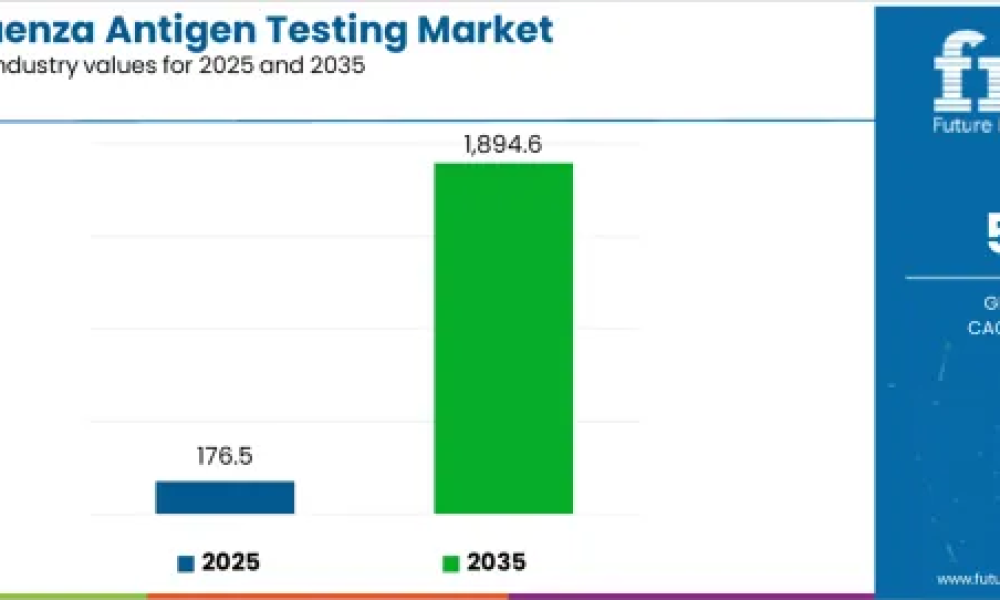
Future Market Insights (FMI), a leading provider of market intelligence and consulting services, today released its latest in-depth report on the Avian Influenza Antigen Testing Market. This authoritative analysis reveals a robust growth trajectory for the sector, driven by escalating demands for rapid diagnostics, biosecurity enhancements, and global poultry industry expansions. Valued at USD 176.5 million in 2025, the market is forecasted to expand at a compound annual growth rate (CAGR) of 5.4%, reaching an impressive USD 1,894.6 million by 2035. This represents an absolute opportunity of USD 1,718.1 million over the decade, underscoring the market’s pivotal role in safeguarding animal health and food security worldwide.
In an era where avian influenza outbreaks pose significant threats to poultry production and public health, the need for efficient, point-of-care testing solutions has never been more critical. FMI’s report highlights how antigen testing technologies are revolutionizing disease management by offering 50-70% faster detection compared to traditional laboratory methods. These innovations enable proactive surveillance, minimizing economic losses from flock depopulation and trade disruptions. “As industry leaders navigate increasingly complex regulatory landscapes and biosecurity challenges, our insights equip decision-makers with the data needed to invest strategically in diagnostic advancements,” said a senior analyst at FMI. “This market is not just growing—it’s evolving to meet the demands of a resilient global agriculture ecosystem.”
Market Segmentation: Tailored Solutions Driving Adoption
The report breaks down the market into key segments, providing granular insights for stakeholders. By test modality, rapid antigen test kits dominate with a 42.3% share in 2025, prized for their portability, lateral flow assay technology, and reduced turnaround times ideal for field applications. ELISA kits follow at 37.4%, offering quantitative precision for laboratory and research settings, while immunofluorescence holds 14.4%, supporting specialized visualization needs.
Sample types reveal swabs as the frontrunner at 57.3%, essential for respiratory sampling and flock surveillance due to their convenience. Tissue samples account for 23.2%, aiding post-mortem analysis, and fecal samples 15.1%, facilitating environmental monitoring. End-users are led by veterinary diagnostic labs, which emphasize high-throughput consistency, alongside poultry farms, government surveillance agencies, and research institutes. This segmentation underscores the market’s versatility, catering to diverse operational scales from small farms to large-scale commercial operations.
Regional Dynamics: Asia Pacific Leads the Charge
Geographically, the Asia Pacific region emerges as a powerhouse, fueled by booming poultry sectors in countries like India and China. India is projected to grow at the highest CAGR of 4.0%, propelled by expansions in key states such as Punjab, Andhra Pradesh, Tamil Nadu, and Maharashtra, bolstered by government initiatives for mandatory surveillance. China follows at 3.6% CAGR, with focus areas in Shandong, Henan, Hebei, and Guangdong, where regulatory scaling and agricultural modernization are key drivers.
North America, particularly the USA, anticipates a 3.3% CAGR, driven by biosecurity innovations and a 25% annual increase in diagnostic utilization among commercial poultry producers. Europe, starting from USD 40.7 million in 2025 and reaching USD 53.4 million by 2035 at 2.8% CAGR, sees Germany leading with a 24.7% share, emphasizing quality excellence in regions like Lower Saxony and Bavaria. France and the UK contribute with 3.2% and 2.9% CAGRs, respectively, integrating regulatory frameworks in areas like Brittany and Pays de la Loire. Brazil in Latin America grows at 3.0%, leveraging production hubs in Santa Catarina and Paraná for enhanced testing efficiency and 98% regulatory compliance.
These regional trends reflect a global shift toward integrated surveillance ecosystems, where point-of-care systems and digital tools link farms, labs, and regulators for real-time data management.
Trends, Drivers, and Opportunities: Shaping the Future
Key trends include a pivot to automated analyzers and multiplex platforms that detect multiple pathogens, reducing costs and boosting efficiency in large flocks. The adoption of biosensor technologies promises minutes-long results during outbreaks, a game-changer for high-stakes environments.
Market drivers are multifaceted: outbreak prevention through 25-35% annual surveillance expansions, government mandates for animal health monitoring by 2030, and technological leaps in field-deployable solutions. However, restraints such as regulatory validation costs, technical complexities in sample handling, and infrastructure gaps in developing regions pose challenges. Accuracy limitations across viral strains also highlight the need for ongoing innovation.
Opportunities abound, particularly in high-growth markets like India and China, where poultry incentives and collaborations for multiplex solutions can drive penetration. Government funding, R&D tax incentives, and streamlined regulations further open doors for next-generation platforms with intelligence software and lifecycle support services.
Subscribe for Year-Round Insights → Stay ahead with quarterly and annual data updates: https://www.futuremarketinsights.com/reports/brochure/rep-gb-27336
Request for Sample Report | Customize Report |purchase Full Report –https://www.futuremarketinsights.com/reports/sample/rep-gb-27336
Competitive Landscape: Innovation at the Forefront
The market features 15-25 players with moderate concentration, where the top three command 30-40% share. Industry leaders like Zoetis Animal Health excel through comprehensive portfolios and strong agricultural ties, creating high switching costs. Competitors such as BioChek, Ringbio, Biopanda Reagents, Abbexa, and Elabscience differentiate via specialized technologies like rapid immunoassays and regional expertise. Emerging players in Asia are innovating with cost-optimized, compliant solutions, intensifying competition on accuracy, reliability, and full-service offerings.
FMI’s analysis emphasizes strategic expansions, including geographic diversification and integrations with veterinary networks, as critical for maintaining leadership. “Decision-makers should prioritize partnerships that enhance diagnostic ecosystems, ensuring scalability and compliance in an unpredictable market,” added the FMI analyst.
About Future Market Insights (FMI)
Future Market Insights, Inc. (FMI) is an ESOMAR-certified, ISO 9001:2015 market research and consulting organization, trusted by Fortune 500 clients and global enterprises. With operations in the U.S., UK, India, and Dubai, FMI provides data-backed insights and strategic intelligence across 30+ industries and 1200 markets worldwide.
Why FMI: Decisions that Change Outcomes- https://www.futuremarketinsights.com/why-fmi
Contact Us:
Future Market Insights Inc.
Christiana Corporate, 200 Continental Drive,
Suite 401, Newark, Delaware – 19713, USA
T: +1-347-918-3531
Website: https://www.futuremarketinsights.com
LinkedIn| Twitter| Blogs | YouTube
Have a specific Requirements and Need Assistant on Report Pricing or Limited Budget please contact us – [email protected]



