
America’s workforce is paying a physical price for productivity — and the body parts absorbing the greatest damage may explain why workplace injuries remain so costly, persistent, and difficult to prevent.
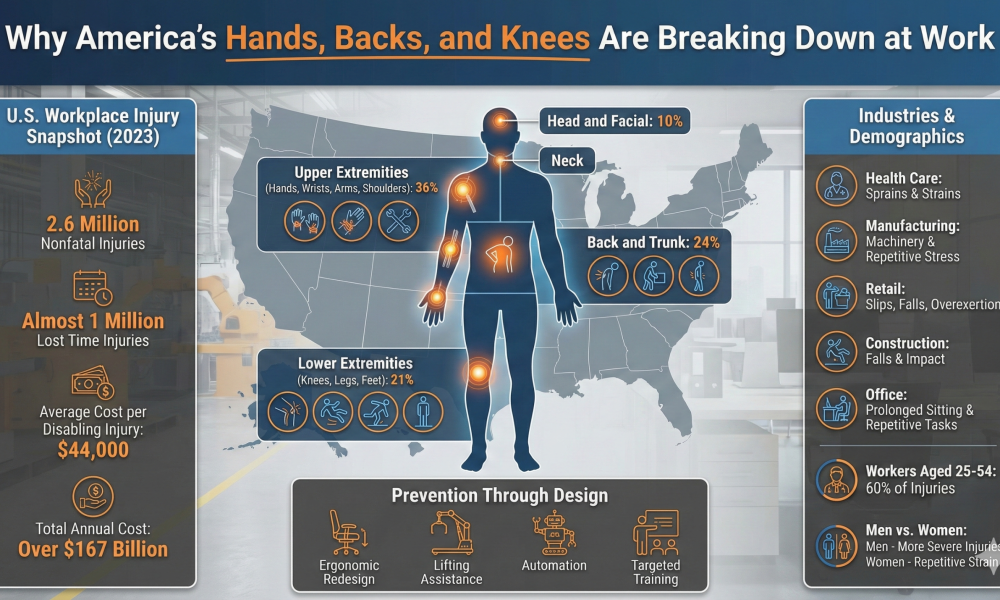
In 2023, U.S. employers reported 2.6 million nonfatal workplace injuries, nearly one million of which forced workers to take time off. New analysis from The Schiller Kessler Group of national injury data reveals a striking pattern: most injuries cluster around the same vulnerable regions of the body, regardless of industry.
The Anatomy of Workplace Injury
According to National Safety Council data, upper extremities — including the hands, wrists, arms, and shoulders — account for 36% of all workplace injuries, making them the most frequently harmed body region nationwide.
These injuries stem from repetitive motion, overexertion, and direct contact with tools or machinery. Because hands and arms are essential to nearly all work functions, even minor injuries can prevent employees from performing basic tasks.
Back and trunk injuries follow closely, representing 24% of all cases. Poor ergonomics, heavy lifting, and prolonged unnatural postures continue to drive chronic back pain — one of the most expensive and recurrent workplace injuries.
Lower extremity injuries account for 21%, often caused by slips, trips, falls, or prolonged standing. Meanwhile, head and facial injuries comprise 10%, usually linked to impact or falls, while neck injuries, though less common, frequently result in long-term discomfort and reduced mobility.
Industries Shape Injury Patterns
Different industries produce different injuries, but the physical toll is universal.
Health care workers experience high rates of sprains and strains from patient handling and constant movement.
Manufacturing employees face machinery-related injuries and repetitive stress damage.
Retail workers are frequently injured by slips, falls, and overexertion from stocking.
Construction workers suffer falls and impact injuries from tools and uneven surfaces.
Even office-based workers face growing injury risks tied to prolonged sitting, repetitive typing, and insufficient ergonomic support.
Who Suffers the Most
The data reveals notable demographic patterns. Workers aged 25 to 54 account for 60% of all injuries, reflecting their central role in physically demanding employment.
Men experience slightly more injuries overall and are more likely to suffer severe injuries requiring long recovery times. Women, particularly in health care and service roles, face higher rates of repetitive strain and exposure-related injuries.
The Financial Cost of Physical Strain
Each disabling injury costs employers an average of $44,000, with serious cases exceeding $100,000. Collectively, workplace injuries cost the U.S. economy over $167 billion annually, draining productivity and straining industries already grappling with labor shortages.
Prevention Starts With Design
This data points to a clear solution: injury prevention must focus on how work is performed, not just where it happens. Ergonomic redesign, lifting assistance, automation, and injury-specific training can dramatically reduce strain on the body’s most vulnerable regions.
Until those measures become standard, America’s workforce will continue paying with its hands, backs, and knees.
Frequently Asked Questions About Workplace Injury Trends
Why do hands and arms account for the highest number of workplace injuries?
Hands and arms are involved in nearly every job task across industries. Repetitive motion, tool use, lifting, and direct contact with machinery increase exposure to strain and impact, making upper extremities particularly vulnerable to injury.
Why are back injuries so common across different types of jobs?
Back injuries are often linked to poor ergonomics, improper lifting techniques, and sustained awkward postures. These risks exist not only in physically demanding roles but also in office environments where prolonged sitting and inadequate workstation setup are common.
Are workplace injuries becoming more severe over time?
While safety standards have improved in many areas, injuries that do occur often lead to longer recovery periods. Chronic musculoskeletal injuries, especially to the back and knees, tend to worsen over time without proper intervention, increasing long-term disability risk.
Which industries face the greatest injury risk?
Industries with high physical demands, such as construction, manufacturing, and health care, consistently report higher injury rates. However, service and office-based roles are increasingly affected by repetitive strain and ergonomic-related injuries.
Who is most affected by workplace injuries?
Workers between the ages of 25 and 54 experience the majority of injuries, reflecting their concentration in physically active roles. Injury patterns also vary by gender, with men more likely to suffer severe trauma and women experiencing higher rates of repetitive strain injuries.
Why are workplace injuries so costly for employers?
Beyond medical expenses, injuries lead to lost productivity, replacement labor costs, training expenses, and increased insurance premiums. Long-term injuries can also result in permanent work restrictions or early workforce exit.
Can workplace injuries be prevented?
Many injuries are preventable through ergonomic design, task automation, proper equipment, and targeted training. Focusing on how work is performed—rather than relying solely on protective gear—has proven most effective in reducing injury rates.




