
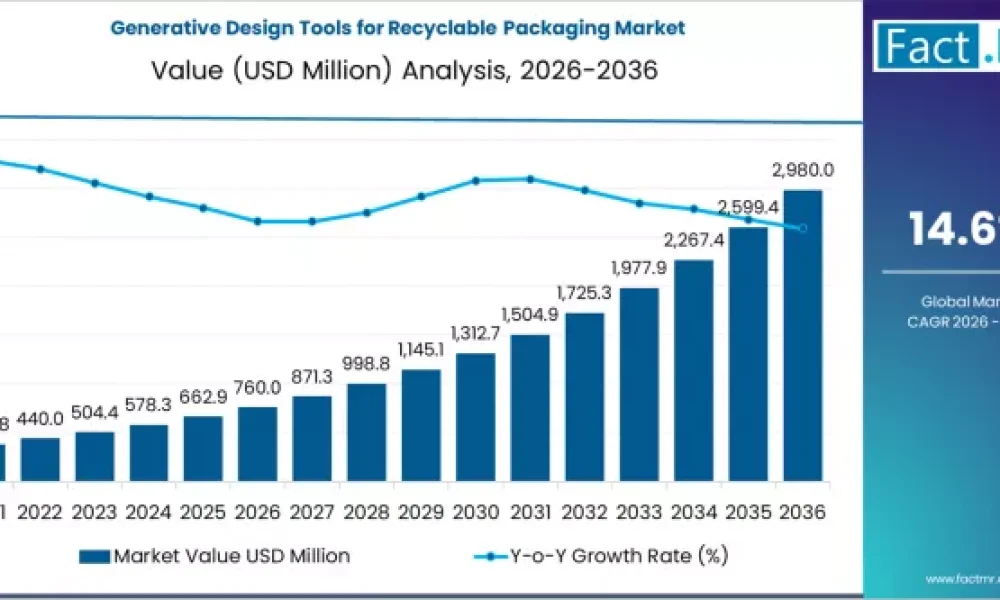
The global generative design tools for recyclable packaging market is entering a high-velocity growth phase, with its valuation projected to rise from USD 480 million in 2026 to USD 1.2 billion by 2036. According to specialized industry analysis, the market is set to expand at an impressive compound annual growth rate (CAGR) of 9.6%, driven by the convergence of Artificial Intelligence (AI) and the global mandate for sustainable material reduction.
Generative design tools represent a paradigm shift in how packaging is engineered. Instead of humans manually sketching designs, AI algorithms are fed constraints—such as material type, structural load, barrier requirements, and recyclability targets—to autonomously generate thousands of optimized design permutations. This allows brands to achieve “lightweighting” goals that were previously thought impossible, reducing plastic use by up to 30% without sacrificing shelf integrity.
Summary Table: Generative Design Tools for Recyclable Packaging Market Outlook
| Metric | Details |
| Market Value (2026E) | USD 480 Million |
| Forecast Value (2036F) | USD 1.2 Billion |
| Projected CAGR (2026-2036) | 9.6% |
| Leading Deployment | Cloud-Based SaaS (64.2% Share) |
| Primary End-User | Consumer Packaged Goods (45%+ Share) |
| Highest Growth Market | India (11.4% CAGR) |
Request for Sample Report | Customize Report | Purchase Full Report – https://www.factmr.com/connectus/sample?flag=S&rep_id=13660
Core Market Dynamics:
The market is shifting from traditional CAD (Computer-Aided Design) to cloud-based AI platforms that prioritize material circularity and manufacturing feasibility.
Who is leading the sector? Industry pioneers including Autodesk, Inc., Dassault Systèmes, PTC Inc., Altair Engineering, and specialized sustainability firms like DiFold and Carbon are at the forefront, integrating Life Cycle Assessment (LCA) data directly into the design loop.
What is the dominant deployment mode? Cloud-Based SaaS Solutions command a significant 64.2% market share. The ability to run complex structural simulations in the cloud allows global packaging teams to collaborate in real-time, drastically reducing time-to-market for eco-friendly product launches.
Where is growth most accelerated? India is emerging as a high-velocity frontier with an 11.4% CAGR, fueled by a massive boom in the organized retail and e-commerce sectors. China follows with a 10.8% CAGR, supported by aggressive state-led investments in green manufacturing technologies.
Why is the technology shifting? The market is moving toward LCA-Integrated Design. Modern generative tools don’t just optimize for strength; they calculate the carbon footprint and “Recyclability Score” of every design iteration, ensuring that the final output aligns with global Extended Producer Responsibility (EPR) mandates.
Sector Insights: Consumer Goods and E-Commerce Anchor Adoption
The Consumer Packaged Goods (CPG) segment remains the primary engine of growth, projected to hold over 45% of the market share by 2026. Global beverage and personal care brands are utilizing generative design to create “lattice” structures and bio-mimetic shapes that require significantly less resin. Simultaneously, the E-Commerce Logistics segment is adopting these tools to design custom-fit, 100% recyclable fiber-based cushions and mailers, eliminating the need for plastic “bubble wrap” and oversized boxes.
“AI is solving the ‘Unsolvable Paradox’ of packaging,” the analysis states. “We are seeing a major trend where ‘Structural Biomimicry’ is used to replace solid plastic walls with honeycombed or webbed structures that offer the same protection with half the material. Generative design is no longer a luxury for high-end prototypes; it is becoming a mandatory efficiency tool for anyone looking to survive the transition to a plastic-taxed economy.”
Key Market Trends and Strategic Outlook
1. Optimization through Digital Twins
A significant absolute dollar opportunity lies in Physics-Based Simulation Twins. By creating a digital twin of the recycling facility within the software, generative tools can predict if a specific package shape will be successfully sorted by infrared scanners or if it will accidentally end up in a landfill, allowing for design corrections before a single prototype is made.
2. The Rise of “Paper-Based” Generative Architecture
Innovation is currently focused on folding geometries. Generative algorithms are being used to discover complex origami-inspired folds for paperboard that provide high vertical strength, allowing brands to replace rigid plastic tubs with collapsible, 100% recyclable paper alternatives.
3. Regulatory and ESG Tailwinds
In the United States (8.8% CAGR) and European Union (9.2% CAGR), growth is supported by ESG (Environmental, Social, and Governance) reporting requirements. Companies are using the data outputs from generative design tools to provide transparent proof of “material savings” to shareholders and regulatory bodies.
Investment Perspective: The Digital Engine of Sustainable Manufacturing
The generative design tools market represents a robust opportunity for software providers and engineering consultancies. As brands race to meet “2030 Net Zero” targets, the ability to automate the creation of high-performance, low-impact packaging is expected to remain a primary growth driver through 2036.
Have specific requirements or need assistance on report pricing or have a limited budget? Please contact [email protected]
About Fact.MR:
Fact.MR is a global market research and consulting firm, trusted by Fortune 500 companies and emerging businesses for reliable insights and strategic intelligence. With a presence across the U.S., UK, India, and Dubai, we deliver data-driven research and tailored consulting solutions across 30+ industries and 1,000+ markets. Backed by deep expertise and advanced analytics, Fact.MR helps organizations uncover opportunities, reduce risks, and make informed decisions for sustainable growth



