
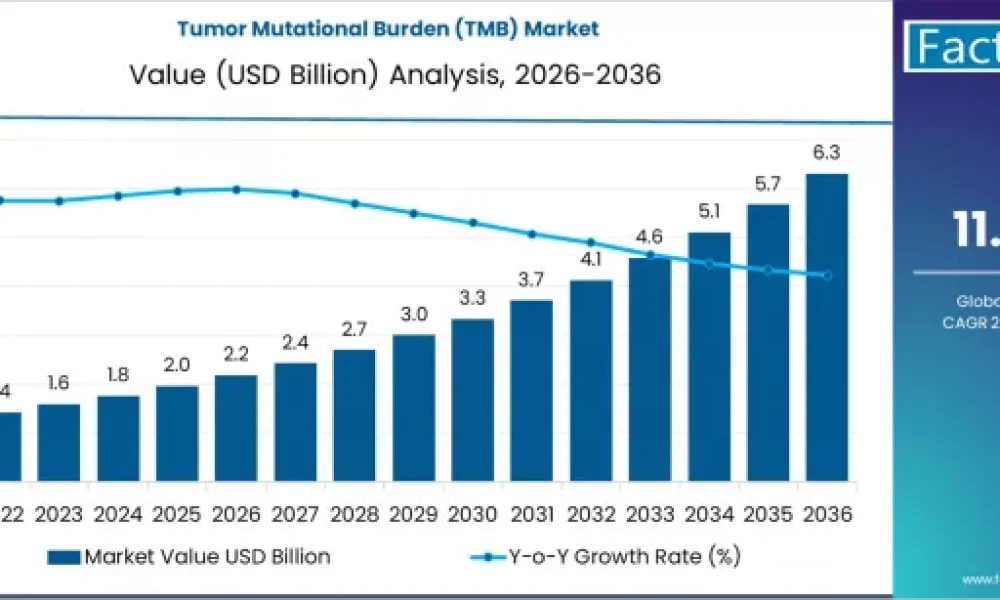
The global Tumor Mutational Burden (TMB) market is entering a phase of high-velocity clinical integration, with its valuation projected to rise from USD 0.6 billion in 2026 to USD 1.8 billion by 2036. According to specialized industry analysis, the market is set to expand at a compound annual growth rate (CAGR) of 11.6%, driven by TMB’s critical role as a predictive biomarker for immune checkpoint inhibitor (ICI) response.
TMB—a measure of the total number of mutations per megabase of DNA in a cancer cell’s genome—has emerged as a vital tool in the precision oncology toolkit. High TMB levels often lead to the production of more “neoantigens,” making tumors more visible to the immune system. As a result, TMB testing is becoming standard practice for identifying patients who are most likely to benefit from high-cost immunotherapies like Pembrolizumab.
Summary Table: Tumor Mutational Burden (TMB) Market Outlook
| Metric | Details |
| Market Value (2026E) | USD 0.6 Billion |
| Forecast Value (2036F) | USD 1.8 Billion |
| Projected CAGR (2026-2036) | 11.6% |
| Leading Technology | NGS Platforms (45.2% Share) |
| Primary End-User | Diagnostic Laboratories (50%+ Share) |
| Highest Growth Market | India (13.5% CAGR) |
Request for Sample Report | Customize Report | Purchase Full Report – https://www.factmr.com/connectus/sample?flag=S&rep_id=13613
Core Market Dynamics: Answering the Strategic ‘How’ and ‘Why’
The TMB market revolves around Next-Generation Sequencing (NGS) assays and bioinformatics pipelines designed to quantify genetic mutations across broad genomic regions.
Who is leading the sector? Industry pioneers including Foundation Medicine (Roche), Illumina, Inc., Thermo Fisher Scientific, Guardant Health, and Agilent Technologies are at the forefront, developing standardized assays for both tissue and liquid biopsies.
What is the dominant technology? Next-Generation Sequencing (NGS) Platforms command a significant 45.2% market share. NGS is the only technology capable of the large-scale genomic profiling required to calculate TMB with the necessary sensitivity and specificity.
Where is growth most accelerated? India is emerging as a global growth leader with a 13.5% CAGR, fueled by an expansion in specialized oncology centers. China follows closely with a 12.8% CAGR, supported by massive national investments in precision medicine and genomics research.
Why is the technology shifting? The market is moving toward Blood-based TMB (bTMB). While tissue biopsies were the original standard, liquid biopsies are gaining rapid traction because they are non-invasive and can capture the genomic diversity of metastatic cancer that a single tissue sample might miss.
Sector Insights: Diagnostic Laboratories and Cancer Centers Drive Growth
The Diagnostic Laboratories segment remains the primary end-user, projected to hold over 50% of the market share by 2026. However, the Biopharmaceutical Companies segment is seeing the fastest growth as TMB is increasingly used as a stratification tool in clinical trials to ensure new immunotherapies are tested on the most responsive patient populations.
“TMB is the compass for the immunotherapy era,” the analysis states. “We are seeing a major trend toward ‘Harmonization.’ As the industry moves from specialized research labs to community hospitals, the focus is on creating standardized TMB scoring systems that provide consistent results regardless of the sequencing platform used. This is essential for turning genomic data into actionable clinical decisions at the bedside.”
Key Market Trends and Strategic Outlook
1. Optimization through Panel-Based Testing
The most significant absolute dollar opportunity lies in Targeted NGS Panels. While Whole Exome Sequencing (WES) is the “gold standard” for TMB, targeted panels are becoming the practical clinical choice. They provide accurate TMB estimates at a fraction of the cost and with much faster turnaround times, making them suitable for routine diagnostic use.
2. The Integration of AI and Machine Learning
Innovation is currently focused on AI-driven bioinformatics. These advanced algorithms can filter out “germline” (inherited) mutations and focus solely on “somatic” (acquired) mutations, ensuring that the TMB score accurately reflects the tumor’s evolution and its likely interaction with the immune system.
3. Regulatory Tailwinds and Reimbursment in the West
In the United States (10.5% CAGR) and Germany (9.8% CAGR), growth is supported by FDA approvals for TMB-high as a “pan-cancer” indication. This regulatory milestone allows clinicians to prescribe immunotherapy based on the TMB score alone, regardless of where in the body the tumor originated.
Investment Perspective: A High-Growth Genomic Frontier
The TMB market represents a robust opportunity for firms specializing in molecular diagnostics and genomic data analysis. As global healthcare shifts toward “Personalized Medicine,” the demand for high-reliability biomarkers—capable of ensuring that the right patient gets the right treatment at the right time—is expected to remain a primary growth engine through 2036.
Have specific requirements or need assistance on report pricing or have a limited budget? Please contact [email protected]
About Fact.MR:
Fact.MR is a global market research and consulting firm, trusted by Fortune 500 companies and emerging businesses for reliable insights and strategic intelligence. With a presence across the U.S., UK, India, and Dubai, we deliver data-driven research and tailored consulting solutions across 30+ industries and 1,000+ markets. Backed by deep expertise and advanced analytics, Fact.MR helps organizations uncover opportunities, reduce risks, and make informed decisions for sustainable growth



