
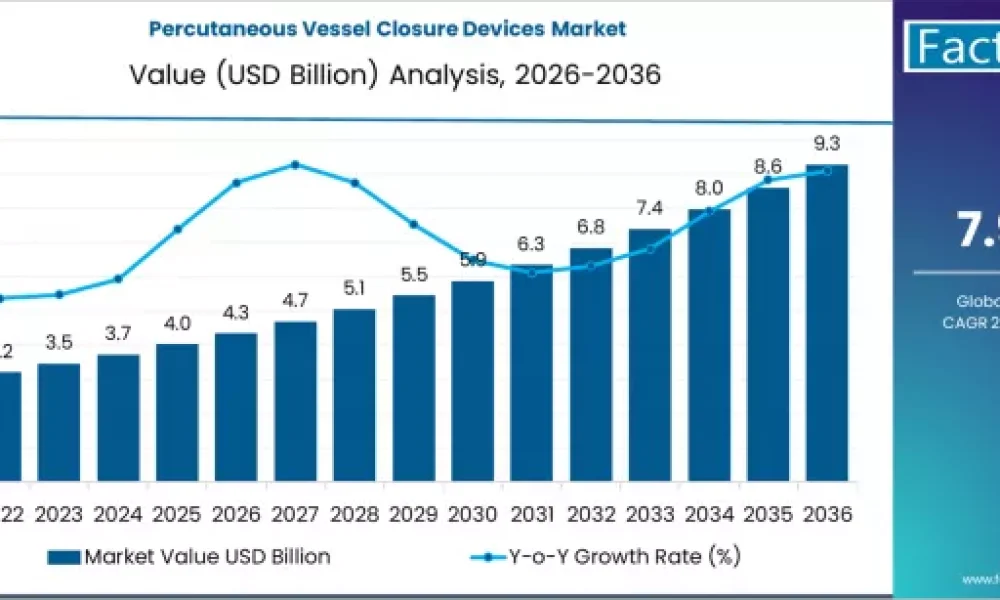
The global percutaneous vessel closure devices market is witnessing a structural transformation, with its valuation projected to rise from USD 1.2 billion in 2026 to USD 2.1 billion by 2036. According to a specialized industry analysis, the market is set to expand at a compound annual growth rate (CAGR) of 5.8%, driven by the global surge in interventional cardiology and the increasing demand for “same-day” surgical discharge.
As medical facilities transition away from traditional manual compression—which requires hours of patient immobilization—percutaneous vessel closure devices (VCDs) have become the gold standard for sealing femoral artery punctures following catheterization. These devices significantly reduce time-to-hemostasis and time-to-ambulation, allowing hospitals to improve bed turnover rates and patient comfort.
Summary Table: Percutaneous Vessel Closure Devices Outlook
| Metric | Details |
| Market Value (2026E) | USD 1.2 Billion |
| Forecast Value (2036F) | USD 2.1 Billion |
| Projected CAGR (2026-2036) | 5.8% |
| Leading Technology | Active Closure Devices (45.2% Share) |
| Primary End-User | Hospitals & Interventional Suites (60%+ Share) |
| Highest Growth Market | India (8.2% CAGR) |
Request for Sample Report | Customize Report | Purchase Full Report – https://www.factmr.com/connectus/sample?flag=S&rep_id=13591
Core Market Dynamics: Answering the Strategic ‘Who,’ ‘What,’ and ‘Why’
Percutaneous vessel closure devices are specialized mechanical or chemical tools used to achieve rapid hemostasis at the site of a vascular access puncture after diagnostic or interventional procedures.
Who is leading the sector? Industry titans including Abbott Laboratories, Terumo Corporation, Cardinal Health (Cordis), Teleflex Incorporated, and Haemonetics Corporation are at the forefront, developing next-generation active and passive closure systems.
What is the dominant technology? Active Closure Devices—which include suture-mediated and clip-based systems—command a significant 45.2% market share. These are favored for their ability to provide immediate mechanical closure, particularly in high-risk patients or those on anticoagulant therapy.
Where is growth most accelerated? India is emerging as the fastest-growing market with an 8.2% CAGR, fueled by a massive expansion in private cardiac care hospitals. China follows with a 7.6% CAGR, supported by a rising geriatric population and increased government focus on cardiovascular health.
Why is the technology shifting? The market is moving toward Bio-absorbable and Plug-based systems. There is an escalating demand for devices that leave no permanent metallic or suture footprint in the artery, reducing the risk of long-term vascular complications or site scarring.
Sector Insights: Hospitals and Ambulatory Surgical Centers Lead Demand
The Hospital and Interventional Suite segment remains the primary end-user, projected to hold over 60% of the market share by 2026. However, the Ambulatory Surgical Centers (ASCs) segment is seeing the fastest growth as more routine diagnostic catheterizations shift to outpatient settings, where rapid patient recovery is essential for operational efficiency.
“Vessel closure is the final, critical step in the interventional value chain,” the analysis states. “We are seeing a major trend where ‘Large-Bore’ closure devices are gaining traction. With the rise of complex procedures like TAVR (Transcatheter Aortic Valve Replacement), the industry is demanding devices that can reliably close 14F to 24F access sites—a challenge that was previously only manageable through open surgical repair.”
Key Market Trends and Strategic Outlook
1. Optimization through Suture-Mediated Technology
One of the most significant absolute dollar opportunities lies in Suture-Mediated Closure Systems. These devices mimic surgical techniques by placing a physical stitch at the arteriotomy site. They are increasingly preferred for complex interventions because they allow for “pre-close” techniques, ensuring safety before the main procedure even begins.
2. The Rise of “All-In-One” Hemostasis Kits
Manufacturers are moving toward providing integrated kits that include the closure device, local anesthetics, and specialized dressings. This “Procedural Efficiency” model is helping hospitals reduce waste and standardize their vascular access protocols across multiple departments.
3. Regulatory and Economic Tailwinds in the West
In the United States (5.5% CAGR) and Germany (5.1% CAGR), growth is supported by a focus on reducing hospital-acquired complications. As healthcare reimbursement models shift toward “bundled payments,” the use of VCDs is viewed as a cost-saving measure by preventing expensive hematomas and shortening hospital stays.
Investment Perspective: A High-Value Cardiovascular Pillar
The percutaneous vessel closure devices market represents a robust opportunity for medical device firms. As global heart disease rates continue to climb and technology moves toward even smaller, more efficient access points, the demand for high-reliability closure solutions—capable of ensuring patient safety and rapid recovery—is expected to remain a primary growth engine through 2036.
Have specific requirements or need assistance on report pricing or have a limited budget? Please contact [email protected]
About Fact.MR:
Fact.MR is a global market research and consulting firm, trusted by Fortune 500 companies and emerging businesses for reliable insights and strategic intelligence. With a presence across the U.S., UK, India, and Dubai, we deliver data-driven research and tailored consulting solutions across 30+ industries and 1,000+ markets. Backed by deep expertise and advanced analytics, Fact.MR helps organizations uncover opportunities, reduce risks, and make informed decisions for sustainable growth



