
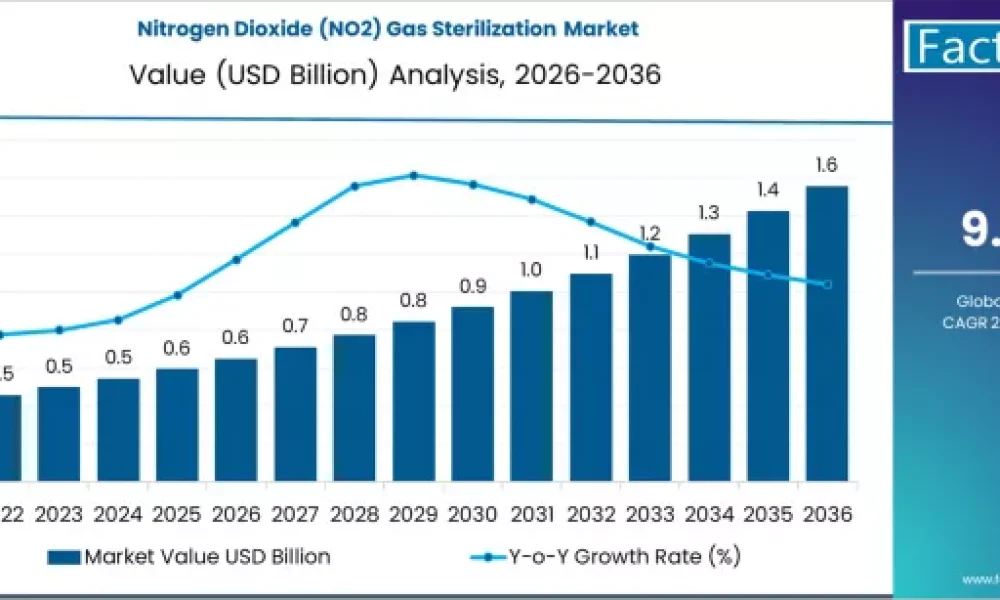
The global Nitrogen Dioxide (NO2) gas sterilization market is entering a phase of disruptive growth, with its valuation projected to rise from USD 0.65 billion in 2026 to USD 1.56 billion by 2036. According to specialized industry data from January 2026, the market is set to expand at a compound annual growth rate (CAGR) of 9.1%, driven by the urgent need for safer, faster alternatives to traditional methods like ethylene oxide (EtO).
As medical technology advances toward drug-device combinations, biologics, and miniaturized electronics, traditional high-heat or high-vacuum sterilization methods are often too aggressive. NO2 sterilization has emerged as the premier “cold” alternative, operating at ultra-low temperatures ($10°C$ to $30°C$) and ambient pressure, preserving the integrity of delicate plastics, resins, and onboard electronics.
Summary Table: NO2 Gas Sterilization Market Outlook
| Metric | Details |
| Market Value (2026E) | USD 0.65 Billion |
| Forecast Value (2036F) | USD 1.56 Billion |
| Projected CAGR (2026-2036) | 9.1% |
| Leading Product | NO2 Sterilization Chambers (24.7% Share) |
| Primary End-User | Hospitals & CSSD Units (26.6% Share) |
| Fastest Growing Market | India (12.7% CAGR) |
Request for Sample Report | Customize Report | Purchase Full Report – https://www.factmr.com/connectus/sample?flag=S&rep_id=13587
Core Market Dynamics: Answering the Strategic ‘Who,’ ‘What,’ and ‘Why’
NO2 sterilization utilizes nitrogen dioxide gas to rapidly deactivate a wide range of microorganisms, including highly resistant Geobacillus stearothermophilus spores, through oxidative stress.
Who is leading the sector? Industry pioneers such as Noxilizer, Inc. are at the forefront, recently securing USD 30 million in growth capital to scale their platform. Other major players in the broader sterilization space, including STERIS, Getinge AB, and Sotera Health, are increasingly integrating this technology to complement their portfolios.
What is the dominant technology? NO2 Sterilization Chambers command a leading 24.7% market share. This hardware infrastructure is essential for medical device manufacturing facilities and hospitals seeking to replace existing EtO or hydrogen peroxide plasma capacity.
Where is growth most accelerated? India is emerging as the fastest-growing frontier with a projected 12.7% CAGR, fueled by domestic medical device production. Brazil (12.2%) and China (11.7%) follow closely, driven by large-scale, export-oriented manufacturing needs.
Why is the technology shifting? The primary driver is the shift away from EtO due to environmental mandates. NO2 is non-carcinogenic at operational levels and requires significantly less aeration time—often reducing cycle times to 2–4 hours—allowing manufacturers to bypass the days-long degassing required by traditional methods.
Sector Insights: Hospitals and Device Manufacturers Drive Volume
The Hospitals and CSSD Units segment is the primary end-user, projected to hold a 26.6% market share in 2026. However, Low-Temperature Medical Device Sterilization remains the largest application at 32.3%, critical for modern, minimally invasive surgical toolkits that cannot withstand thermal stress.
“NO2 is the ‘missing link’ in modern sterilization,” the analysis states. “We are seeing a major trend where manufacturers bring sterilization back in-house. Because NO2 systems don’t require the massive safety bunkers associated with EtO, companies are cutting logistics costs and reducing supply chain bottlenecks that have plagued the industry for years.”
Key Market Trends and Strategic Outlook
1. Optimization through “In-House” Sterilization
As EtO contract sterilization providers face increasing remediation mandates and capacity constraints, there is a significant move toward in-house NO2 platforms. This allows for a “lean” manufacturing process where products are sterilized immediately after packaging, moving from the production line to distribution in hours rather than weeks.
2. The Rise of Biologics and Combination Products
The emergence of large-molecule injectable biologics (essential for treating retinal disorders and HIV) necessitates a process with low pressure and temperature. NO2’s ability to limit piston movement in pre-filled syringes and protect temperature-sensitive active ingredients makes it a “perfect fit” for the terminal sterilization of drug-delivery systems.
3. Regulatory and ESG Tailwinds
In the United States (8.8% CAGR) and Germany (8.6% CAGR), growth is supported by federal efforts to find EtO alternatives. The non-explosive and non-carcinogenic nature of NO2 aligns with growing ESG (Environmental, Social, and Governance) demands from global healthcare corporations and political advocacy groups.
Investment Perspective: A High-Growth Niche Filling the “EtO Gap”
The NO2 gas sterilization market represents a robust opportunity for specialty chemical and medical equipment firms. With the number of EtO facilities declining by nearly 10% in the past three years, NO2 is uniquely positioned to fill the resulting capacity gap, particularly for the 50 million devices sterilized daily in the U.S. that require low-temperature, high-penetration solutions.
Have specific requirements or need assistance on report pricing or have a limited budget? Please contact [email protected]
About Fact.MR:
Fact.MR is a global market research and consulting firm, trusted by Fortune 500 companies and emerging businesses for reliable insights and strategic intelligence. With a presence across the U.S., UK, India, and Dubai, we deliver data-driven research and tailored consulting solutions across 30+ industries and 1,000+ markets. Backed by deep expertise and advanced analytics, Fact.MR helps organizations uncover opportunities, reduce risks, and make informed decisions for sustainable growth



