
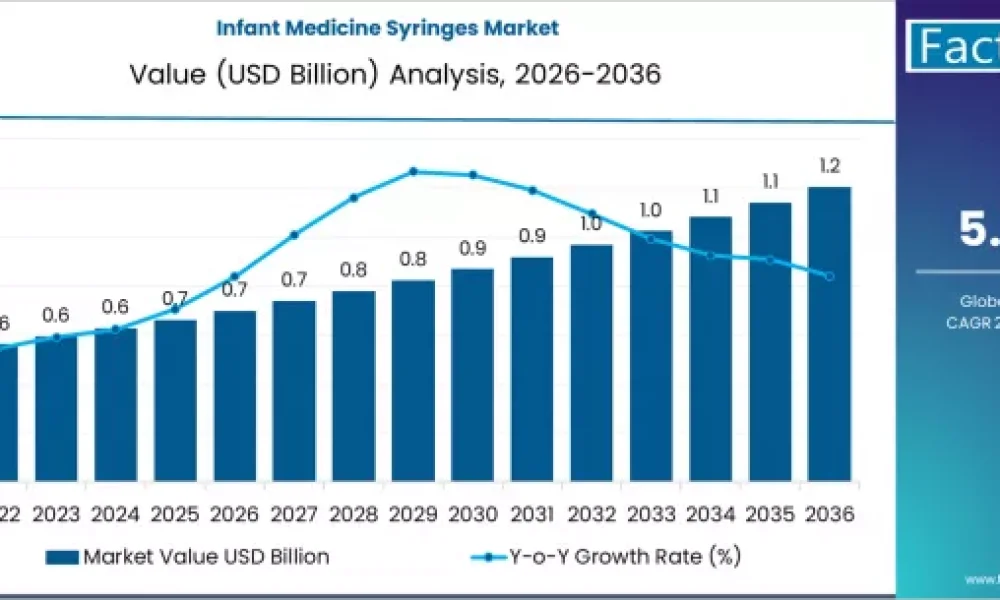
The global infant medicine syringes market is poised for steady growth over the next decade. In 2026, the market is valued at approximately USD 0.7 billion and is projected to reach around USD 1.2 billion by 2036, representing a compound annual growth rate (CAGR) of roughly 5.6%. Oral dosing syringes dominate the market, accounting for nearly 59% of overall product share. Hospitals and neonatal intensive care units (NICUs) are the primary end users, representing about 37% of demand, followed by pharmacies and home care segments.
Geographically, North America, Europe, and the Asia Pacific region are expected to lead growth. Emerging economies, particularly India, China, and Indonesia, show strong potential due to expanding healthcare infrastructure and increased access to pediatric care. Major players shaping the competitive landscape include Becton Dickinson (BD), B. Braun, Terumo, Nipro, Cardinal Health, Baxter, ICU Medical, Medline Industries, Henke‑Sass, Wolf, and Vygon.
To access the complete data tables and in-depth insights, request a Discount On The Report here: https://www.factmr.com/connectus/sample?flag=S&rep_id=13545
Key Growth Drivers
1. Rising Need for Accurate Pediatric Dosing
Infants are highly sensitive to dosage variations, making accurate medication delivery essential. Calibrated dosing syringes are preferred over traditional measuring tools to prevent dosing errors, driving their adoption in hospitals, pharmacies, and home care settings. Precision in delivery has become a clinical priority, supporting widespread market demand.
2. Growing Pediatric Healthcare Awareness
Increasing awareness among caregivers and healthcare professionals emphasizes the importance of precise dosing for liquid medications. As protocols for pediatric safety become stricter, caregivers and institutions are increasingly favoring standardized, high-quality syringe systems to minimize risk.
3. Expansion of Healthcare Infrastructure
Rising healthcare coverage and the proliferation of clinics, hospitals, and pharmacies in emerging markets have expanded market reach. Access to professional pediatric care encourages the adoption of quality dosing syringes, both in institutional settings and home care.
4. Product Innovation & Safety Features
Product developments have enhanced usability and safety, further propelling market growth. Features such as clear gradation markings, anti-slip ergonomic designs, needle-free oral tips, and BPA-free medical-grade materials improve accuracy and caregiver confidence. Innovations like pre-filled syringes and smart dosing systems that track adherence are also emerging as key differentiators.
5. Institutional Procurement Trends
Hospitals and NICUs increasingly standardize on high-quality syringe systems to meet regulatory and safety mandates. Long-term contracts with institutional buyers create stable revenue streams for manufacturers and drive sustained market expansion.
Disruption Signals & Market Risks
1. Supply Chain Challenges
Global supply chain fragmentation, particularly for medical device raw materials and packaging, could create temporary shortages and drive up costs. Manufacturers dependent on international supply chains may face disruptions affecting production schedules.
2. Regulatory and Compliance Complexity
Stringent safety, sterility, and biocompatibility regulations for pediatric medical devices raise barriers to entry and increase compliance costs. Manufacturers must navigate complex approvals to ensure market access, which can slow product launches or limit the entry of new players.
3. Competitive Saturation & Pricing Pressure
Dominance of well-established players with strong distribution networks creates high competition. Market saturation may result in moderated pricing, pushing smaller manufacturers to focus on niche segments or innovation to differentiate themselves.
4. Home-care Adoption Challenges
While demand for home-use syringes is growing, adoption is influenced by caregiver knowledge and preference for simpler alternatives like oral cups. Effective education and user-friendly design are critical for expanding this segment.
Industry Scenarios Through 2036
Optimistic Scenario (High Adoption)
In a scenario with accelerated adoption, the market could experience a CAGR of 6.5–7%, reaching USD 1.3–1.4 billion by 2036. Growth would be driven by global health initiatives emphasizing pediatric safety, widespread adoption of smart dosing technologies, and increased access to e-commerce platforms enabling home use.
Base Scenario (Likely)
With steady adoption across hospital, pharmacy, and home care segments, the market is expected to grow at a CAGR of around 5–5.6%, reaching approximately USD 1.2 billion by 2036. Stable demand from hospitals and gradual uptake in emerging markets would underpin this scenario.
Conservative Scenario (Slowdown)
In a constrained scenario, the market may grow at 3–4% CAGR, potentially reaching only USD 1.0 billion by 2036. Factors include supply chain disruptions, delayed regulatory approvals, slower home-care adoption, and cost constraints in low-income regions.
Strategic Implications for Stakeholders
For Manufacturers
Invest in next-generation dosing technologies, including smart and connected syringes that monitor adherence.
Strengthen hospital and pharmacy partnerships through long-term contracts and loyalty programs.
Develop cost-efficient portfolios tailored to emerging markets without compromising safety or accuracy.
For Distributors & Retailers
Expand multi-channel access, combining institutional supply with online and retail distribution.
Implement caregiver education programs to support safe home use and enhance market penetration.
For Healthcare Systems
Standardize infant dosing protocols with medical-grade syringes to reduce medication errors.
Incorporate outcome metrics and safety audits to track the effectiveness of dosing devices.
Market Metrics at a Glance
| Metric | Value |
|---|---|
| 2026 Market Value | USD 0.7 Billion |
| 2036 Market Forecast | USD 1.2 Billion |
| CAGR (2026–2036) | 5.6% |
| Leading Product Type | Oral Dosing Syringes (59%) |
| Primary End Users | Hospitals & NICUs (37%) |
| Leading Regions | North America, Europe, Asia Pacific |
Conclusion
The global infant medicine syringes market is on a growth trajectory driven by the critical need for accurate dosing, expanding healthcare access, increasing pediatric safety awareness, and ongoing product innovations. While challenges such as regulatory hurdles, supply chain pressures, and competition exist, strategic investments in technology, education, and institutional partnerships can ensure sustained market expansion. Manufacturers, distributors, and healthcare providers who focus on quality, safety, and accessibility are well-positioned to benefit from this growing market over the next decade.
Have a specific Requirements and Need Assistant on Report Pricing or Limited Budget please contact us – [email protected]
To View Related Report :
Infant Sleep Monitor Market https://www.factmr.com/report/infant-sleep-monitor-market
Infant Heart Monitor Market https://www.factmr.com/report/infant-heart-monitor-market
Neonatal Infant Care Market https://www.factmr.com/report/neonatal-infant-care-market
Telemedicine Market https://www.factmr.com/report/telemedicine-market



