
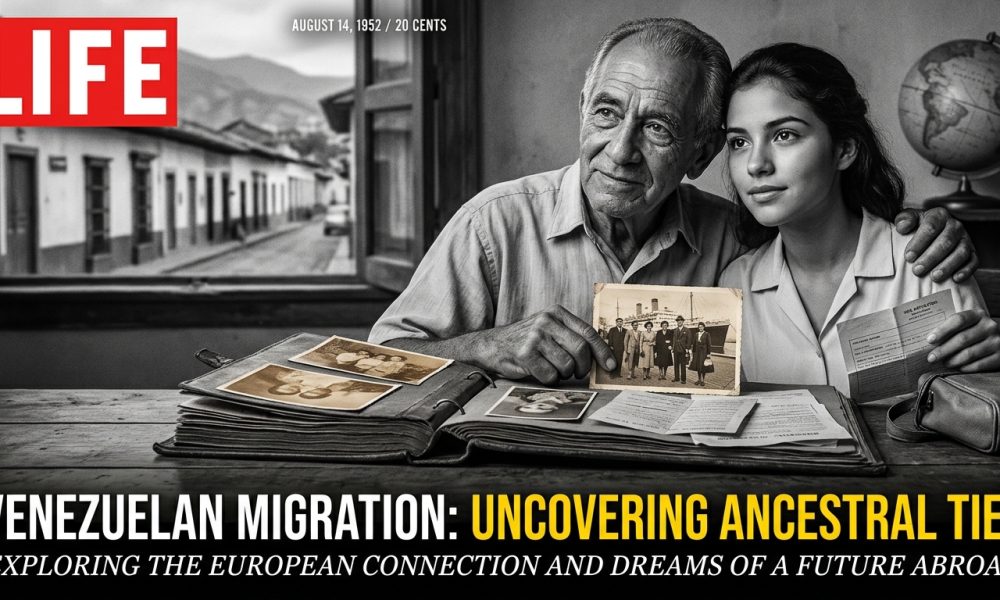
Historic immigration from Spain, Italy, Portugal, and other European countries has left generations of Venezuelans with family connections that may support citizenship claims, as international migration, changing nationality laws, and long-term relocation concerns encourage descendants to review ancestral records and future residency options.
WASHINGTON, DC, November 2, 2026 — Venezuela’s extensive history of European immigration has taken on new significance as families examine whether parents, grandparents, or earlier ancestors may provide legally recognized pathways to another nationality amid ongoing international migration and shifting opportunities for settlement abroad.
For Venezuelans whose ancestors arrived from Spain, Italy, Portugal, or other European countries during the twentieth century, historical birth certificates, marriage records, naturalization documents, and migration histories can provide important evidence when investigating citizenship through descent.
The growing relevance of these connections reflects the intersection of two migration movements separated by generations, with earlier Europeans establishing families in Venezuela and some of their descendants now investigating whether inherited nationality rights could support future opportunities overseas.
Although ancestral citizenship may provide meaningful benefits in residence, employment, education, and family reunification, eligibility depends on the laws of the relevant country, each generation’s historical circumstances, and official government recognition.
Venezuela’s Migration History Creates Ancestral Connections Across Europe
In the decades after the Second World War, Venezuela attracted European immigrants seeking work, commercial opportunities, and greater economic stability, especially as its expanding petroleum economy supported industrial growth and population expansion.
Spanish, Italian, and Portuguese communities established businesses, professional practices, cultural associations, and extended families throughout Venezuelan cities, creating enduring relationships between South America and the European countries from which earlier generations had departed.
These historical connections remain visible in family surnames, community institutions, religious traditions, and civil registration records. Still, their potential significance for citizenship depends on legally recognized relationships rather than cultural Identification alone.
A Venezuelan whose grandfather arrived from Italy or whose grandmother emigrated from Spain may have a potential starting point for citizenship research. However, an ancestral birthplace does not, by itself, establish that nationality was transmitted.
The Venezuelan Diaspora Has Reached Millions Worldwide
Venezuela’s prolonged economic difficulties, political instability, and humanitarian challenges have contributed to one of the largest international migration movements in the Americas, affecting families whose members now live across several countries.
According to the United Nations refugee agency’s December 2025 figures, nearly 7.9 million Venezuelan refugees and migrants were living outside their country, with more than 6.9 million hosted across Latin America and the Caribbean.
The scale of the movement has made family reunification, lawful residence, employment authorization, and access to reliable documentation important considerations, although individual migrants’ circumstances and motivations differ substantially.
Some Venezuelans hope to return when conditions permit. In contrast, others have established lasting family and professional relationships abroad, creating circumstances in which additional lawful nationality rights may matter for future planning.
Spanish Ancestry Offers a Documented Example of Citizenship Interest
Spain’s historical relationship with Venezuela is particularly significant because substantial Spanish emigration left numerous families with identifiable ancestral connections, including descendants of people who departed during periods of political repression and economic hardship.
A 2022 El País report on Spanish descendants seeking citizenship in Latin America documented a Venezuelan family whose grandfather traveled from Spain to the port of La Guaira in 1964.
The report described how original migration documents and family birth certificates became relevant to citizenship applications under Spain’s Democratic Memory Law, illustrating the practical importance of records preserved across multiple generations.
These accounts show how ancestral migration can raise significant legal questions decades later, while also emphasizing that a successful application depends on statutory eligibility and the documentary standards set by Spanish authorities.
Spain’s Democratic Memory Law Created a Special Nationality Pathway
Spain’s Democratic Memory Law, enacted in October 2022, established additional nationality opportunities for qualifying descendants of Spanish nationals, including certain families affected by historical exile and other circumstances addressed by the legislation.
The framework recognized several applicant categories, including specified descendants of originally Spanish parents or grandparents and certain adult children whose parents obtained Spanish nationality through earlier historical recognition provisions.
For Venezuelan families with Spanish ancestors, the legislation created an opportunity to examine records previously considered primarily genealogical, particularly when relatives had emigrated during periods tied to Spain’s twentieth-century political history.
However, the eligibility provisions required careful interpretation because possessing a Spanish surname or identifying a distant Spanish-born relative did not automatically establish a qualifying claim under every category of the law.
The Spanish Application Deadline Has Already Passed
One of the most important developments affecting Venezuelan descendants is that the deadline to file applications under Spain’s Democratic Memory Law expired on October 22, 2025, after an extension of the original application period.
The Spanish Consulate General in Caracas confirmed that it would no longer accept new appointment requests under the relevant provisions beginning October 23, 2025, creating a significant distinction between timely applicants and those beginning research afterward.
Individuals who submitted qualifying appointment requests before the deadline and received the required official confirmation may still have opportunities to complete their procedures, subject to the consulate’s instructions and documentary requirements.
Families investigating Spanish ancestry in November 2026 should therefore avoid relying on older advertisements suggesting that the special application period remains open. However, other citizenship or residence pathways may exist under separate provisions.
Spanish Consular Applications Remain a Major Administrative Undertaking
Spain’s Ministry of Foreign Affairs reported in June 2026 that its worldwide consular network had received more than 1.22 million in-person applications under the Democratic Memory Law by May 31 of that year.
The ministry also reported hundreds of thousands of approvals and civil registry entries, underscoring the program’s substantial administrative scale and the ongoing work required to process applications received during the eligibility period.
These worldwide figures should not be interpreted as Venezuelan-specific totals, because demand extended across multiple countries with significant Spanish diasporas, including other Latin American jurisdictions affected by earlier Spanish emigration.
For Venezuelan applicants with timely submissions, the remaining administrative process may still require original records, proof of qualifying family relationships, and satisfactory documentation of the specific historical circumstances supporting recognition.
Italian Ancestry Provides Another Important Historical Connection
Italian immigration created substantial communities in Venezuela during the twentieth century, establishing family relationships that some descendants now investigate when considering whether Italian nationality could provide lawful access to European residence and employment opportunities.
However, Italy’s citizenship legislation changed significantly in 2025, restricting recognition through distant ancestry for many foreign-born individuals who already possess another nationality, including applicants whose families emigrated to South America generations earlier.
The revised framework emphasizes specified exceptions involving qualifying parental or grandparental citizenship and certain parental residence histories, meaning an Italian-born great-grandparent no longer provides the same potential pathway available under earlier recognition practices.
Venezuelan applicants should therefore examine current Italian law before investing heavily in historical records, particularly when their ancestral connection extends beyond the generations recognized through the newer statutory exceptions.
Historical Naturalization Events Can Determine Italian Eligibility
A key question for Venezuelans claiming Italian ancestry is whether an immigrant ancestor acquired Venezuelan citizenship and whether that event affected the ancestor’s original Italian nationality under the law in force at the time.
Historical nationality rules sometimes treated naturalization abroad as an event affecting citizenship, potentially influencing whether nationality could pass to a child born before or after the ancestor acquired another country’s nationality.
Applicants may need Venezuelan naturalization records, Italian birth certificates, and additional documents establishing the legal status of each intervening generation, particularly where the claim depends on exclusive Italian nationality under the revised framework.
An ancestor’s birth in Italy remains important historical evidence. Still, the receiving authority must also determine whether the relevant nationality requirements and legally recognized transmission conditions have been met.
Portuguese Family Connections May Support Separate Citizenship Investigations
Portuguese immigration also contributed to Venezuela’s demographic and commercial development, creating family connections that descendants may investigate through the nationality legislation governing Portuguese parents, grandparents, and other recognized relationships.
Portugal’s nationality framework includes pathways involving qualifying parentage and grandparental connections, but requirements depend on the applicant’s circumstances and the legislation in force when the relevant application is considered.
People researching Portuguese ancestry may need certified civil records establishing the ancestor’s nationality and the relationships connecting successive generations, along with other evidence required under the relevant legal procedure.
Applicants should avoid assuming that Portugal follows the same rules as Spain or Italy, because European countries maintain distinct citizenship legislation despite sharing certain regional residence and mobility arrangements.
A European Surname Does Not Establish Citizenship Eligibility
Venezuelan families may identify Spanish, Italian, or Portuguese heritage through surnames, oral histories, or community traditions, but those indicators alone generally cannot establish citizenship under formal nationality procedures.
A family surname may have survived for generations after the original immigrant acquired Venezuelan nationality, while historical law may have affected the legal ability to transmit an earlier citizenship.
Similarly, a surname associated with one European country may have multiple geographic origins, making it important to locate reliable family records rather than treating linguistic or cultural associations as conclusive evidence.
The strongest citizenship investigations begin with identifiable ancestors and authentic civil documentation, allowing applicants to determine whether the relevant family relationship satisfies the issuing country’s current legal requirements.
Birth Certificates Create the Foundation for Ancestral Claims
Civil birth certificates commonly provide the documentary foundation for ancestry-based citizenship applications because they identify parents, establish birth dates, and connect generations through legally recognized family relationships.
A Venezuelan whose grandmother was born in Spain may need the grandmother’s Spanish birth certificate, the intervening parent’s birth record, and the applicant’s own Venezuelan certificate.
Where relevant ancestors married, changed their names, or acquired another nationality, additional official records may be needed to establish continuity and address discrepancies across documents issued in different jurisdictions.
Applicants should distinguish authentic genealogical evidence from documents accepted for legal nationality recognition, particularly when foreign authorities require specific certificate formats, translations, authentication, or supporting records.
Marriage Records Can Resolve Family Identity Questions
Historical marriage certificates may become essential when ancestors changed surnames or when parental details differ between European records and later Venezuelan civil documents created after migration.
An Italian grandmother might appear under her original surname in a European birth register and under her married surname in a Venezuelan record identifying her children’s birth.
Official marriage documentation can help establish that both records concern the same individual, although further evidence may be required where names, dates, or parental information remain inconsistent.
Applicants should resolve discrepancies through authorized corrections or acceptable supporting evidence rather than informally modifying documents, because inaccurate records can undermine the reliability of an otherwise legitimate citizenship application.
European and Venezuelan Archives May Hold Different Parts of the Evidence
The records needed for an ancestral citizenship investigation may be spread across European municipal registries, Venezuelan civil offices, historical immigration collections, and other institutions that preserve earlier family documentation.
A European archive may establish the original ancestor’s birth and nationality, while Venezuelan records may document subsequent marriage, naturalization, residence, and the births of later generations.
Researchers sometimes encounter missing records or inconsistent information, particularly when historical events occurred before modern digital recordkeeping or when administrative responsibilities changed between government departments.
A carefully reconstructed family timeline can help identify which documents remain necessary, allowing applicants to target relevant archives rather than collecting extensive historical materials unrelated to the applicable citizenship requirements.
Migration Records Offer Valuable Clues but Have Limits
Passenger manifests, immigration registrations, and other historical travel records can help identify an ancestor’s arrival in Venezuela, the country from which the person departed, and possible relatives who accompanied the journey.
These documents may provide important clues when locating European civil records, particularly where the family remembers only an approximate migration date or the name of a port.
However, a passenger record identifying someone as Spanish or Italian does not necessarily establish that the individual retained the nationality required to transmit citizenship decades afterward.
Applicants should use migration documents to support research while relying on the evidence specifically recognized by the relevant nationality authority for formal citizenship determinations.
Migration Status and Ancestral Citizenship Are Different Legal Questions
Venezuelans living outside their country may possess refugee status, humanitarian Protection, temporary residence, employment authorization, or other immigration permissions, none of which automatically establish eligibility for European citizenship through ancestry.
An ancestral nationality claim must be evaluated under the relevant country’s citizenship legislation. At the same time, existing immigration status remains governed by separate rules set by the country where the individual currently resides.
This distinction matters particularly for people who have applied for asylum or international Protection, because contacting authorities associated with an existing nationality or undertaking certain international travel can carry legal implications depending on individual circumstances.
Individuals with pending Protection claims should seek qualified advice before obtaining foreign travel documents or undertaking actions that could affect their immigration proceedings or Protection status.
Dual Citizenship Can Preserve Multiple Legal Connections
Venezuelan nationality law generally recognizes the possibility of holding another citizenship. Still, individuals should review the requirements of both Venezuela and the additional country before assuming all rights and obligations apply the same way.
The U.S. Department of State’s official guidance on dual nationality explains that individuals may possess citizenship in more than one country and that each nationality can create separate legal responsibilities and travel requirements.
For Venezuelan-Americans investigating European ancestry, additional nationality does not automatically terminate American citizenship or eliminate United States passport requirements, taxation responsibilities, or other obligations arising under applicable law.
Applicants should also consider how the European country treats multiple citizenships, whether specific registration requirements apply, and which documents they must present when entering or leaving countries where they are recognized as nationals.
European Citizenship Can Offer Residence and Employment Opportunities
For Venezuelans who qualify for nationality in a European Union member state, citizenship may offer substantial opportunities for lawful residence, employment, education, and establishing lasting family connections in Europe.
These rights can be especially important for professionals seeking employment without relying solely on employer-sponsored immigration authorization. However, regulated occupations may still require qualification recognition and compliance with domestic licensing requirements.
Families considering European settlement should also examine access to healthcare, housing, education, and available financial resources, because citizenship does not necessarily establish immediate eligibility for every public service or government benefit.
The practical value of another nationality therefore depends on the applicant’s objectives, including whether the goal involves family reunification, professional relocation, retirement, or preserving an alternative place of residence.
A European Passport Does Not Resolve Every Migration Challenge
Another citizenship can provide important residence and mobility rights. Still, it does not automatically settle existing immigration proceedings, guarantee employment, or eliminate obligations arising from previous legal relationships with other countries.
Individuals relocating from Venezuela may need to address practical questions involving documentation, housing, education, healthcare, professional recognition, and the financial arrangements necessary to establish a sustainable life abroad.
Families with members of different nationalities may face additional immigration requirements, particularly when spouses or adult relatives do not automatically gain the same citizenship rights as the principal applicant.
A meaningful relocation plan should therefore examine each family member’s position rather than assuming that one successful ancestral citizenship application creates identical rights across an entire household.
Biometric Passport Technology Does Not Establish Ancestral Eligibility
Modern European passports incorporate electronic security features intended to help authorities assess the integrity and apparent origin of electronically stored identity information, providing additional safeguards during official document inspection.
Amicus International Consulting explains these technologies in its guide on how to scan a passport’s NFC chip and understand the results, distinguishing the reading of electronic information from authentication and broader questions concerning legal issuance.
A successful electronic authentication result can support confidence in particular security characteristics of an issued passport. Still, it cannot independently establish that an ancestor possessed the nationality required for a citizenship-by-descent claim.
Applicants must therefore rely on official citizenship recognition and properly issued travel documents rather than assuming that technological verification substitutes for the legal requirements governing nationality acquisition.
Professional Assistance Should Begin With an Eligibility Review
Venezuelans investigating European ancestry may benefit from professional genealogical research when historical documents are hard to locate, particularly when ancestors migrated decades earlier, and family records remain scattered across several jurisdictions.
However, genealogists and nationality lawyers serve different functions, because identifying a foreign-born relative does not automatically establish the legal citizenship status needed for recognition under another country’s legislation.
A qualified eligibility assessment should determine whether the relevant pathway remains available, which statutory conditions must be met, and what documents are needed before you spend substantially on archival research or application services.
Commercial promises of guaranteed European citizenship deserve careful examination, particularly when they rely on expired Spanish procedures, outdated Italian nationality rules, or generalized assumptions about citizenship transmission through distant ancestors.
The Next Generation May Have Different Citizenship Rights
Families pursuing ancestral citizenship should also consider whether recognition could create opportunities for children or future descendants, because many nationality systems impose specific conditions governing transmission across generations born outside the country.
Registration timing, parental nationality, birth dates, and historical residence may all affect eligibility, meaning one family member’s successful application does not necessarily establish equivalent rights for every subsequent descendant.
These considerations matter most when families want to preserve long-term European connections, rather than obtain travel documents for immediate relocation or a single overseas job opportunity.
A careful assessment can identify which relatives possess current claims and whether future generations must satisfy additional statutory conditions before the nationality can be transmitted.
Venezuela’s European Heritage Remains Relevant to Future Mobility
Venezuela’s history of European immigration shows how international migration can create enduring legal and cultural connections, with earlier generations’ decisions continuing to shape the opportunities available to descendants decades later.
For qualifying families, Spanish, Italian, Portuguese, or other European ancestry may provide a starting point for citizenship recognition. However, the applicable nationality rules and authentic supporting records ultimately determine whether a claim succeeds.
The continued movement of Venezuelans across international borders has increased the practical importance of these historical connections, particularly among individuals seeking lawful residence opportunities, professional flexibility, and greater certainty for their families.
Ultimately, Venezuelan migration highlights the value of ancestral ties because earlier European settlement may support meaningful citizenship opportunities today. Still, family heritage becomes a legally recognized second nationality only when current legislation, official documentation, and government procedures establish a qualifying claim.




