
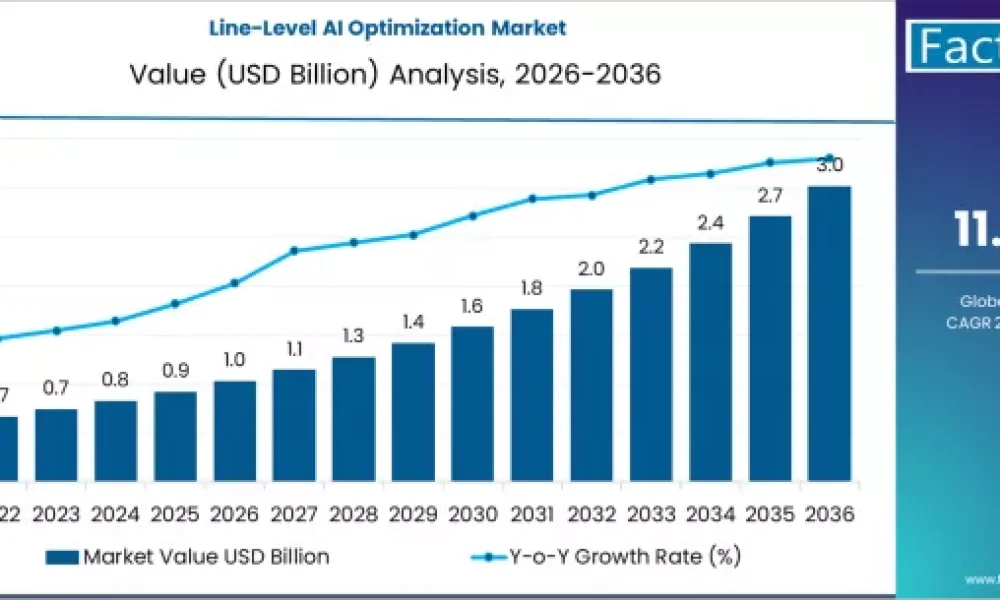
The global line-level AI optimization market is set for substantial growth over the next decade, driven by increasing adoption of intelligent manufacturing systems, Industry 4.0 initiatives, and the need for real-time operational efficiency. Market forecasts indicate that the sector will expand from approximately USD 1.03 billion in 2026 to around USD 3.02 billion by 2036, reflecting a compound annual growth rate (CAGR) of roughly 11.4%. This expansion is underpinned by the growing emphasis on improving production line throughput, reducing downtime, and minimizing operational costs through advanced artificial intelligence solutions.
To access the complete data tables and in-depth insights, request a Discount On The Report here: https://www.factmr.com/connectus/sample?flag=S&rep_id=13548
Technology Shifts and Innovation Trends
The line-level AI optimization market is experiencing a transformative phase in technology adoption. Core technological drivers include AI and machine learning-based predictive optimization, which dominates the market with nearly half of the share in 2026. These solutions allow manufacturers to monitor and adjust machine operations in real time, identifying inefficiencies and recommending or implementing corrective measures autonomously.
Complementing predictive optimization, digital twin technology is gaining traction. Digital twins replicate physical production lines in virtual environments, enabling manufacturers to simulate performance scenarios, identify bottlenecks, and test optimizations without interrupting actual production. The integration of real-time AI control with cloud-based analytics is enhancing decision-making processes, ensuring that operational adjustments are data-driven and precise.
Deployment strategies are shifting from descriptive analytics, which primarily analyze past performance, to prescriptive and autonomous systems that actively control line operations. Edge computing is becoming a key enabler, allowing AI algorithms to run directly on the factory floor. This reduces latency and ensures immediate feedback loops, critical for high-speed production lines where delays can translate to substantial losses. The combination of AI, machine learning, and edge computing is accelerating the transition toward fully autonomous manufacturing lines, with minimal human intervention.
Demand Dynamics Across Segments
Demand for line-level AI optimization is particularly strong in high-speed packaging lines, which face significant cost penalties for downtime and errors. Throughput and downtime optimization represent the dominant use cases, capturing over half of the market share in 2026. Manufacturers are increasingly focused on enhancing line efficiency while maintaining quality standards, especially in sectors such as fast-moving consumer goods (FMCG), pharmaceuticals, food and beverage, and automotive components.
Filling and packing lines are leading the adoption of AI optimization solutions due to their repetitive processes and sensitivity to operational disruptions. By optimizing these lines, companies can achieve consistent output, reduce waste, and ensure timely delivery to meet market demand. The market also sees increasing demand from assembly lines, where complex workflows and multi-step operations benefit from predictive maintenance and real-time monitoring.
End-use industries driving growth include consumer goods manufacturing, pharmaceuticals, automotive, and electronics. In consumer goods and pharmaceuticals, high-volume production requires precision and speed, making AI-driven line optimization crucial. In automotive and electronics sectors, the complexity of assembly processes and integration with supply chain logistics further amplify the need for intelligent line-level control.
Geographic and Competitive Landscape
The fastest-growing markets are concentrated in Asia, particularly India and China, with forecast CAGRs of approximately 14.5% and 13.1%, respectively, between 2026 and 2036. These regions benefit from rapidly expanding manufacturing sectors, favorable government policies supporting industrial automation, and increased investments in digital infrastructure. North America and Europe are experiencing steady growth, with CAGRs of 10.7% and 8.8% respectively, driven by advanced industrialization and high Industry 4.0 adoption rates. Emerging markets such as Brazil and Southeast Asia are also contributing to overall expansion, albeit at a slower pace.
Competition is intensifying, with key players combining industrial automation expertise with AI and machine learning technologies. Major companies are investing in research and development, acquiring AI startups, and forming strategic partnerships to expand their market presence. Market consolidation is likely as established automation providers integrate AI capabilities into their existing product lines, while specialized AI software providers gain access to industrial markets.
Key Market Drivers
Several factors are driving demand for line-level AI optimization. Operational efficiency remains a critical priority, as manufacturers seek to extract maximum output from existing assets while minimizing costs. AI solutions enable predictive maintenance, real-time throughput optimization, and dynamic adjustment of production parameters, which collectively enhance overall productivity.
The rise of smart factory technologies and the Industrial Internet of Things (IIoT) provides the data backbone necessary for effective AI optimization. Sensors, IoT devices, and connected equipment generate massive volumes of operational data, which AI algorithms analyze to identify inefficiencies, predict failures, and optimize line performance. The shift from reactive to proactive operations allows companies to reduce unplanned downtime, improve product quality, and enhance resource utilization.
Cost reduction and waste minimization are additional drivers. By optimizing production lines, manufacturers can reduce energy consumption, lower raw material waste, and minimize errors, leading to significant cost savings. AI systems also support regulatory compliance by maintaining consistent quality and providing real-time reporting on operational metrics.
Market Constraints and Challenges
Despite the strong growth trajectory, the market faces several challenges. Many manufacturers operate on legacy infrastructure, making integration of advanced AI systems complex and expensive. Siloed data and lack of interoperability between equipment can slow deployment and limit the effectiveness of optimization solutions.
Security and data governance are also critical concerns. As AI solutions increasingly rely on cloud-based platforms and edge computing, protecting sensitive operational data and ensuring compliance with regional regulations is essential. Additionally, the need for skilled personnel to implement, monitor, and maintain AI systems can limit adoption in regions with limited technical expertise.
Investment Outlook
The investment outlook for the line-level AI optimization market is highly positive. Sustained growth at a CAGR of 11–12% through 2036 presents significant opportunities for investors in AI platforms, digital twin systems, and edge computing solutions. Strategic partnerships between AI software providers and industrial automation companies are emerging as a key growth lever, enabling faster market penetration and improved service offerings.
Investments are particularly attractive in high-volume manufacturing sectors where performance gains directly impact profitability. Sectors such as FMCG, pharmaceuticals, automotive, and electronics offer immediate returns on investment, as AI optimization reduces downtime, improves product quality, and enhances throughput. Early adoption by leading manufacturers is also creating a competitive advantage, further incentivizing investment in advanced line-level AI solutions.
Conclusion
The global line-level AI optimization market is on a trajectory of strong and sustained growth, driven by technological innovation, operational efficiency demands, and increased adoption of smart factory practices. By 2036, the market is projected to nearly triple in value, underscoring the critical role of AI in modern manufacturing. Technological shifts, particularly the integration of predictive analytics, digital twins, and edge computing, are transforming production lines into highly intelligent and autonomous systems.
Manufacturers that embrace these technologies will achieve significant improvements in throughput, reduced downtime, and operational cost savings. While challenges such as legacy infrastructure and data governance remain, the investment outlook remains robust. The market is poised for expansion across regions and industries, with high growth in Asia and continued adoption in North America and Europe. Overall, line-level AI optimization represents a strategic imperative for manufacturers seeking to enhance efficiency, competitiveness, and profitability in an increasingly data-driven industrial landscape.
Have a specific Requirements and Need Assistant on Report Pricing or Limited Budget please contact us – [email protected]
To View Related Report :
AI Grain Harvest S7 Combine Logistics Market https://www.factmr.com/report/ai-grain-harvest-s7-combine-logistics-market
AI Inference Hardware Benchmarking Test Market https://www.factmr.com/report/ai-inference-hardware-benchmarking-test-market
AI-Guided Variable Rate Agrochemical Tank Mix Platform Market https://www.factmr.com/report/ai-guided-variable-rate-agrochemical-tank-mix-platform-market
AI Networking and Edge Platform Imaging Market https://www.factmr.com/report/ai-in-networking-and-edge-platform-imaging-market



