
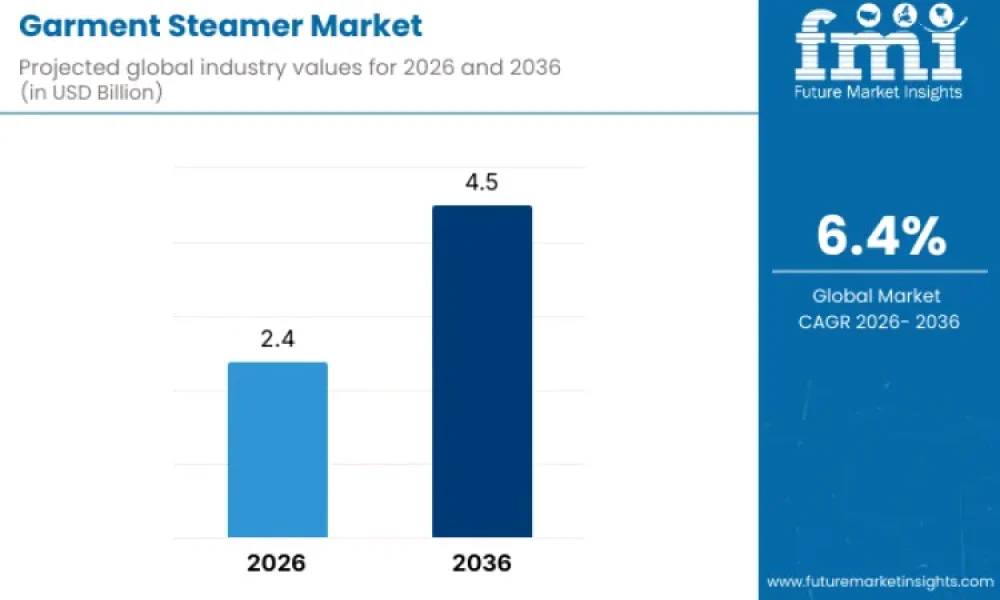
The global garment steamer market is entering a strong growth phase, fueled by changing consumer lifestyles, rising fashion awareness, and rapid innovation by both established brands and emerging manufacturers. According to the latest market outlook, the industry is projected to grow from USD 2.4 billion in 2026 to USD 4.5 billion by 2036, registering a steady CAGR of 6.4% over the forecast period.
As consumers increasingly prioritize convenience, speed, and fabric care safety, garment steamers are gaining preference over traditional irons. Their ability to remove wrinkles, sanitize garments, and work across a wide range of fabrics positions them as an essential appliance for modern households, travelers, and commercial users alike.
To access full datasets and expert analysis — Request A Complimentary Sample Report Today
Market Growth Driven by Lifestyle Shifts and Smart Innovation
The growth of the garment steamer market is closely tied to the rise of busy urban lifestyles and dual-income households, particularly among working professionals. Steamers offer faster heat-up times, require less setup space, and are gentler on delicate fabrics such as silk, chiffon, and wool. These advantages make them highly appealing to consumers seeking time-saving garment care solutions.
Manufacturers are also responding to increasing demand for eco-friendly appliances. Compared to conventional irons, garment steamers typically consume less water and energy, aligning well with sustainability goals. New-generation steamers now feature multi-functionality, including garment sanitization, deodorizing, allergen removal, and antimicrobial steaming—innovations that are expanding use cases beyond wrinkle removal.
Key Market Segments of the Garment Steamer Industry
By Product Type
- Handheld / Portable Garment Steamers
- Upright / Non-Portable Garment Steamers
By Sales Channel
- Direct Sales
- Hypermarkets / Supermarkets
- Multi-Brand Stores
- Exclusive Brand Stores
- Independent Stores
- Online Stores
- Other Sales Channels
By Region
- North America
- Latin America
- Europe
- East Asia
- South Asia
- Oceania
- Middle East & Africa (MEA)
Among these, handheld and portable garment steamers dominate the market, holding nearly 58% share in 2026, due to their compact design, ease of use, and suitability for travel and small living spaces.
Online Retail and E-Commerce Fueling Market Expansion
Online stores account for approximately 40% of total garment steamer sales, making them the leading distribution channel. The rapid growth of e-commerce platforms allows consumers to compare products, access reviews, watch usage demonstrations, and benefit from frequent discounts and bundle offers.
For manufacturers—especially new and emerging brands—online channels provide a cost-effective way to expand global reach and scale operations. Lightweight and compact designs further support efficient shipping, reinforcing the dominance of digital retail in this market.
Regional Outlook: Fastest-Growing and Established Markets
- India leads as the fastest-growing market, with a CAGR of 6.7%, driven by urbanization, rising disposable incomes, and growing acceptance of compact home appliances.
- China follows with a 5.5% CAGR, supported by e-commerce platforms, influencer marketing, and demand for multifunctional products.
- Japan (5.3%) emphasizes compact design, precision, and hygiene-focused steaming solutions.
- Germany (5.0%) focuses on premium, energy-efficient, and certified appliances.
- United States (3.8%) remains a key innovation hub, with strong demand from young professionals and travel users.
Competitive Landscape: Established Leaders and Emerging Innovators
The garment steamer market features a dynamic mix of global leaders and agile new entrants, all investing in technology advancement, product differentiation, and market expansion strategies.
- Philips Domestic Appliances leads with smart temperature control, quick heat-up, and eco-efficient handheld steamers designed for home and travel use.
- Rowenta (Groupe SEB) focuses on premium, EU-compliant, eco-efficient steamers with anti-calc systems and safety features.
- Panasonic Corporation differentiates through ultra-quiet, compact steamers with antimicrobial and garment-sanitizing technologies.
- Jiffy Steamer Company, LLC dominates the professional and commercial segment with durable, industrial-grade solutions.
- Conair Corporation (SteamFast) targets affordability and smart-home integration for tech-savvy consumers.
- Emerging brands like PurSteam and SALAV are gaining traction through aggressive online pricing, rapid product updates, and mass-market appeal.
- Asian conglomerates such as Midea Group and Haier Group Corporation are integrating garment steamers into broader smart home ecosystems, focusing on app connectivity and multifunctional designs.
Future Outlook: Technology, Sustainability, and Expansion
Looking ahead to 2036, the garment steamer market is poised for continued expansion as manufacturers invest in energy-efficient designs, smart features, and fabric-care technologies. Companies aiming to expand their businesses are increasingly forming partnerships, enhancing R&D capabilities, and leveraging digital sales channels to capture new customer segments.
With rising consumer demand for versatile, sustainable, and user-friendly garment care solutions, both established and new manufacturers are well-positioned to capitalize on evolving preferences and shape the future of the global garment steamer industry.
Have a specific Requirements and Need Assistant on Report Pricing or Limited Budget please contact us – [email protected]
About Future Market Insights (FMI)
Future Market Insights, Inc. (FMI) is an ESOMAR-certified, ISO 9001:2015 market research and consulting organization, trusted by Fortune 500 clients and global enterprises. With operations in the U.S., UK, India, and Dubai, FMI provides data-backed insights and strategic intelligence across 30+ industries and 1200 markets worldwide
Why Choose FMI: https://www.futuremarketinsights.com/why-fmi



