
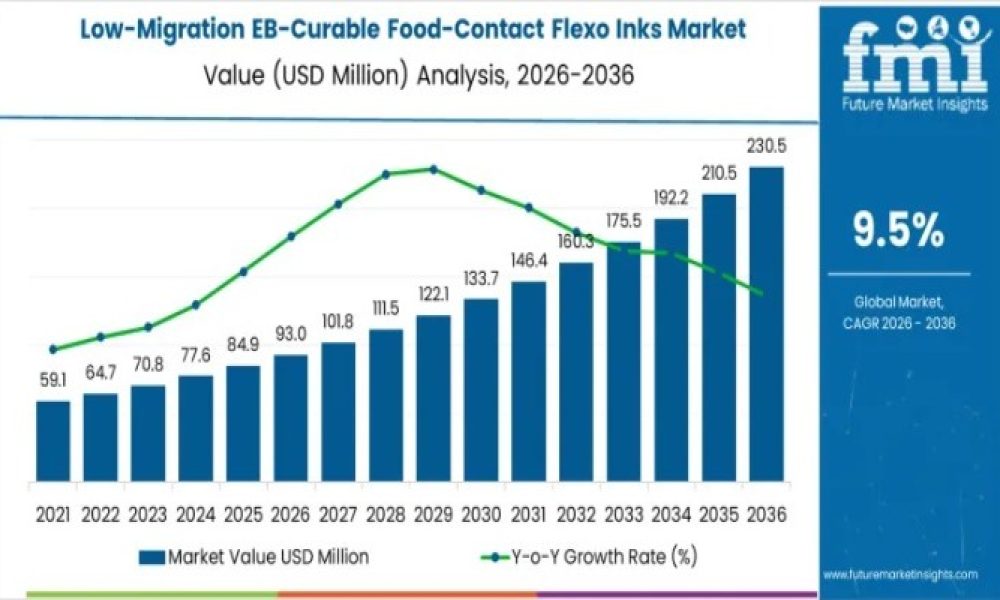
The global low-migration EB-curable food-contact flexo inks market is entering a decade of sustained, regulation-led growth as food safety, compliance assurance, and production reliability reshape ink procurement decisions across the packaging value chain. Valued at USD 93 million in 2026, the market is projected to reach USD 230.5 million by 2036, expanding at a robust compound annual growth rate (CAGR) of 9.5%.
This growth trajectory reflects a structural shift rather than cyclical demand. Food brand owners, converters, and packaging printers are prioritizing inks that demonstrate predictable migration performance, curing reliability, and documented compliance histories over short-term cost advantages. As regulatory scrutiny tightens and audit requirements become more formalized, low-migration EB-curable flexo inks are increasingly viewed as risk-mitigation tools rather than discretionary upgrades.
Discover Market Opportunities – Get Your Sample of Our Industry Overview Today!
Market at a Glance: Key Data Highlights
- Market Value (2026): USD 93 million
- Forecast Value (2036): USD 230.5 million
- Forecast CAGR (2026–2036): 9.5%
- Leading Product Type: Free radical EB inks
- Primary Application: Food packaging
- Key Growth Regions: Asia Pacific, Europe, North America
- Major Players: Siegwerk, Flint Group, Sun Chemical (DIC Corp), INX International, Hubergroup
Regulatory Pressure and Migration Control Define Market Momentum
Demand for low-migration EB-curable food-contact flexo inks is being shaped primarily by regulatory compliance requirements rather than decorative or branding considerations. Conventional solvent-based and UV-curable inks have faced ongoing scrutiny due to the potential presence of residual monomers, photoinitiators, and additives that may migrate into food products through direct contact or headspace exposure.
Electron beam (EB) curing technology addresses these concerns by enabling polymer crosslinking without photoinitiators, significantly reducing the risk of unintended substance transfer. As food safety authorities and brand owners tighten acceptable migration thresholds, EB-curable ink systems are gaining traction as reliable, future-proof solutions.
Key demand drivers include:
- Increasing enforcement of food-contact material regulations
- Lower tolerance for extractables and migrants in primary packaging
- Brand owner risk aversion and audit-driven procurement policies
- Growing preference for solvent-free, high-performance printing systems
Growth Outlook: Two Distinct Expansion Phases
2026–2031: Compliance-Led Market Foundation
During the early phase of the forecast period, the market expands from USD 93 million to USD 135 million, adding approximately USD 42 million in value. Adoption is concentrated in premium, export-oriented, and highly regulated food packaging applications where contamination risk is tightly managed.
Growth in this phase is supported by:
- Improved EB curing efficiency and press integration
- Faster flexographic line speeds with consistent curing margins
- Increased confidence among converters supplying regulated food brands
2031–2036: Process Optimization and Scale Expansion
From 2031 onward, broader converter adoption drives a stronger growth phase. Market value rises from USD 135 million to over USD 230 million, adding nearly USD 97 million during this period.
This expansion reflects:
- Wider deployment across mainstream food packaging lines
- Higher throughput requirements and repeat qualification efficiencies
- Alignment with evolving global food safety standards
Product and Application Leadership
Free Radical EB Inks Lead by Product Type
Free radical EB inks account for approximately 52% of total demand, driven by their:
- Reliable and rapid curing behavior
- Broad substrate compatibility
- Established regulatory acceptance pathways
- Proven performance on high-speed flexographic presses
Longstanding qualification data and predictable polymerization behavior reinforce confidence among converters and brand owners, making free radical systems the default choice for food-contact applications.
Food Packaging Dominates by Application
Food packaging represents nearly 58% of total market demand, reflecting the sector’s high regulatory exposure and volume scale. Flexible packaging, cartons, wrappers, and paper-based food packs require inks that maintain barrier integrity and migration stability throughout storage and distribution.
Secondary demand comes from:
- Pharmaceutical packaging
- Cosmetics packaging
- Labels with indirect food contact
Regional Demand Patterns Highlight Regulatory Intensity
Growth varies by country based on regulatory frameworks, packaging scale, and industrial maturity:
- China: 11.0% CAGR, driven by large-scale food packaging production and rapid industrial adoption
- Germany: 10.5% CAGR, led by strict EFSA compliance and high-quality printing standards
- Italy: 9.5% CAGR, supported by packaging modernization and specialty food segments
- United States: 9.0% CAGR, reflecting FDA compliance and flexible packaging growth
- Japan: 8.5% CAGR, emphasizing precision, consistency, and advanced printing technology
Competitive Landscape: Trust Over Price Competition
Competition in the low-migration EB-curable food-contact flexo inks market is defined by risk control, documentation depth, and process stability rather than aggressive pricing. Switching costs remain high due to press calibration, curing dose optimization, and the expense of requalification and regulatory retesting.
Strategic positioning among key players includes:
- Siegwerk & Sun Chemical (DIC Corp): Compliance leadership and conservative migration thresholds
- Flint Group: Integrated flexographic systems and high-speed press compatibility
- INX International: Operational flexibility for printers transitioning from UV systems
- Hubergroup: Strong focus on documentation, audits, and regulatory discipline
Across the market, success is built on predictable curing under real production conditions, odor control, resistance to set-off, and long-term compliance confidence.
Why FMI: https://www.futuremarketinsights.com/why-fmi
About Future Market Insights (FMI)
Future Market Insights, Inc. (FMI) is an ESOMAR-certified, ISO 9001:2015 market research and consulting organization, trusted by Fortune 500 clients and global enterprises. With operations in the U.S., UK, India, and Dubai, FMI provides data-backed insights and strategic intelligence across 30+ industries and 1200 markets worldwide.



