
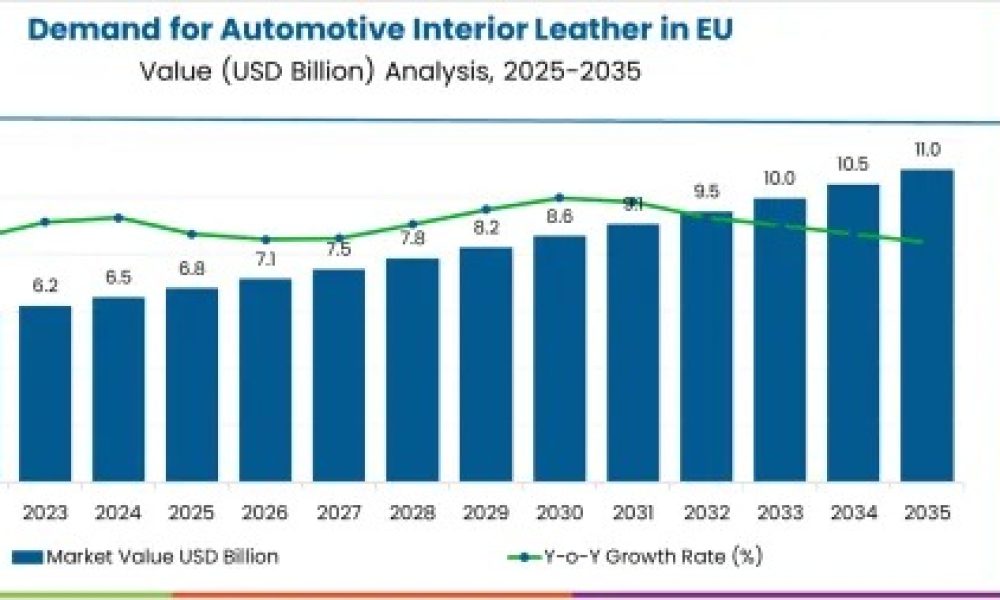
The European automotive interior leather industry is poised for significant growth over the next decade, with market value projected to rise from USD 6.8 billion in 2025 to USD 11.0 billion by 2035, reflecting a compound annual growth rate (CAGR) of 4.9% and an absolute increase of USD 4.2 billion. This growth trajectory is underpinned by rising consumer demand for sustainable materials, expanding premium vehicle production, and evolving applications across seats, dashboards, door panels, and center consoles.
PU Leather Remains Dominant Material Type
Polyurethane (PU) leather is set to maintain its leadership position, accounting for 56.0% of the EU automotive interior leather market in 2025. Its popularity stems from a unique combination of cost-effectiveness, design flexibility, and environmental advantages, including reduced water consumption and chemical processing compared to traditional animal leather. PU leather’s durability, stain resistance, and consistent quality make it the material of choice for diverse applications, from seat upholstery to dashboards and door panels. Leading suppliers such as BOXMARK Leather GmbH, Bader GmbH, and other certified European producers continue to reinforce PU leather’s market position through automotive-grade quality standards and sustainable production practices.
Seats Drive Major Application Demand
Seat upholstery remains the largest application segment, accounting for 45.0% of total EU market demand in 2025. High-touch surfaces and occupant contact intensity make seats the most visible and critical interior element, reinforcing vehicle premium perception. Innovation in perforated surfaces, ventilated seats, multi-tone color combinations, and antimicrobial treatments continues to enhance comfort, hygiene, and aesthetics. Premium European brands, including BMW, Mercedes-Benz, Audi, and Volkswagen, prioritize leather quality for seats to strengthen brand differentiation and meet consumer expectations for luxury, comfort, and sustainability.
Get access to comprehensive data tables and detailed market insights — request your sample report today!
OEM Channels Lead Sales
Original equipment manufacturer (OEM) channels are projected to control 58.0% of market sales in 2025, reflecting the importance of direct integration in new vehicle platforms. OEMs ensure material quality, validated performance, and compliance with stringent EU regulations, including REACH chemical safety and End-of-Life Vehicles Directive requirements. By contrast, aftermarket applications cater to seat replacement, refurbishment, and customization, reflecting growing interest in interior personalization.
Passenger Cars Dominate Vehicle Segments
Passenger cars represent 65.0% of automotive interior leather demand, driven by high production volumes in German, French, Italian, Spanish, and Dutch automotive manufacturing centers. Premium passenger vehicles serve as the primary platform for testing and validating innovative interior materials, including bio-based alternatives, recycled content formulations, and advanced antimicrobial surface treatments. This dominance highlights the segment’s strategic role in advancing material innovation and premium positioning across European automotive markets.
Drivers of Growth
Sustainable Material Adoption: Growing consumer awareness of environmental and animal welfare concerns is accelerating adoption of bio-based and recycled leather alternatives, including mycelium, Piñatex (pineapple leather), apple, cactus, and grape-based materials.
Electric Vehicle Expansion: EV interiors increasingly incorporate sustainable leather alternatives to reinforce zero-emission brand messaging and align with European regulatory frameworks on environmental performance.
Premiumization and Personalization: European consumers increasingly demand bespoke interiors with extensive color palettes, stitching patterns, perforations, and multi-material combinations, enhancing brand differentiation and customer loyalty.
Regulatory Compliance and Circular Economy: EU mandates for recyclability, chemical safety, and sustainability verification drive adoption of certified materials, life cycle assessments, and circular economy practices.
Regional Market Insights
Germany leads the EU market with the highest CAGR of 5.8%, supported by its premium vehicle manufacturing base and robust supplier ecosystem. France follows with a 5.3% CAGR, driven by domestic automotive production and sustainable material adoption. Italy demonstrates 5.1% CAGR, leveraging its luxury vehicle heritage and artisanal leather craftsmanship. Spain and the Netherlands exhibit CAGRs of 4.8% and 4.6%, respectively, reflecting volume production, sustainability emphasis, and integration into European automotive value chains.
Personalize Your Experience: Ask for Customization to Meet Your Requirements
Competitive Landscape
The EU automotive interior leather market is highly competitive, with key players including Lear Corporation (14% market share), BOXMARK Leather (12%), Bader GmbH (10%), Scottish Leather Group (8%), and Seiren Co., Ltd. (7%). Companies focus on sustainability, bio-based innovations, antimicrobial treatments, recycled content integration, and premium customization to differentiate their offerings. The remaining 49% of the market is shared among diverse regional suppliers and specialized innovators.
Market Outlook
Between 2025 and 2035, the EU automotive interior leather industry is expected to grow nearly 1.6X, driven by sustainable material adoption, premium vehicle production, and expanding applications. Bio-based leather technologies, advanced antimicrobial treatments, and recycled content formulations are anticipated to reshape the landscape, meeting rising consumer demand for premium, environmentally responsible interior materials.
The EU automotive interior leather industry represents a dynamic intersection of tradition, innovation, and sustainability, positioning European manufacturers and suppliers at the forefront of premium automotive interior development worldwide.
About Future Market Insights (FMI)
Future Market Insights, Inc. (FMI) is an ESOMAR-certified, ISO 9001:2015 market research and consulting organization, trusted by Fortune 500 clients and global enterprises. With operations in the U.S., UK, India, and Dubai, FMI provides data-backed insights and strategic intelligence across 30+ industries and 1200 markets worldwide.



