
Dewatering Bin Market Enters a Decade of Consistent, Infrastructure-Led Growth
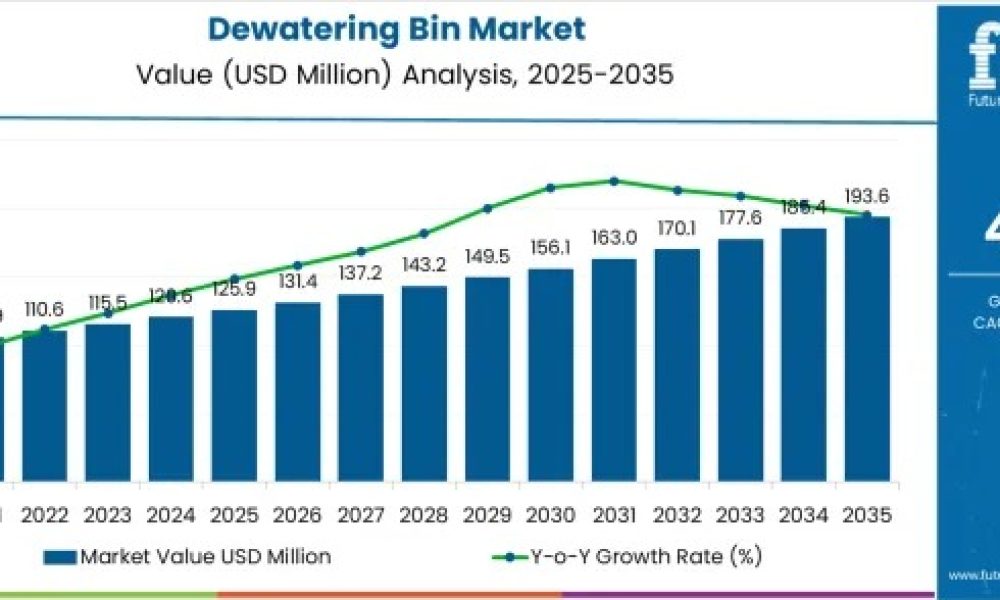
The global Dewatering Bin Market is projected to grow from USD 125.9 million in 2025 to USD 193.6 million by 2035, registering a CAGR of 4.4%. This steady expansion is driven by rising investments in wastewater treatment, construction, mining, and industrial waste management. As regulators tighten discharge norms and industries aim to reduce waste volumes and disposal costs, dewatering bins are becoming essential equipment rather than auxiliary solutions.
Subscribe for Year-Round Insights → Stay ahead with quarterly and annual data updates
Market Size, Forecast, and Value Creation
Over the forecast period, the market is expected to generate an absolute value increase of USD 67.7 million. Growth from 2025 to 2028 is primarily supported by municipal infrastructure upgrades and expanding industrial output, particularly in Asia Pacific and North America. From 2029 onward, growth becomes more balanced as mature markets stabilize and emerging economies accelerate adoption.
Key market indicators include:
- Market value (2025): USD 125.9 million
- Forecast value (2035): USD 193.6 million
- CAGR (2025–2035): 4.4%
- Leading application share: Wastewater treatment and municipal engineering at 44.1%
Application Segments Driving Demand
Wastewater treatment and municipal engineering remain the dominant application, accounting for 44.1% of global demand. Construction and civil engineering follow, driven by excavation, trenching, and foundation projects that require efficient water removal.
Application-wise contribution highlights:
- Construction and civil engineering: 37%
- Mining and mineral processing: 26%
- Industrial wastewater treatment: 17%
- Food and beverage processing: 11%
- Municipal services: 9%
This diversified application mix ensures demand stability across economic cycles.
Technology Trends Shaping the Market
Gravity sedimentation dewatering bins lead the technology segment with a 35% share, favored for their simplicity, low energy consumption, and minimal maintenance. These systems are widely used in municipal and industrial wastewater facilities where reliability and cost control are critical.
Key technology trends include:
- Growing adoption of modular and stackable designs
- Use of corrosion-resistant and lightweight materials
- Integration of automated discharge and safety features
- Early adoption of IoT-enabled monitoring for fill levels and drainage efficiency
These advancements are improving operational efficiency and reducing labor dependency.
Regional Growth Outlook
Asia Pacific leads global growth, supported by rapid urbanization and industrial expansion. China and India outpace the global average, driven by investments in municipal wastewater infrastructure and industrial effluent treatment.
Country-level growth insights:
- China: 5.9% CAGR, led by industrial wastewater projects
- India: 5.5% CAGR, supported by urban development initiatives
- Germany: 5.1% CAGR, driven by advanced waste treatment standards
- United States: 4.2% CAGR, sustained by municipal and industrial compliance needs
Europe maintains steady growth, while ASEAN and Oceania show rising adoption due to expanding urban waste management programs.
Key Drivers Supporting Market Expansion
The market’s growth is underpinned by the global focus on efficient waste management and environmental compliance. Dewatering bins help reduce waste volume, lower transportation costs, and improve workplace safety, making them valuable across multiple industries.
Primary growth drivers include:
- Stricter wastewater discharge and sludge handling regulations
- Expansion of municipal infrastructure projects
- Increasing construction and mining activity
- Demand for cost-effective and low-maintenance waste solutions
Competitive Landscape and Strategic Focus
The market is moderately consolidated, with competition centered on durability, drainage performance, and ease of handling. Leading players include Babcock & Wilcox, UCC Environmental, Wastequip, Ironclad Environmental, ParkUSA (ParkProcess), Con-Fab, Spectrum Water Technology, DumpsterLiners, Morrow Water Technologies, and E-Pak Manufacturing.
Manufacturers are differentiating through:
- Heavy-duty designs for high solids handling
- Customizable bin sizes and discharge mechanisms
- Enhanced coatings and liners for extended service life
- Strong after-sales and support services
Market Outlook Through 2035
By 2035, the dewatering bin market is expected to reflect a mature yet resilient growth profile. Early infrastructure-led momentum transitions into technology-driven stability, supported by automation, modular designs, and broader industrial adoption. The sector’s role in sustainable waste management positions it as a long-term growth market aligned with environmental and operational priorities.
Get data that aligns with your strategic priorities — ask for report customization today:
Have a specific Requirements and Need Assistant on Report Pricing or Limited Budget please contact us – [email protected]
About Future Market Insights (FMI)
Future Market Insights, Inc. (FMI) is an ESOMAR-certified, ISO 9001:2015 market research and consulting organization, trusted by Fortune 500 clients and global enterprises. With operations in the U.S., UK, India, and Dubai, FMI provides data-backed insights and strategic intelligence across 30+ industries and 1200 markets worldwide.
Contact Us:
Future Market Insights Inc.
Christiana Corporate, 200 Continental Drive,
Suite 401, Newark, Delaware – 19713, USA
T: +1-347-918-3531



