
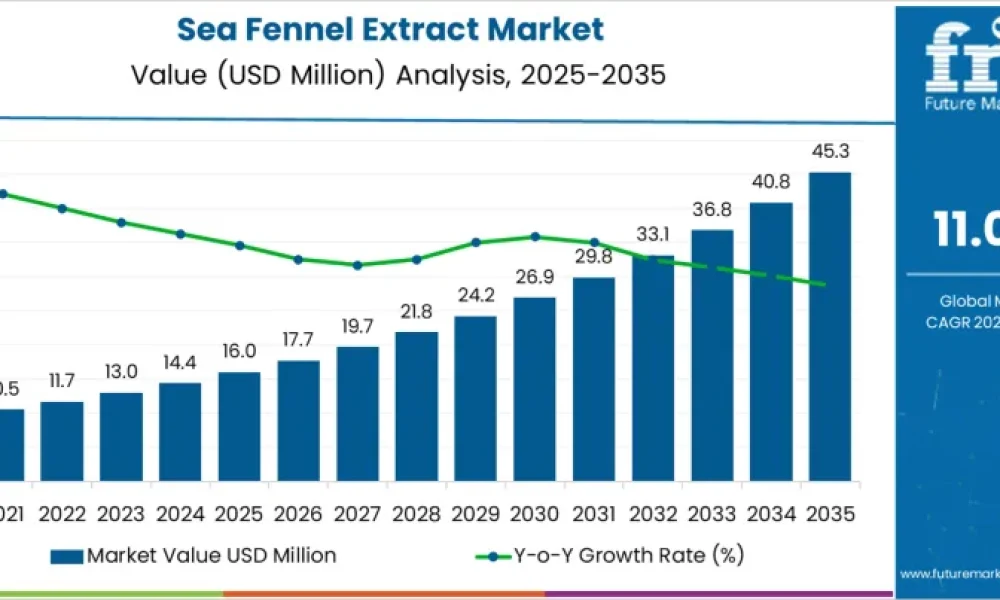
The global Sea Fennel Extract Market is entering a high-growth phase, driven by rising demand for marine-derived botanical actives across cosmetics, nutraceuticals, and functional food applications. Valued at USD 16.0 million in 2025, the market is forecast to reach USD 45.3 million by 2035, expanding at a robust CAGR of 11.0% over the forecast period. This growth reflects not only wider adoption, but also deeper formulation usage, higher active concentrations, and continuous advances in extraction and standardization technologies.
Subscribe for Year-Round Insights → Stay ahead with quarterly and annual data updates – https://www.futuremarketinsights.com/reports/sample/rep-gb-29367
Market Outlook: From Niche Coastal Botanical to Global Bioactive
Sea fennel (Crithmum maritimum), traditionally used in coastal culinary and herbal practices, has evolved into a precision active ingredient valued for its antioxidant profile, mineral richness, and natural preservation properties. Early market development has been shaped by premium skincare brands, dermocosmetic formulations, and specialty food producers seeking clean-label and traceable marine ingredients.
From 2025 to 2030, the market is expected to grow to USD 24.2 million, supported by rising use in hydration serums, anti-fatigue creams, scalp care products, gourmet condiments, and wellness beverages. From 2030 onward, growth accelerates significantly as ingestible beauty, stress-recovery supplements, and functional nutrition products increase extract loading per formulation, pushing the market to USD 45.3 million by 2035.
Opportunities for Established and Emerging Manufacturers
Both established ingredient giants and new, specialized manufacturers are finding strong opportunities in this evolving landscape:
- Large multinational suppliers are scaling standardized, high-volume sea fennel extracts for global cosmetic and nutraceutical brands.
- Emerging processors and coastal specialists are investing in cold extraction, solvent recovery, encapsulation, and drying technologies to deliver high-purity, differentiated actives.
- New entrants are leveraging sustainability storytelling, contract harvesting, and vertical integration to meet rising demand for traceable marine botanicals.
This dual-track market structure allows innovation-led companies to coexist alongside scale-driven suppliers, accelerating technology development and product diversification.
Key Growth Drivers
- Rising demand for clean-label, natural, and marine-derived ingredients
- Expansion of dermocosmetics, nutricosmetics, and ingestible beauty
- Increased focus on skin barrier repair, anti-pollution, and blue-light defense
- Advancements in extract standardization and bioactive profiling
- Growing interest in functional foods and wellness nutrition
Key Segments of the Sea Fennel Extract Market
By End-Use Application
- Skin Care (leading segment – 11.8% share)
- Body Care
- Hair Care
- Sun Care
- Color Cosmetics
- Men’s Grooming
- Baby & Kids Care
- Dermocosmetic / Professional Care
By Product Form
- Powder (leading form – 15.2% share)
- Granules / Agglomerates
- Flakes
- Pellets / Prills
- Liquid (Solution)
- High-Active Concentrates
- Dispersions / Suspensions
- Emulsions
- Pastes & Gels
- Wax / Solid Blocks
- Oils
Powder remains dominant due to its oxidative stability, ease of dosing, longer shelf life, and formulation flexibility.
Regional Growth Hotspots
- Asia Pacific and Europe are the fastest-growing regions.
- India leads global growth with a 14.8% CAGR, driven by herbal cosmetics, nutraceuticals, and online wellness retail.
- China (13.7%) benefits from strong marine bioprocessing infrastructure and export-oriented ingredient manufacturing.
- Japan (12.6%) remains a high-value market focused on premium skincare and nutricosmetics.
- The UK, Germany, and the USA show steady growth supported by clean beauty, regulated cosmetics, and functional wellness products.
Competitive Landscape: Key Players Driving Innovation
The Sea Fennel Extract Market features a diverse mix of global leaders and specialized innovators, including:
- BASF SE
- Croda International
- Evonik Industries
- Symrise (including IFF/Givaudan actives)
- Dow Inc.
- Ashland
- Clariant
- Seppic
- Lubrizol, Lonza, Inolex, and other emerging specialists
Large players focus on scalable, standardized extracts, while smaller firms deliver high-purity, customized solutions for premium cosmetics and functional food applications.
Future Outlook
Long-term growth will depend on supply chain reliability, controlled coastal cultivation, climate-resilient harvesting, and regulatory compliance across food and personal care sectors. As manufacturers continue to invest in new technologies and marine bioactives, sea fennel extract is set to transition from a niche botanical into a globally traded, high-value functional ingredient.
With strong CAGR momentum, expanding applications, and increasing participation from both established and new manufacturers, the Sea Fennel Extract Market represents a compelling opportunity for innovation-driven growth through 2035.
Have a specific Requirements and Need Assistant on Report Pricing or Limited Budget please contact us – [email protected]
About Future Market Insights (FMI)
Future Market Insights, Inc. (FMI) is an ESOMAR-certified, ISO 9001:2015 market research and consulting organization, trusted by Fortune 500 clients and global enterprises. With operations in the U.S., UK, India, and Dubai, FMI provides data-backed insights and strategic intelligence across 30+ industries and 1200 markets worldwide.



