
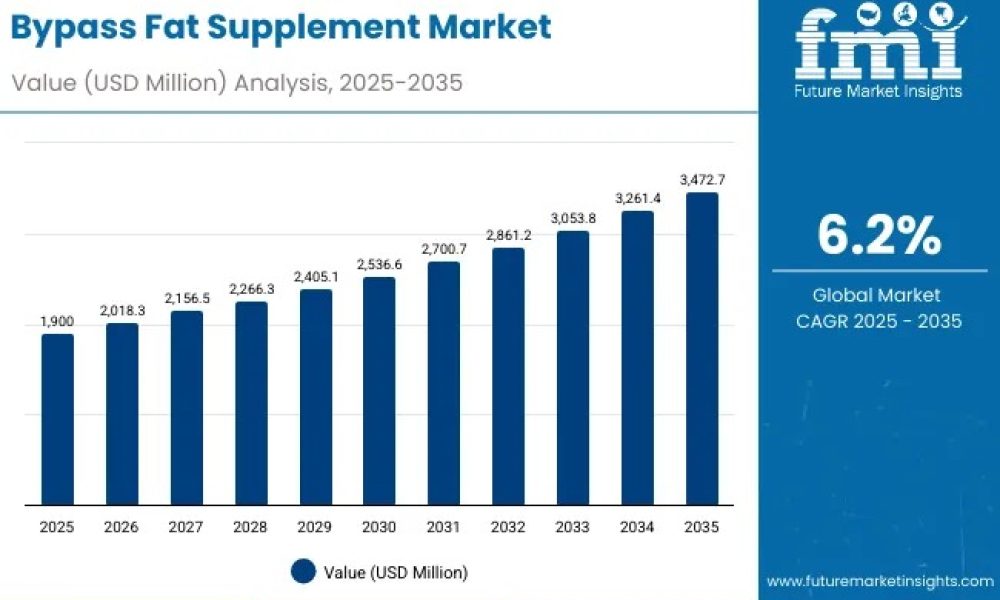
The global bypass fat supplement market is witnessing robust growth as dairy and livestock sectors increasingly adopt energy-efficient nutrition systems to optimize milk yield, feed efficiency, and operational costs. Valued at USD 1,900.0 million in 2025, the market is projected to reach USD 3,472.7 million by 2035, reflecting a CAGR of 6.2% and adding USD 1,570 million over the decade.
The first half of the decade (2025–2030) is expected to contribute 40.5% of total growth, as precision nutrition platforms and modern feeding systems gain traction. The subsequent period (2030–2035) will contribute 59.5%, driven by rumen protection technologies, advanced lipid encapsulation, and high-efficiency nutritional delivery systems, supporting dairy, beef, and specialized livestock operations.
Explore trends before investing – request a sample report today! https://www.futuremarketinsights.com/reports/sample/rep-gb-28455
Market Segmentation and Source Dynamics
- Source: Plant-based bypass fats dominate with 70% market share, offering cost-effectiveness and broad adoption. Animal-based variants (30%) target premium, high-energy applications.
- Livestock Type: Dairy cattle lead demand at 65%, followed by beef cattle (20%) and sheep/goats (15%), reflecting diverse application across milk production, beef finishing, and specialized livestock operations.
- Form: Flakes account for 40% of demand, enabling easy handling and operational compliance in complex feeding programs.
Rising feed costs, regulatory pressures, and a shift toward performance-oriented dairy management are key drivers. Feed price volatility has intensified operational cost concerns, compelling farmers to adopt efficient energy supplementation strategies. Government mandates and quality standards further incentivize adoption of high-performance bypass fat systems.
Technological Advancements Enhancing Market Growth
Recent innovations in rumen protection, lipid encapsulation, and nutritional delivery have significantly increased bypass fat supplement efficiency. Modern formulations leverage protective coatings and targeted delivery mechanisms to optimize energy utilization and feed conversion. Integration with veterinary guidance, performance monitoring, and precision feeding protocols allows energy supplementation tailored to livestock metabolic needs, improving milk yield, reproductive efficiency, and body condition.
Economic benefits are clear: energy-dense bypass fat supplements reduce total feed requirements, improve livestock performance, and deliver strong ROI, often justifying initial investments in less than a year.
Regional Insights
- Europe: Germany leads with 7.0% CAGR, driven by dairy infrastructure expansion and precision nutrition adoption. The UK follows at 6.7%, with rising recognition of advanced livestock technologies. France grows at 5.7%, supported by integrated dairy systems.
- Asia Pacific: India shows 6.4% CAGR, underpinned by advanced livestock technology adoption. China demonstrates 6.1% CAGR, emphasizing precision systems and long-term operational reliability.
- North America: The USA grows at 5.4%, supported by modernized dairy infrastructure and government agricultural programs.
- Latin America: Brazil exhibits 2.1% CAGR, reflecting mature agricultural systems with steady demand for energy supplementation solutions.
Scientific Validation
- FAO: Rumen-protected fats increase dietary energy without affecting fermentation, enhancing milk yield and composition.
- ICAR-NDRI (India): Bypass fat supplementation in lactating cows improves milk yield, fat percentage, and feed efficiency.
- USDA: Concentrated energy sources support greater milk yield while maintaining energy balance.
- Punjab Agricultural University: Bypass fats enhance milk yield, milk fat, and net energy efficiency without increasing feed intake.
Competitive Landscape
The market is competitive, with major players emphasizing technological innovation, product customization, and supply chain reliability:
- Volac Wilmar Feed Ingredients – 30% market share, high-efficiency supplements.
- Berg + Schmidt – specialized energy supplementation with technical support.
- ADM – customized livestock nutrition solutions.
- Kemin Industries – established feed systems with strong support networks.
- Jiangxi Fineway Biotechnology – innovative products for emerging markets.
Subscribe for Year-Round Insights → Stay ahead with quarterly and annual data updates! https://www.futuremarketinsights.com/reports/brochure/rep-gb-28455
Key Drivers and Trends
- Expansion of advanced agricultural facilities supporting complex livestock nutrition.
- Integration of precision dairy systems and digital livestock management technologies.
- Adoption of ultra-efficient, customized energy supplements aligned with modern dairy protocols.
The bypass fat supplement market is set to witness sustained expansion, fueled by precision nutrition adoption, technological innovations, and rising demand for energy-efficient livestock management solutions. As agricultural operators increasingly integrate advanced feeding systems, high-efficiency bypass fat supplements are poised to become an indispensable component of modern dairy and livestock operations.
About Future Market Insights (FMI)
Future Market Insights, Inc. (FMI) is an ESOMAR-certified, ISO 9001:2015 market research and consulting organization, trusted by Fortune 500 clients and global enterprises. With operations in the U.S., UK, India, and Dubai, FMI provides data-backed insights and strategic intelligence across 30+ industries and 1200 markets worldwide.



