
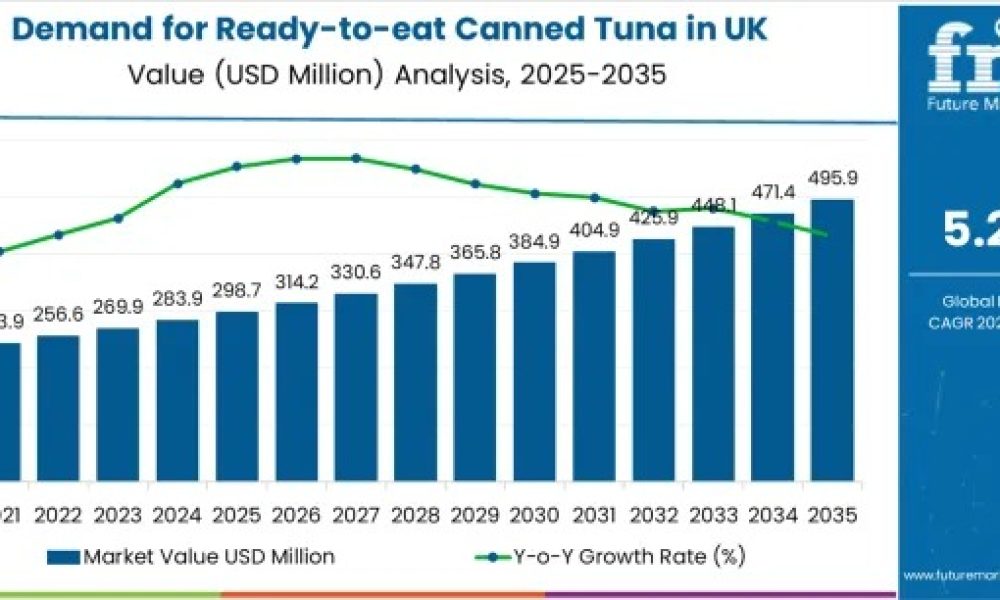
The demand for ready-to-eat canned tuna in the UK is set to rise from USD 298.7 million in 2025 to USD 495.9 million by 2035, adding USD 188.6 million in new value, supported by strong adoption across supermarkets, catering operators, and health-focused households. A 5.2% CAGR over the decade reflects the country’s shift toward convenient, nutrition-led protein consumption and growing reliance on premium seafood products across modern retail networks.
Retail chains continue scaling their protein-rich convenience assortments, while consumers increasingly embrace packaged seafood for meal efficiency, nutrient retention, and quality assurance. England and Scotland remain at the forefront of retail innovation, with supermarkets expanding their multi-tiered product architecture to accommodate value, mid-range, and premium canned tuna assortments.
Explore trends before investing – request a sample report today! https://www.futuremarketinsights.com/reports/sample/rep-gb-28305
Market Overview: 2025–2035 Outlook
The UK market is entering a decade of sustained growth, with 44.8% of the value expansion expected during 2025–2030, driven by rapid assortment upgrades and health-forward consumer buying. From 2030 to 2035, demand intensifies across catering and online channels as portion-controlled and premium-flavoured variants gain wider traction.
Key data highlights:
- 2025 Market Value: USD 298.7 million
- 2035 Forecast Value: USD 495.9 million
- Forecast CAGR: 5.2%
- Leading Type: In Water (67.4% share)
- Leading Channel: Supermarkets (53.6% share)
- Top Growth Regions: England, Scotland, Wales, Northern Ireland
What Is Driving UK Demand?
Growing health consciousness, stringent nutrition standards, and rising preference for low-fat, high-protein foods are reshaping buyer behaviour. Ready-to-eat canned tuna aligns with these evolving expectations through its clean label, high protein content, long shelf life, and suitability for meal-prep culture.
Across the UK, food retailers and catering providers increasingly prioritise products that deliver consistent nutrition with minimal preparation time. These shifts position canned tuna as a versatile, cost-efficient protein source for both retail consumers and commercial kitchens.
Segmental Insights
In Water Category Dominates with 67.4% Share
The in water segment leads due to its strong alignment with health-focused diets and low-oil consumption habits. Continuous improvements in formulation, texture, and protein delivery reinforce its top position.
Drivers of segment dominance include:
- Clean nutrition profiles suitable for diverse diets
- Strong appeal among health-conscious consumers
- Broad acceptance across retail and catering applications
Supermarkets Hold 53.6% of Total Demand
Supermarkets remain the anchor distribution channel, benefiting from deep assortment penetration, strong promotional activity, and tiered pricing strategies.
Key supermarket strengths:
- Ability to serve value, standard, and premium customer segments
- High shopper footfall in England and Scotland
- Extended shelf space for canned seafood products
Regional Outlook
The UK market demonstrates strong national momentum, with each region contributing meaningfully to decade-long expansion:
- England: CAGR 5.4% – national leader in innovation and retail modernization
- Scotland: CAGR 5.1% – strong retail infrastructure and concentrated consumer demand
- Wales: CAGR 4.8% – rising retail modernization and nutrition-driven purchasing
- Northern Ireland: CAGR 4.5% – expanding food retail and household adoption
England maintains the strongest growth trajectory, underpinned by advanced retail ecosystems in London, the Midlands, and the South East, where premium protein consumption continues to accelerate.
Opportunity Pathways for Market Participants
Manufacturers and retailers can tap into multiple emerging value pockets:
- Premium Retail Expansion: USD 58.4–87.6 million
- Catering & Foodservice Applications: USD 41.2–61.8 million
- Automated Retail & Distribution Integration: USD 36.8–55.2 million
- In Water Product Innovation: USD 46.7–70.0 million
- Premium & Specialty Formulations: USD 34.9–52.3 million
- Service Networks & Retail Support: USD 27.0–40.5 million
These pathways reflect the sector’s rising demand for nutritional differentiation, packaging advancements, and supply chain reliability.
Subscribe for Year-Round Insights → Stay ahead with quarterly and annual data updates! https://www.futuremarketinsights.com/reports/brochure/rep-gb-28305
Competitive Landscape
The UK ready-to-eat canned tuna market is consolidated, with established household brands reinforcing their hold through manufacturing scale, product credibility, and nationwide distribution. Leading players are intensifying investments in quality assurance, flavour innovation, and sustainability-led sourcing to retain competitive advantage.
Key companies include:
- John West
- Princes Foods
- Tesco
- Century Pacific Food
- Bumble Bee Foods
- StarKist
- Tonnino
- Wild Planet Foods
- Safe Catch
- Genova Seafood
Together, these brands continue shaping consumer perception, driving category innovation, and strengthening regional nutritional infrastructure across the UK’s modern food economy.
About Future Market Insights (FMI)
Future Market Insights, Inc. (FMI) is an ESOMAR-certified, ISO 9001:2015 market research and consulting organization, trusted by Fortune 500 clients and global enterprises. With operations in the U.S., UK, India, and Dubai, FMI provides data-backed insights and strategic intelligence across 30+ industries and 1200 markets worldwide.



