
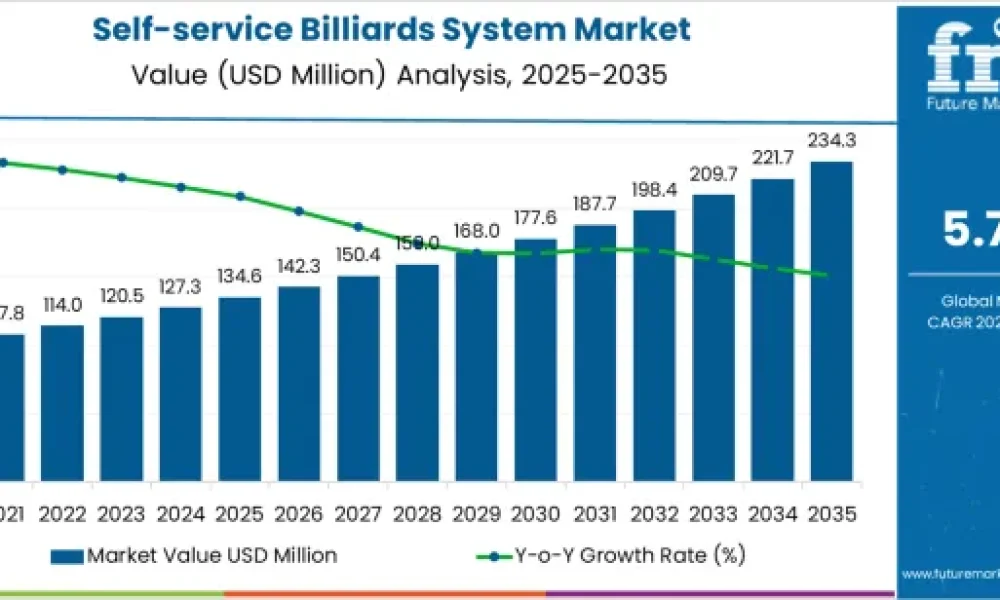
The global market for self-service billiards systems is set to surge from USD 134.6 million in 2025 to USD 234.3 million by 2035, reflecting a robust compound annual growth rate (CAGR) of 5.7% over the next decade, according to a new in-depth analysis from FutureMarketInsights.
This projected expansion — amounting to a remarkable 74.1% increase in market value — underscores a growing shift within the leisure and entertainment sector toward automation, contactless operations, and streamlined venue management.
Subscribe for Year-Round Insights → Stay ahead with quarterly and annual data updates : https://www.futuremarketinsights.com/reports/sample/rep-gb-27724
Market Drivers: Automation Meets Modern Leisure
The upward trajectory of the self-service billiards market reflects multiple converging trends across entertainment, real estate, and smart-facility development:
- Rising demand for automated entertainment solutions: As labor costs grow and venues look to reduce overhead, operators are increasingly turning to self-service systems that allow patrons to play without requiring staff supervision. These systems bring efficiency gains, reduce staffing needs, and enable venues to stay open extended hours with minimal operational burden.
- Digital transformation and unmanned venue adoption: With broader acceptance of remote monitoring, contactless payment, and unmanned facility management, self-service billiards systems are emerging as a go-to solution for commercial entertainment centers and community‑oriented leisure venues.
- Smart infrastructure and IoT-enabled operations: The integration of IoT sensors, mobile payment platforms, and cloud-based analytics enables operators to track usage in real time, optimize table throughput, dynamically manage bookings, and deliver superior user experience. These technology-driven features align with broader global adoption of smart building management practices.
Segmental Insights: What Fuels Growth
Software Leads Component Demand
In 2025, software accounts for 52% of the self-service billiards market — making it the leading component segment. This highlights a paradigm shift: increasingly, venues prioritize digital systems for backend management, payment processing, remote monitoring, and user interface, over purely hardware‑centric solutions.
The dominance of software reflects market preferences for scalable, upgradeable and remotely manageable systems — capable of integrating mobile booking and payments, real‑time analytics, occupancy tracking, and dynamic scheduling.
Commercial Entertainment Venues: Primary Application Drivers
The largest share of deployment comes from commercial entertainment venues, which account for 68% of the market in 2025. These include malls, entertainment complexes, gaming lounges, and dedicated billiards halls — scenes where high footfall, extended operating hours, and customer self-service demand combine to make automated billiards systems particularly attractive.
Venue operators are drawn by the potential to boost table utilization, reduce labor expenses, optimize revenue per square foot, and offer consistent customer experience with minimal staffing overhead.
Regional Growth Dynamics: Asia‑Pacific & Beyond
The growth outlook is particularly strong in regions where urbanization, technology infrastructure, and entertainment investment are rapidly rising. Key country‑level forecast CAGRs (2025–2035) include:
- China: ~7.7% — driven by rapid urbanization, smart city initiatives, and widespread mobile payment adoption across entertainment venues.
- India: ~7.1% — propelled by expanding middle-class entertainment spending, growth of commercial real estate with leisure amenities, and increasing adoption of smart facility solutions across urban areas.
- Germany: ~6.6%, Brazil: ~6.0%, United States: ~5.4%, United Kingdom: ~4.8%, Japan: ~4.3%.
The robust forecast for India is particularly notable — positioning the country as a key growth market within the global automated entertainment landscape. Urban residential complexes, shopping malls, and mixed-use developments are increasingly incorporating recreational infrastructure such as unmanned billiards venues to cater to the evolving lifestyle choices of younger demographics.
Technology Trends & Emerging Patterns
Several key innovations and market trends are shaping the next generation of self-service billiards adoption:
- AI‑powered facility management and analytics: Providers are integrating AI algorithms with sensor data to enable predictive maintenance, occupancy forecasting, and dynamic pricing or scheduling strategies — enhancing operational efficiency and customer engagement.
- Mobile-first booking, payment, and user experience platforms: As smartphone penetration grows worldwide, system vendors are prioritizing intuitive mobile apps for booking tables, processing payments, and managing user access — a shift away from cash or manual kiosk‑based systems.
- Cloud-based multi-venue management systems: Centralized platforms enable operators to oversee multiple venues from a single dashboard, monitor usage and performance analytics, and scale operations with minimal incremental overhead — a model increasingly favored in modern, multi-location entertainment chains.
Challenges & Considerations
Despite strong growth prospects, certain constraints continue to affect market adoption:
- High initial investment and technical complexity: Deploying a fully self-service billiards system — including software, IoT sensors, hardware modules, payment gateways, and facility integration — requires significant up-front capital and technical know-how. This can pose adoption barriers, especially for smaller venues or operators with limited budgets.
- Maintenance and support requirements: The sophisticated nature of integrated systems — combining hardware, software, sensors, and payment infrastructure — demands ongoing maintenance, updates, and reliable support to ensure seamless operation and customer satisfaction.
- Competition from traditional staffed billiards venues: In many markets, conventional pool halls and staffed entertainment centers remain entrenched. Convincing operators to shift to unmanned, self-service models may require clear demonstration of ROI, improved customer throughput, and proven reliability.
Have a specific Requirements and Need Assistant on Report Pricing or Limited Budget please contact us – [email protected]
About Future Market Insights (FMI)
Future Market Insights, Inc. (FMI) is an ESOMAR-certified, ISO 9001:2015 market research and consulting organization, trusted by Fortune 500 clients and global enterprises. With operations in the U.S., UK, India, and Dubai, FMI provides data-backed insights and strategic intelligence across 30+ industries and 1200 markets worldwide.



