
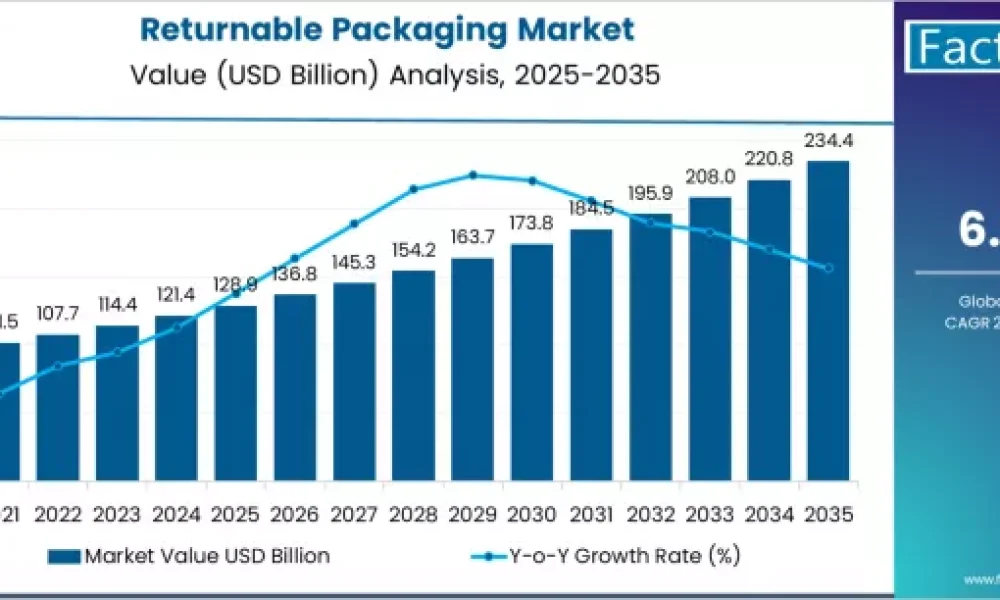
The U.S. returnable packaging market is entering a decade of powerful expansion as manufacturers, retailers, and logistics operators accelerate the transition from disposable materials to circular, reusable systems. With sustainability now a core component of supply-chain strategy and consumer loyalty, returnable packaging is becoming one of the most important growth levers across multiple industries. From 2025 to 2035, the market is projected to grow significantly, driven by economic efficiency, regulatory momentum, and rapid advances in smart asset-tracking technologies.
Industry analyses estimate that the U.S. returnable packaging market, valued at approximately USD 22 billion in 2024, is expected to reach nearly USD 48 billion by 2035, representing a CAGR of about 7% over the forecast period. This aligns with broader global performance indicators showing healthy mid-single-digit annual growth across the returnable packaging landscape. Continued corporate investment in circularity and rising consumer expectations for sustainable solutions are setting the stage for a decade of accelerated adoption.
To access the complete data tables and in-depth insights, request a Discount On The Report here: https://www.factmr.com/connectus/sample?flag=S&rep_id=12185
Market Drivers Shaping 2025–2035 Growth
1. Corporate Commitments and Cost Efficiencies
Across consumer packaged goods, retail, food and beverage, and industrial supply chains, companies are under pressure to reduce packaging waste and cut long-term operational costs. Returnable packaging systems—pallets, crates, totes, drums, and refillable consumer containers—reduce the need for continuous purchasing of single-use materials. When optimized, durable packaging assets deliver strong cost-per-use advantages over their lifecycle. As more companies commit to net-zero strategies and circularity goals, reusable systems are becoming a cornerstone of procurement and logistics planning.
2. Rising Consumer Demand for Sustainable Packaging
American consumers are increasingly prioritizing sustainability in their purchasing decisions. Surveys consistently show strong preference for recyclable, reusable, and low-waste packaging formats, particularly among younger demographics. This influence is reshaping brand and retailer strategies. Companies adopting refillable or returnable options in categories such as beverages, personal care, household cleaning, and grocery products are already reporting higher customer engagement and loyalty. Over the next decade, high-frequency purchase categories will drive accelerated adoption of consumer-facing return systems.
3. Regulatory Momentum and Environmental Policy Pressure
State and municipal regulations are pushing the packaging sector toward circularity. Extended Producer Responsibility (EPR) programs, waste reduction mandates, packaging taxes, and restrictions on single-use plastics are expanding across the U.S. For companies operating nationwide, these evolving regulatory landscapes make reusable systems increasingly attractive. Returnable packaging provides an effective compliance pathway by reducing waste generation and lowering exposure to disposal fees. As government policies continue to tighten, adoption will only accelerate.
4. Technology, Automation, and Asset-Tracking Innovation
The last five years have transformed returnable packaging economics. IoT sensors, GPS and RFID tagging, cloud-based asset-management systems, and automated sanitation processes are enabling companies to track, clean, and redeploy packaging more efficiently. These technologies increase the number of cycles each asset can complete and reduce losses and shrinkage across the supply chain. Technology-driven visibility has become essential for managing large pools of reusable assets, and the next decade will see even closer integration of smart tracking, AI forecasting, and automated inventory reconciliation.
The Biggest Trends 2025–2035
Refill and Return Programs Become Mainstream
What began as pilot projects in grocery, beverage, coffee, and personal care channels is scaling. Retailers are increasingly deploying in-store refill stations and reverse vending infrastructure, while brands expand return-for-reuse systems for bottles, jars, and pouches. Standardization of reusable container formats and cleaning protocols is allowing larger ecosystems to emerge. Over the next decade, refill and return are projected to become major components of the packaging mix in both retail and e-commerce.
Material Shifts: Durable Plastics Lead but Diversification Grows
High-density plastics remain dominant in the returnable packaging market due to durability, cost efficiency, and lightweight performance. However, innovation is accelerating across metals, molded fiber, composites, and hybrid systems. Material selection is increasingly application-specific: plastics for totes and crates, metal for high-strength industrial containers, wood for pallets, and aluminum or glass for consumer-facing packaging. Future advances will focus on improving recyclability at the end of an asset’s life, ensuring compatibility with circular manufacturing loops.
Pooling and Packaging-as-a-Service Accelerate Adoption
One of the fastest-growing segments is third-party pooling—shared networks of reusable pallets, crates, and containers that companies can rent instead of owning. Packaging-as-a-service models reduce capital expenditure, allow scaling without asset management burdens, and enable companies to tap into professionally managed cleaning and logistics infrastructures. Pooling will be a major adoption catalyst for mid-sized manufacturers, retailers, and food processors throughout the 2025–2035 period.
Integration with Automation and Robotics
As warehouses and distribution centers increasingly automate, returnable packaging is being designed with robotic handling compatibility in mind. Uniform, durable containers support seamless integration with automated storage, retrieval, and order-picking systems. This trend will intensify as companies digitize operations for speed and labor efficiency.
Challenges to Overcome
Operational Complexity
Managing returns, cleaning, reverse logistics, and asset tracking requires new workflows and infrastructure. Without technological support or partnerships, these systems can be costly or inefficient. Ensuring assets complete enough cycles to justify investment remains a central challenge.
Regulatory Fragmentation
U.S. packaging regulations vary widely by state, which can make national implementation of returnable packaging programs complicated. Harmonizing processes across diverse regulatory environments will require strategic design and flexibility.
Consumer Participation Barriers
Convenience remains critical. Returnable consumer packaging programs succeed only when returning or refilling is effortless. Companies must streamline user experiences through incentives, digital wallets, mobile collection tools, and attractive deposit-return schemes.
Have a specific Requirements and Need Assistant on Report Pricing or Limited Budget please contact us – [email protected]
To View Related Report :
Market Segmentation Opportunities
High-frequency consumer goods—including beverages, beauty, and household cleaning—offer strong ROI due to repeat purchase cycles.
Industrial and B2B logistics—pallets, crates, intermediate bulk containers—will continue to hold the largest market share.
Technology and service layers—tracking platforms, cleaning services, repair hubs—represent the fastest growing revenue opportunities.
Outlook for 2035
By 2035, the U.S. returnable packaging market is expected to nearly double in size, supported by circular-economy investments, regulatory alignment, and widespread adoption of tracking technologies. The industry’s shift from pilot projects to integrated systems signals a structural transition: returnable packaging is no longer a sustainability experiment but an operational necessity. Companies that standardize asset designs, form strategic pooling partnerships, and invest in intelligent tracking will enjoy cost efficiencies, regulatory resilience, and stronger consumer engagement throughout the next decade.
About Fact.MR
Fact.MR is a global market research and consulting firm, trusted by Fortune 500 companies and emerging businesses for reliable insights and strategic intelligence. With a presence across the U.S., UK, India, and Dubai, we deliver data-driven research and tailored consulting solutions across 30+ industries and 1,000+ markets. Backed by deep expertise and advanced analytics, Fact.MR helps organizations uncover opportunities, reduce risks, and make informed decisions for sustainable growth.



