
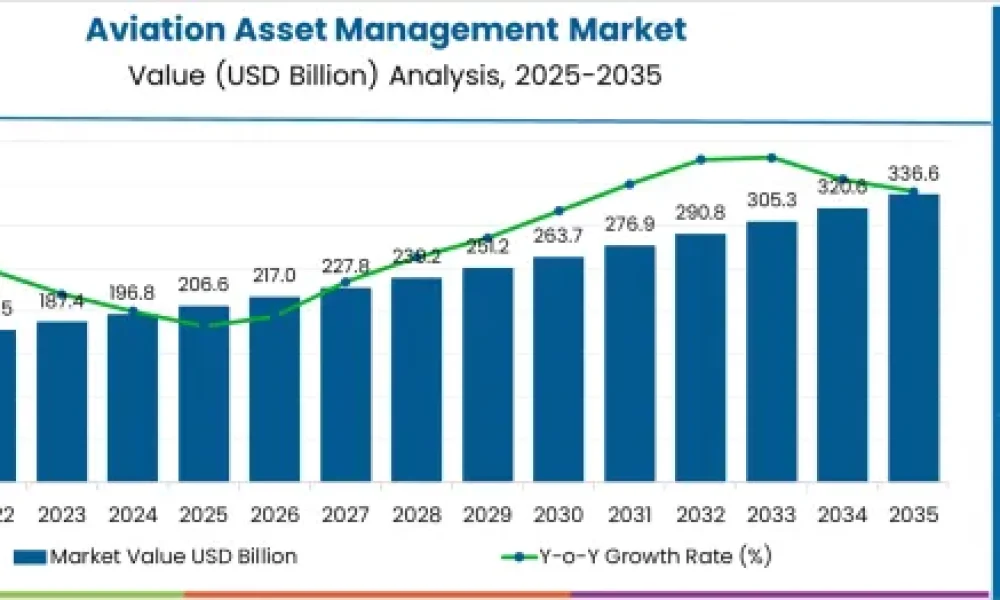
The global aviation asset management market is entering a decade of sustained expansion, with the industry valued at USD 206.6 billion in 2025 and projected to climb to USD 336.6 billion by 2035, achieving a steady 5.0% CAGR over the forecast period. Rolling five-year growth analyses indicate consistent performance across the sector, supported by strengthened aircraft leasing activity, modernization of fleets, and rapid adoption of predictive maintenance platforms.
Between 2025 and 2030, the market is expected to grow from USD 206.6 billion to USD 263.7 billion, reflecting a rolling CAGR of 5.0%. Momentum continues in subsequent intervals, including the 2026–2031 and 2028–2033 cycles, driven by increasing sale-and-leaseback transactions, lifecycle cost optimization, and digital asset monitoring. Stable growth near 5.0% persists through 2035, underscoring the market’s resilience amid fluctuating fuel prices, evolving regulatory frameworks, and global fleet expansion.
Modernization, Digital Maintenance, and Leasing Activity Drive Market Performance
Aviation asset management is increasingly recognized as a strategic enabler for operational efficiency, safety assurance, and asset value retention. The sector supports 15–17% of the broader aviation operations and maintenance market, 12–14% of the aircraft lifecycle services market, and holds a substantial 20–22% share within aviation data analytics and predictive maintenance.
Adoption is accelerating as airlines prioritize cost efficiency, extended aircraft life cycles, and improved reliability. Platforms integrating IoT sensors, digital twins, AI-based forecasting, and real-time dashboards are reshaping how airlines and lessors manage maintenance, inventory, and fleet utilization.
Rising passenger traffic, expansion of low-cost carriers, and the need to modernize aging fleets continue to fuel market growth. These dynamics are accompanied by an industry shift toward flexible leasing arrangements that reduce capital burden and support rapid capacity adjustments.
Subscribe for Year-Round Insights → Stay ahead with quarterly and annual data updates
https://www.futuremarketinsights.com/reports/sample/rep-gb-23057
Aircraft and Operating Lease Segments Maintain Market Leadership
The aircraft segment remains the dominant asset class, expected to account for 72.3% of total market revenue in 2025. The high capital intensity of aircraft and their extended economic lifespan underscore the importance of structured asset management strategies focused on maintaining airworthiness, preserving residual value, and optimizing transition processes.
Within purchase types, the operating lease segment is projected to contribute 49.6% of global market revenue in 2025. Its appeal lies in offering fleet flexibility, reduced balance sheet exposure, and minimized residual value risk—benefits that airlines increasingly rely on amid evolving market conditions. The rising reliance on operating leases is prompting lessors to strengthen portfolio diversification, refine remarketing capabilities, and invest in digital optimization tools.
Leasing services also remain the leading service segment, forecast to capture 58.1% of the market in 2025. Growing demand for end-to-end asset support—spanning maintenance coordination, compliance, portfolio reporting, and remarketing—continues to reinforce the role of global lessors in the aviation value chain.
Market Drivers, Restraints, and Emerging Opportunities
Market demand is propelled by the industry’s focus on maximizing aircraft availability, minimizing ground time, and implementing proactive maintenance strategies. Airlines seek platforms that streamline asset health monitoring, synchronize maintenance planning with parts logistics, and enhance cost predictability.
However, adoption is affected by challenges such as fragmented data flows across maintenance systems, regulatory complexity, and high upfront investment in digital transformation. Harmonizing data from flight operations, onboard systems, and third-party maintenance platforms remains a key obstacle.
Despite these constraints, opportunities are expanding across predictive analytics, cloud-based fleet management, modular dashboards, mobile accessibility, and integrated lifecycle management contracts. The growing availability of Spare-Part-On-Demand models, engine leasing, and component pooling further enhances the value proposition for operators seeking to contain costs.
Personalize Your Experience: Ask for Customization to Meet Your Requirements
https://www.futuremarketinsights.com/customization-available/rep-gb-23057
Regional Growth Overview: China and India Lead Global Expansion
China is positioned as the fastest-growing market with a 6.8% CAGR, driven by rapid domestic fleet expansion, increasing operating lease penetration, and rising global influence through sale-leaseback agreements. AI-enabled asset forecasting tools and expanding aftermarket capacity also support robust demand.
India follows with a 6.3% CAGR, fueled by rising regional aviation demand, increased sale-leaseback transactions, and adoption of predictive maintenance to minimize aircraft-on-ground incidents. Component and engine leasing activities are expanding as India’s carriers emphasize liquidity and operational efficiency.
Germany (5.8% CAGR), France (5.3% CAGR), and the United Kingdom (4.8% CAGR) maintain strong momentum in Europe, supported by digital asset tracking, sustainability-focused fleet modernization, and advanced leasing ecosystems.
Competitive Landscape and Strategic Developments
The market is shaped by major players including Aercap Holdings NV, Boeing Global Services, GE Capital Aviation Services, Airbus Group, BOC Aviation, and Avolon. Competitive differentiation is built on portfolio scale, lease flexibility, digital asset visibility, risk-sharing models, and remarketing capabilities. OEM-linked service providers continue to integrate predictive maintenance analytics and parts supply solutions to support fleet reliability.
Recent industry developments highlight strengthening investment confidence:
- AIP Capital and Monroe Capital announced a USD 1 billion aircraft leasing portfolio initiative (June 2025).
- Flydocs entered a five-year digital lifecycle management partnership with Sunclass Airlines (April 2025).
- Honeywell and NXP Semiconductors expanded collaboration on AI-enabled autonomous flight technologies (January 2025).
Why Choose FMI: Empowering Decisions that Drive Real-World Outcomes:
https://www.futuremarketinsights.com/why-fmi
About Future Market Insights (FMI)
Future Market Insights, Inc. (FMI) is an ESOMAR-certified, ISO 9001:2015 market research and consulting organization, trusted by Fortune 500 clients and global enterprises. With operations in the U.S., UK, India, and Dubai, FMI provides data-backed insights and strategic intelligence across 30+ industries and 1200 markets worldwide.



