
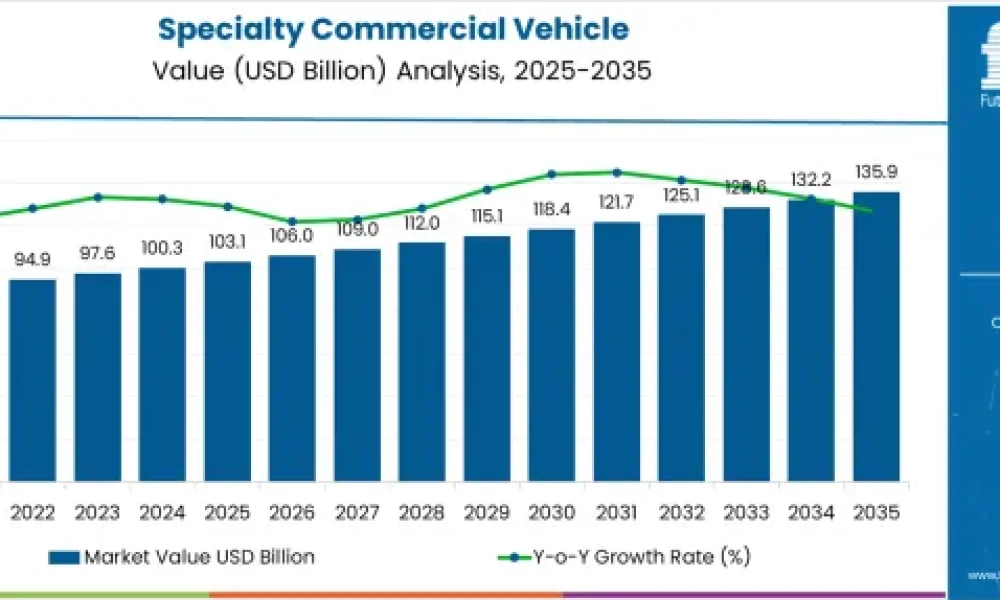
The global Specialty Commercial Vehicle Market is entering a phase of stable yet strategic expansion, supported by accelerating upgrades in emergency response fleets, municipal service vehicles, and mobile healthcare units. The market—estimated at USD 103.1 billion in 2025—is projected to reach USD 135.9 billion by 2035, reflecting a steady 2.8% CAGR as governments and private operators prioritize reliability, compliance, and task-specific mobility solutions.
Specialty commercial vehicles (SCVs), including ambulances, fire trucks, mobile fuel tankers, inspection vans, and mobile medical units, continue to play a critical role in urban infrastructure, public health, disaster response, and essential services. Increasing global focus on safety standards, hygiene protocols, integrated telematics, and productivity-enhancing vehicle configurations is reshaping fleet modernization strategies across regions.
Ambulances Lead Global Revenue Share With 47.3% in 2025
The ambulance category remains the largest segment, contributing 47.3% of global revenue in 2025. Rising investments in emergency medical services, expansion of prehospital care networks, and growing awareness around rapid response capabilities are driving segment dominance.
Modern ambulances are now equipped with advanced life-support systems, digital monitoring platforms, hygienic interiors, and ergonomic suspension designs enabling high-speed patient transport with improved clinical outcomes. The segment is expanding beyond metro markets, with rural and remote regions adopting mobile healthcare fleets to address access gaps.
Subscribe for Year-Round Insights → Stay ahead with quarterly and annual data updates
https://www.futuremarketinsights.com/reports/sample/rep-gb-22534
ICE Vehicles Maintain 51.6% Market Share Despite Electrification Push
The Internal Combustion Engine (ICE) segment continues to hold a commanding 51.6% share in 2025, supported by robust fueling infrastructure, lower acquisition costs, and superior performance under demanding duty cycles.
Specialty operations—particularly firefighting, long-range medical transfers, utility maintenance, and heavy-duty municipal services—continue to depend on ICE platforms due to payload requirements, terrain constraints, and reliability needs. While electric, hybrid, and plug-in hybrid models are gaining ground, electrification remains concentrated in shorter-route municipal and airport service vehicles.
Medical & Healthcare Vehicles Dominate Application Segment With 44.9% Share
The medical and healthcare category leads with 44.9% revenue share in 2025. Demand is rising for mobile medical clinics, diagnostic vans, emergency response units, vaccination vehicles, and rural outreach platforms.
Heightened global focus on pandemic preparedness, health equity, and point-of-care medical delivery is boosting adoption. The segment benefits from investments in digital diagnostics, cold-chain enabled interiors, and modular clinical workspaces.
Market Drivers: Healthcare, Cold-Chain, and Utility Expansion Push Fleet Demand
The specialty commercial vehicle market is experiencing significant momentum from three core sectors:
- Healthcare Mobility
Global demand for mobile medical units grew 9% between 2023 and 2024, with adoption rising across Latin America, India, Southeast Asia, and Africa. Governments and NGOs are deploying mobile labs, X-ray vans, dental units, and vaccination centers to bridge healthcare gaps.
- Refrigerated Logistics
Refrigerated van registrations increased 14% in Europe and 18% in North America, driven by last-mile pharmaceutical, fresh food, and cold-chain expansion. Up-fits include temperature-controlled cargo areas, insulated paneling, and IoT monitoring systems.
- Utility & Infrastructure Services
Utility fleets saw a 12–15% rise in spending, driven by grid modernization, telecom fiber deployment, and infrastructure repairs. Custom boom trucks, inspection vans, and maintenance units are increasingly equipped with modular power, HVAC packs, and telematics systems.
Market Restraints: Customization Costs and Certification Delays Challenge Builders
Despite positive momentum, the sector faces structural constraints:
- Customization costs add 18–22% to base chassis prices, pushing specialized builds above USD 85,000 per unit.
- Regulatory certification for refrigeration, fire safety, or emissions can delay deliveries by 6–8 weeks.
- Limited availability of qualified up-fitters and service partners extends lead times by 12–16 weeks, especially in emerging economies.
- Fleets experience up to 22% reduced availability due to maintenance gaps and shortage of skilled technicians.
These constraints slow fleet modernization cycles, particularly in small and mid-size operator segments.
Regional & Country Growth Highlights (2025–2035)
While the global market is growing at 2.8%, regional performance varies significantly:
- China — 3.8% CAGR: Demand driven by municipal upgrades, construction activity, and logistics modernization.
- India — 3.5% CAGR: Strong need for water tankers, construction tippers, and medical vans under state mobility schemes.
- Germany — 3.2% CAGR: Focus on snow plows, mobile cranes, and standardized public-sector fleets.
- France — 2.9% CAGR: Demand for livestock carriers, compact refuse collectors, and rail inspection trucks.
- UK — 2.7% CAGR: High usage of street sweepers, armored carriers, and refrigerated vans.
- USA — 2.4% CAGR: Mature market with steady procurement for telecom, SWAT carriers, and highway vehicles.
Emerging markets in Asia, Africa, and Latin America account for increasing volume due to expanding public services and infrastructure development.
Personalize Your Experience: Ask for Customization to Meet Your Requirements
https://www.futuremarketinsights.com/customization-available/rep-gb-22534
Competitive Landscape
The 2025 competitive environment is shaped by global OEMs, regional bodybuilders, and specialized emergency vehicle manufacturers. Key players include:
Arctic Cat, Cargotec, Case New Holland, Demers Ambulances, Eicher, Emergency One, Farber Specialty Vehicles, Hino Motors, Isuzu, LDV, Matthews Specialty Vehicles, Mercedes-Benz, NFI, Oshkosh Corporation, Pierce, REV, Rosenbauer International, Specialty Vehicles, Traton, and Volvo.
Product portfolios emphasize safety compliance, modularity, electrification pilots, chassis-body integration, and advanced diagnostics.
A major industry development occurred in January 2025 when Toyota and Daimler Truck merged Hino Motors and Mitsubishi Fuso, forming a USD 6.4 billion heavy-vehicle company to strengthen competitiveness in emissions compliance and global logistics platforms.
Future Outlook
The specialty commercial vehicle market is set for persistent long-term demand as cities modernize public fleets, healthcare delivery becomes increasingly mobile, and utilities expand infrastructure networks. Innovations in telematics, modular body construction, electric chassis, and climate-optimized interiors will shape the next decade of fleet transformation.
Why Choose FMI: Empowering Decisions that Drive Real-World Outcomes:
https://www.futuremarketinsights.com/why-fmi
About Future Market Insights (FMI)
Future Market Insights, Inc. (FMI) is an ESOMAR-certified, ISO 9001:2015 market research and consulting organization, trusted by Fortune 500 clients and global enterprises. With operations in the U.S., UK, India, and Dubai, FMI provides data-backed insights and strategic intelligence across 30+ industries and 1200 markets worldwide.



