
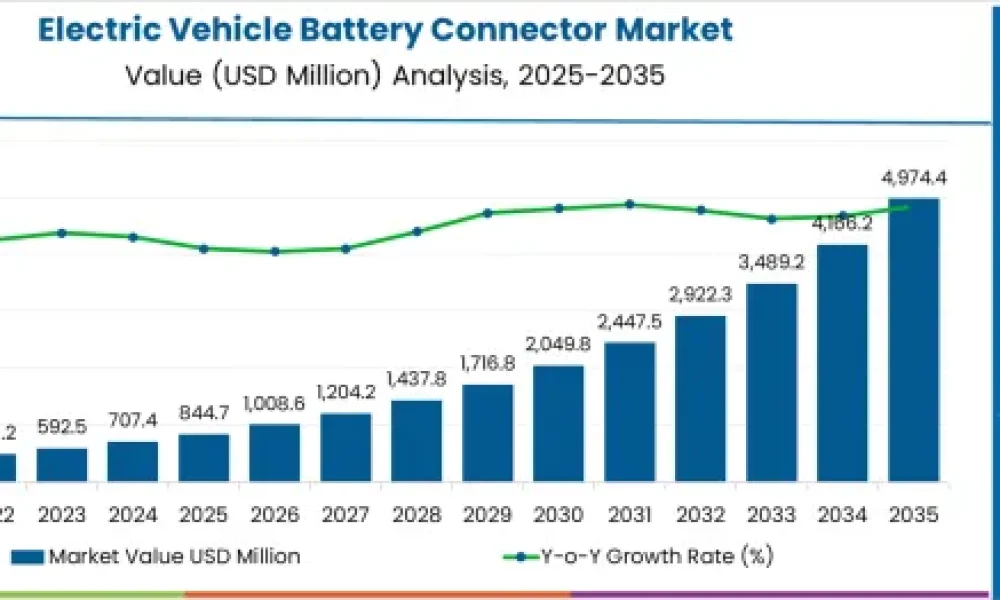
The global Electric Vehicle Battery Connector Market is poised for exceptional expansion, rising from USD 844.7 million in 2025 to USD 4,974.4 million by 2035, at a robust CAGR of 19.4%. This rapid acceleration reflects a global shift toward high-performance electric mobility, widespread regulatory support, and increasing technological sophistication in EV platforms.
Strong Market Momentum Backed by Electrification and Charging Innovation
As automakers expand EV manufacturing capacity and transition to advanced 800V platforms, the demand for high-voltage, thermally stable, and standardized connectors has grown dramatically. Battery connectors now play an essential role in enabling fast charging, reliable energy transfer, thermal safety, and system-level efficiency across a wide range of electric vehicles.
Governments worldwide are accelerating EV adoption through subsidies, charging infrastructure development, and zero-emission mandates. This policy alignment, combined with consumer expectations for shorter charging times and higher driving range, is shaping the next generation of connector technologies.
Advances in liquid-cooled housings, EMI shielding, high-current copper alloys, robotic alignment systems, and embedded diagnostics further support market expansion. As charging ecosystems scale across residential, commercial, and public environments, connector standardization is becoming a critical enabler of compatibility and fast-charging deployment.
Subscribe for Year-Round Insights → Stay ahead with quarterly and annual data updates
https://www.futuremarketinsights.com/reports/sample/rep-gb-22745
Market Highlights (2025–2035)
Quick Stats
- 2025 Market Size: USD 844.7 million
- 2035 Forecast: USD 4,974.4 million
- CAGR (2025–2035): 19.4%
- Leading Charging Level Segment: Level 2 (47.9%)
- Key Growth Regions: North America, Asia-Pacific, Europe
- Top Players: TE Connectivity, Tesla, Aptiv, Siemens, Amphenol, ABB, Bosch, HUBER+SUHNER
Segment Insights
Level 2 Charging Dominates with 47.9% Share
Accounting for nearly half of the market, Level 2 charging infrastructure remains the backbone of global EV charging. Its balanced performance, cost efficiency, and compatibility with both residential and commercial environments continue to drive adoption.
Investments in semi-fast workplace and public charging stations are expected to significantly reinforce demand for Level 2 connectors through 2035.
CCS Connector Segment Leads with 34.6% Share
The Combined Charging System (CCS) has emerged as the global benchmark for EV charging, supported by automakers across North America, Europe, and growing parts of Asia-Pacific. Its ability to support both AC and high-power DC charging makes it a preferred solution in public networks and next-generation EV models.
Technological improvements—such as enhanced thermal control, ruggedized contacts, and faster charging capabilities—continue to strengthen CCS dominance.
BEVs Drive 52.1% of Total Demand
Battery Electric Vehicles (BEVs) represent the largest automotive application for EV battery connectors, accounting for 52.1% of the total market. Their reliance on high-voltage battery systems makes connector performance critical to overall vehicle safety and energy efficiency.
As BEVs increasingly adopt high-density batteries, fast-charging support, and modular pack designs, demand for advanced connectors is set to rise significantly.
Drivers, Restraints, and Industry Trends
Key Growth Drivers
- Rapid expansion of 800V high-voltage EV architectures
- Accelerated investments in fast charging and megawatt charging systems (MCS)
- Regulatory push for zero-emission transportation and standardized plug formats
- Increasing adoption of liquid-cooled, EMI-shielded, and high-current connectors
- Battery swapping and modular EV platforms requiring robust connector interoperability
Market Restraints
- Rising material costs for copper alloys and advanced polymers (+12% over standard connectors)
- Multiple certifications (UL, IEC, automotive isolation) add 4–6 weeks to development cycles
- Alignment and tolerance issues affecting 9% of panel-mounted connector batches
- Smaller EV OEMs face delays due to limited engineering resources for connector compliance
Key Market Trends
- 800V connectors supporting >600A for ultra-fast charging
- Liquid-cooled housings reducing thermal stress by 19%
- Robotic docking systems reducing mating failures by 14%
- Integration of infrared sensors and torque monitoring in connectors
- Increased use of lightweight alloys and composite housings for EV weight reduction
Country-Level Market Growth (2025–2035)
| Country | CAGR |
| China | 26.2% |
| India | 24.3% |
| Germany | 22.3% |
| France | 20.4% |
| UK | 18.4% |
| USA | 16.5% |
| Brazil | 14.6% |
China leads global expansion with aggressive EV production scaling and widespread fast-charging and battery-swapping adoption. India demonstrates strong mid-segment EV demand, especially in two- and three-wheelers. Germany’s momentum is derived from high-precision connectors and premium OEM adoption.
Personalize Your Experience: Ask for Customization to Meet Your Requirements
https://www.futuremarketinsights.com/customization-available/rep-gb-22745
Competitive Landscape
The market remains moderately consolidated, with leading players advancing high-current, ruggedized, and smart connector technologies.
Key Companies
- TE Connectivity Ltd.
- Tesla
- Aptiv PLC
- Siemens AG
- Amphenol
- ABB
- HUBER+SUHNER
- Bosch
- Schneider Electric
- ITT Inc.
Major developments include Amphenol’s USD 2 billion acquisition of Carlisle Interconnect Technologies (CIT), strengthening its capabilities in high-voltage, thermally resilient EV connectors.
Future Outlook
The Electric Vehicle Battery Connector Market is set to experience sustained, long-term expansion as EV penetration deepens across passenger, commercial, and fleet segments. Standardization initiatives, advanced connector designs, and rapid infrastructure deployment will shape a highly competitive and innovation-driven landscape through 2035.
With EV architectures evolving toward higher voltages, faster charging, modular packs, and smart diagnostics, connector manufacturers are positioned at the center of the next decade of electrification growth.
Why Choose FMI: Empowering Decisions that Drive Real-World Outcomes:
https://www.futuremarketinsights.com/why-fmi
About Future Market Insights (FMI)
Future Market Insights, Inc. (FMI) is an ESOMAR-certified, ISO 9001:2015 market research and consulting organization, trusted by Fortune 500 clients and global enterprises. With operations in the U.S., UK, India, and Dubai, FMI provides data-backed insights and strategic intelligence across 30+ industries and 1200 markets worldwide.



