
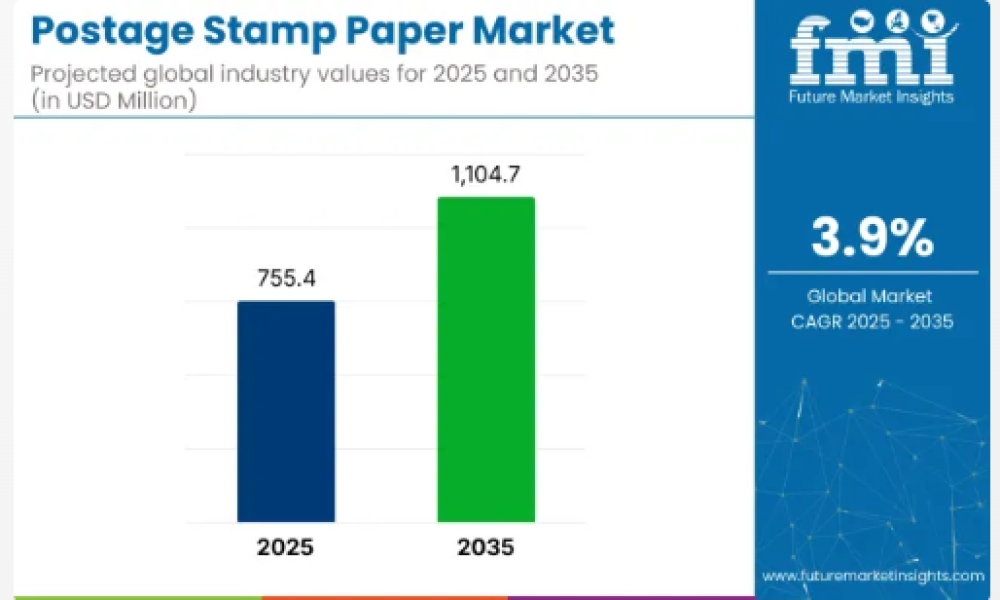
In a data-driven leap, the global postage stamp paper market is projected to grow from approximately USD 755.4 million in 2025 to USD 1,104.7 million by 2035, registering a steady compound annual growth rate (CAGR) of 3.9 percent through the decade. This robust expansion underscores strong demand from postal authorities, collectors, and governments alike, driven by heightened security needs, technological evolution, and sustainability trends.
Key Market Insights at a Glance
The surge in this niche paper market is primarily rooted in the need for durable, high-integrity substrates for postage stamps. Wood-based fiber currently dominates, accounting for 57.6 percent of the market in 2025, thanks to its opacity, strength, and compatibility with advanced printing techniques. On the demand side, postal services remain the major application, representing 61.3 percent of usage in 2025, owing to institutional volume and strict quality standards.
Security is evolving: hybrid security features combining physical, chemical, and digital elements — such as watermarks, embedded threads, and QR-coded tracking — are gaining traction. At the same time, the industry is embracing bio-based security elements made from biodegradable materials, aligning with broader sustainability goals.
Segment Overview
Segmented by fiber type, the market classifies into wood, bark, straw, and other fibers, with wood leading by far due to its reliability and cost effectiveness. By paper type, varieties such as laid, wove, batonné, and glazed are used to achieve specific textures, printability, and security performance. The application dimension is divided into postal services, judicial, non-judicial, and personal uses, with postal services dominating today’s market.
Regional Overview
Regional dynamics reflect diverse growth trajectories. India’s market, for instance, is set to grow at a strong CAGR of 6.9 percent, fueled by expanding postal infrastructure, a budding philatelic culture, and scale economies. China is close behind with a projected CAGR of 6.8 percent, supported by booming e-commerce and modernization of postal systems. In contrast, the UK displays more modest expansion (~0.8 percent CAGR), as digital communication shifts dampen traditional mail demand. The U.S., while mature, maintains a steady 1.1 percent CAGR, driven by niche collector and legal markets. Germany is notable too, with a solid 5.6 percent CAGR, underpinned by strong postal security solutions and collector interest.
Competitive Landscape
Competition in this specialized sector is fierce and innovation-led. Legacy firms such as Tullis Russell, UPM Raflatac, and Goznak are pushing the envelope with partnerships and security innovations. Tullis Russell collaborates with postal authorities to supply secure stock, while UPM Rafflatac integrates RFID capabilities into paper production. Joint ventures — such as Goznak with Security Papers Limited — are targeting high-end, highly secure stamp-grade papers. Meanwhile, more niche players like FNMT-RCM and Stamped Paper Co. are prioritizing eco-friendly, bio-based solutions to serve growing sustainability demand.
Market Outlook: Powering the Next Decade
Over the next ten years, the postage stamp paper market is expected to strengthen along several vectors:
- Security and traceability: With digital-physical integration, stamps will become more than just collectibles — embedding QR codes or serial numbers could make every stamp a traceable asset.
- Green transition: Adoption of biodegradable dyes, plant-based fibers, and eco-security features will help the market align with environmental policies.
- Collector-driven growth: As philately continues to appeal globally, limited-edition, customizable, and premium stamps will fuel demand.
- Institutional scale: Postal authorities will increasingly demand consistent, high-performance paper with advanced security and high print fidelity, supporting large-scale procurement.
Key Players of the Sustainable Label Industry
Leading companies shaping the future of postage stamp paper include:
- Tullis Russell – Known for durable, high-security wood-based stock.
- UPM Raflatac – Innovator in integrating RFID and smart security layers into paper.
- Goznak & Security Papers Limited – Collaborating to offer premium, joint-venture–based secure stamp paper.
- FNMT-RCM, Stamped Paper Co. – Championing bio-based, environmentally friendly solutions.
- Additional firms include Adminware Corporation, Kaizen Metal Forming, B N Paper Co., Glatfelter, and others — all competing via innovation or specialization.
Recent Strategic Developments
Recent months have seen a flurry of strategic activity: major players are expanding their security feature portfolios, forming partnerships with postal authorities, and investing in greener fiber sources. Joint ventures are setting up secure-production lines, while R&D investments are directed toward bio-based security materials. These moves are not only strengthening competitive moats but also aligning with global sustainability goals and traceability expectations.
Subscribe for Year-Round Insights → Stay ahead with quarterly and annual data updates: https://www.futuremarketinsights.com/reports/sample/rep-gb-7901
Have a specific Requirements and Need Assistant on Report Pricing or Limited Budget please contact us – [email protected]
About Future Market Insights (FMI)
Future Market Insights, Inc. (ESOMAR certified, recipient of the Stevie Award, and a member of the Greater New York Chamber of Commerce) offers profound insights into the driving factors that are boosting demand in the market. With a vast team of over 400 analysts worldwide, FMI provides global, regional, and local expertise on diverse domains and industry trends across more than 110 countries.



