
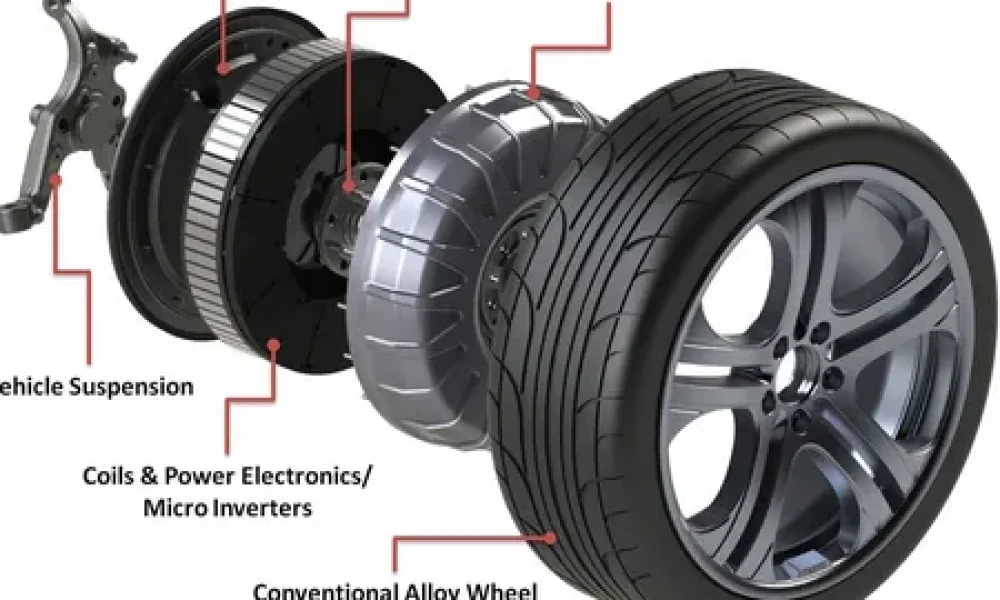
The global Automotive In-Wheel Motors Market is entering a decade of rapid technological and commercial advancement, with market value projected to increase from USD 4.18 billion in 2025 to USD 24.02 billion by 2035, registering a strong CAGR of 19.1%. The surge is being driven by intensifying electric vehicle (EV) adoption, rising demand for flexible vehicle architectures, and growing investment in powertrain decentralization.
In-wheel motors—integrating propulsion directly within the wheel hub—are redefining EV design by eliminating the need for traditional transmission systems, driveshafts, and differentials. This architecture reduces drivetrain losses, enhances energy efficiency, and unlocks additional cabin and battery space, positioning in-wheel motors as a transformative solution for future EV platforms.
Major Automakers Accelerate Innovations in In-Wheel Electric Drive
In 2024, several global automotive leaders demonstrated escalating commitment to in-wheel motor technology through patents, prototypes, and next-generation EV platform strategies.
Hyundai filed a patent for in-wheel electric motor systems designed to improve packaging efficiency while delivering superior independent torque control. As noted by industry reports, the technology enhances regenerative braking and optimizes real-time traction for a safer, more dynamic EV driving experience.
Toyota also strengthened its position in this segment with a patent detailing fully independent in-wheel motor units capable of enabling four-wheel torque vectoring. This high-precision system is engineered to enhance cornering stability, braking efficiency, and EV performance while reducing mechanical complexity.
Ferrari, well-known for its performance engineering, filed a 2024 patent for a multi-motor electric drivetrain incorporating in-wheel motors. According to Motor Authority analyses, the Italian automaker is exploring this architecture to achieve unprecedented vehicle handling precision in high-performance electric models.
Industry innovators such as Elaphe Propulsion Technologies continue to lead the technological frontier. As Luka Ambrozic, Business Development Officer at Elaphe, emphasized, “Modern in-wheel motor technology is not only a powertrain technology – it affects the whole vehicle in ways never before imagined.” This industry perspective reflects a growing consensus that in-wheel motors will define the dynamics, efficiency, and scalability of next-generation EVs.
Subscribe for Year-Round Insights → Stay ahead with quarterly and annual data updates
https://www.futuremarketinsights.com/reports/sample/rep-gb-7677
HEVs to Play a Crucial Validation Role Before BEV Mass Deployment
Hybrid Electric Vehicles (HEVs) are poised to contribute approximately 15% of total in-wheel motor market share by 2035, with a forecast CAGR of 16%. Automakers are increasingly testing in-wheel motors in hybrid configurations to support low-speed EV-only driving, regenerative braking, and enhanced traction management.
The dual-drive architecture allows OEMs to evaluate thermal performance, durability, and motor control algorithms, making HEVs an important launchpad for commercialization before widespread integration in full Battery Electric Vehicles (BEVs).
Radial Flux Motors to Capture 75% Market Share by 2035
Radial flux motors are anticipated to dominate the market, accounting for around 75% of in-wheel motor installations by 2035, supported by a robust 18% CAGR.
Their advantages include:
- High torque density
- Proven design simplicity
- Easy integration into wheel housings
- Superior low-RPM performance for urban and light commercial EVs
Companies such as Elaphe and Protean Electric continue to advance radial flux technologies with innovations in cooling systems, winding designs, and lightweight structural materials.
Regional Outlook: Asia-Pacific to Lead Market Growth
North America
The U.S. and Canada remain early pioneers in electric drivetrain innovation. Leading EV manufacturers, including Tesla, Rivian, and General Motors, continue exploring hub motors to enhance packaging efficiency, extend range, and support autonomous mobility. Complementing this, the U.S. Department of Energy’s initiatives in high-efficiency propulsion systems are accelerating regional adoption.
Europe
European nations—particularly Germany, France, and the UK—are boosting in-wheel motor development through aggressive electrification mandates and investments in sustainable transportation. BMW, Volkswagen, and Renault are actively evaluating hub-motor integration for future compact EVs, supported by strong urban mobility demand and stringent carbon neutrality goals.
Asia-Pacific
Asia-Pacific is projected to be the fastest-growing region, driven by EV leadership in China, Japan, South Korea, and India. Chinese EV manufacturers are expanding R&D on high-efficiency electric drive systems, while Japanese and Korean OEMs—including Nissan, Toyota, Hyundai, and Kia—are incorporating hub motors into concept vehicles and next-generation EV prototypes. Rapid growth in micromobility and autonomous delivery vehicles further expands the regional market opportunity.
Key Market Challenges and Opportunities
Challenges
- High Production Costs & Regulatory Complexity: Compliance with ISO and UNECE standards increases development timelines.
- Thermal Management Constraints: Limited space within the wheel hub makes cooling difficult, impacting durability under high-speed or off-road conditions.
Opportunities
- Lightweighting & Efficient Propulsion Demand: In-wheel motors reduce drivetrain complexity and improve energy efficiency.
- Autonomous & Smart Mobility Growth: Precision torque vectoring and modular scalability make in-wheel motors ideal for next-generation autonomous EVs.
- Material Innovation: Advancements in composites, smart cooling, and graphene-based windings will elevate motor efficiency and durability.
Personalize Your Experience: Ask for Customization to Meet Your Requirements
https://www.futuremarketinsights.com/customization-available/rep-gb-7677
Competitive Landscape: Key Players Strengthen Market Presence
The global market is moderately concentrated, with leading companies including:
| Company | Market Share (Est.) |
| Protean Electric (SAIC Motors) | 18–22% |
| Elaphe Propulsion Technologies | 12–16% |
| NTN Corporation | 10–14% |
| NSK Ltd. | 8–12% |
| Schaeffler AG | 5–9% |
| Other Companies | 35–45% |
Leading players are prioritizing:
- High-torque, compact motor architectures
- AI-driven traction and torque vectoring
- Integrated cooling and power electronics
- Scalable in-wheel platforms for BEVs and autonomous EVs
Future Outlook: 2025–2035
The next decade will witness a major transition toward:
- AI-driven powertrain optimization
- 800V+ architectures for ultra-fast charging
- Modular EV platforms with decentralized propulsion
- Recyclable, low-carbon motor materials aligned with global net-zero goals
As EV manufacturers race toward higher efficiency, greater agility, and smarter mobility ecosystems, the Automotive In-Wheel Motors Market is set for transformative growth through 2035.
Why Choose FMI: Empowering Decisions that Drive Real-World Outcomes:
https://www.futuremarketinsights.com/why-fmi
About Future Market Insights (FMI)
Future Market Insights, Inc. (FMI) is an ESOMAR-certified, ISO 9001:2015 market research and consulting organization, trusted by Fortune 500 clients and global enterprises. With operations in the U.S., UK, India, and Dubai, FMI provides data-backed insights and strategic intelligence across 30+ industries and 1200 markets worldwide.



