
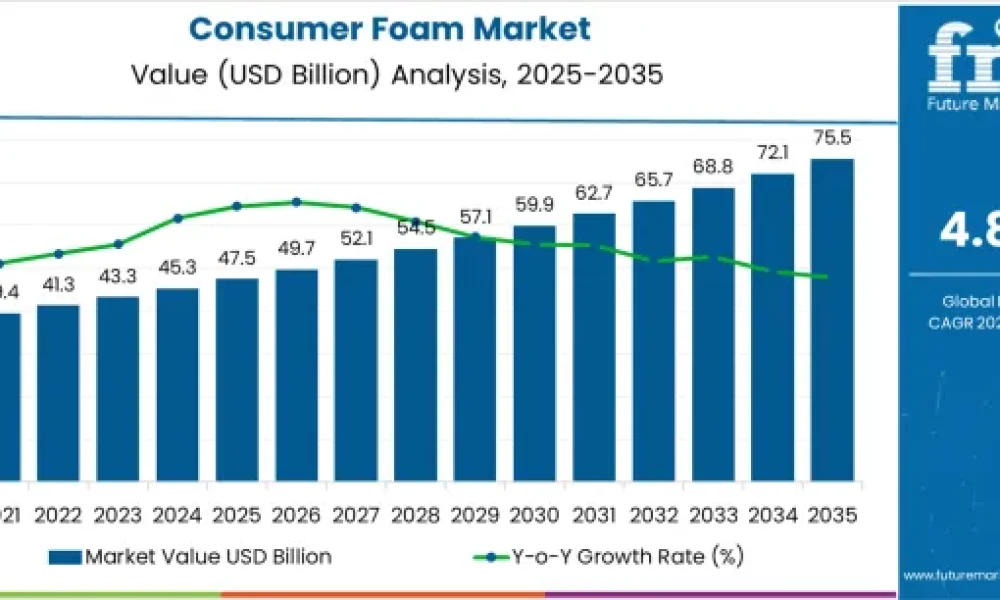
The global consumer foam market is projected to witness significant growth between 2025 and 2035, driven by increasing demand across multiple end-use industries such as furniture, bedding, automotive, packaging, and consumer electronics. Valued at approximately USD 47.5 billion in 2025, the market is expected to expand steadily, reaching USD 75.5 billion by 2035, registering a healthy compound annual growth rate (CAGR) of 4.8% during the forecast period.
Subscribe for Year-Round Insights → Stay ahead with quarterly and annual data updates: https://www.futuremarketinsights.com/reports/sample/rep-gb-18927
Market Growth Drivers
The consumer foam market’s expansion is fueled by several key factors:
- Rising Demand for Comfort and Durability: Consumers worldwide are increasingly prioritizing comfort and durability in their lifestyle products. Foam materials, especially flexible polyurethane foam, are gaining popularity due to their superior cushioning properties and lightweight nature.
- Urbanization and Growing Middle-Class Populations: Rapid urbanization in emerging economies, coupled with rising disposable incomes, is stimulating demand for premium foam-based products in bedding, furniture, and automotive interiors.
- Technological Advancements: Innovations in foam formulations, including enhanced resilience, odor control, and environmentally friendly bio-based alternatives, are shaping market preferences. These advancements align with growing regulatory pressures to reduce volatile organic compound (VOC) emissions.
- Sustainability Trends: Consumers and manufacturers alike are leaning towards sustainable material sourcing and eco-friendly foam products, driving the adoption of recyclable and bio-based foam materials.
Segmental Insights
The consumer foam market is broadly segmented by type, end use, and region, each revealing distinct trends and growth opportunities.
By Type: Flexible vs. Rigid Foam
- Flexible foam dominates the market with a 62% share, largely due to its versatile applications in bedding, furniture, packaging, and automotive interiors. Its customizable density and easy fabrication make it a preferred choice for manufacturers aiming to meet diverse consumer needs.
- Rigid foam, known for its durability and structural applications, also maintains a strong position with a forecast CAGR of 4.6% from 2025 to 2035. This segment benefits from rising construction activities where insulation and structural foams are essential.
By End Use: Bedding & Furniture Lead
- The bedding and furniture segment commands roughly 34.6% of the market share in consumer foam. Consumers’ growing preference for ergonomically designed, comfort-enhanced products drives this trend.
- Expansion in residential construction, home renovations, and e-commerce penetration further boost demand in this segment. Foam’s thermal insulation, sound absorption, and cushioning properties make it an indispensable material for mattresses, sofas, and seating solutions.
Regional Outlook
The consumer foam market is geographically diverse, with key regions contributing significantly to growth:
- North America: The region remains a key market, driven by high consumer awareness about wellness and eco-friendly products. The US alone is expected to grow at a CAGR of 5.2%, supported by online retail growth and demand for customizable foam solutions.
- Asia-Pacific: Fast urbanization and expanding middle-class populations in China, Japan, South Korea, and India are fueling demand. China’s consumer foam market is projected to grow at 6.0%, with South Korea leading the region with a 7.5% CAGR, emphasizing sustainability and smart foam technologies.
- Europe: The UK and Western Europe markets emphasize sustainability and innovation in foam textures and health-centric products, with growth anticipated around 5.5% CAGR.
Market Challenges and Trends
While the outlook remains optimistic, the consumer foam market faces certain challenges:
- Market Maturity and Competition: As foam products saturate the market, growth rates may moderate, leading to intensified competition among manufacturers and pricing pressures.
- Economic Fluctuations: Economic uncertainties can impact consumer spending on non-essential items like foam-based goods, potentially slowing market expansion.
Despite these challenges, key trends are shaping the future landscape:
- Sustainability as a Core Focus: The transition toward recyclable, bio-based foams is becoming a critical differentiator for market leaders.
- Health and Wellness-Oriented Products: Foam products designed for improved sleep quality and ergonomic support are becoming increasingly popular.
- E-commerce and Direct-to-Consumer Sales: Online platforms are revolutionizing how foam products reach consumers, offering customization and convenience.
- Innovations in Cooling Technology: Demand for temperature-regulated foam, such as gel-infused or phase-change materials, continues to rise to enhance consumer comfort.
Leading Players and Industry Developments
Major corporations are spearheading innovation and market growth through investments in technology and sustainability:
- Covestro AG plans a significant investment of EUR 1.6 billion in a new MDI plant in Texas, boosting production capacity.
- BASF SE has launched Elastoflex E, a new range of foam products based on renewable raw materials, promoting sustainability.
- Dow Inc. introduced a polyolefin elastomer foam grade (INFUSE OBC 8707) with enhanced softness and flexibility, ideal for footwear and medical applications.
Other notable players include Milliken & Company, Huntsman Corporation, Armacell International, Recticel S.A., Woodbridge International Holdings, and Carpenter Company, all actively innovating to meet evolving consumer preferences.
Conclusion
The consumer foam market is poised for steady growth from 2025 to 2035, driven by innovation, sustainability, and shifting consumer lifestyles. Flexible foam continues to dominate due to its versatile applications, while bedding and furniture remain the largest end-use segments. Regional growth is led by North America and Asia-Pacific, with increasing adoption of eco-friendly materials and smart foam technologies.
With continuous advancements in foam formulations and growing emphasis on comfort, health, and sustainability, the consumer foam market stands ready to meet the demands of modern consumers and capitalize on emerging opportunities in the global marketplace.
Have a specific Requirements and Need Assistant on Report Pricing or Limited Budget please contact us – [email protected]
About Future Market Insights (FMI)
Future Market Insights, Inc. (FMI) is an ESOMAR-certified, ISO 9001:2015 market research and consulting organization, trusted by Fortune 500 clients and global enterprises. With operations in the U.S., UK, India, and Dubai, FMI provides data-backed insights and strategic intelligence across 30+ industries and 1200 markets worldwide.



