
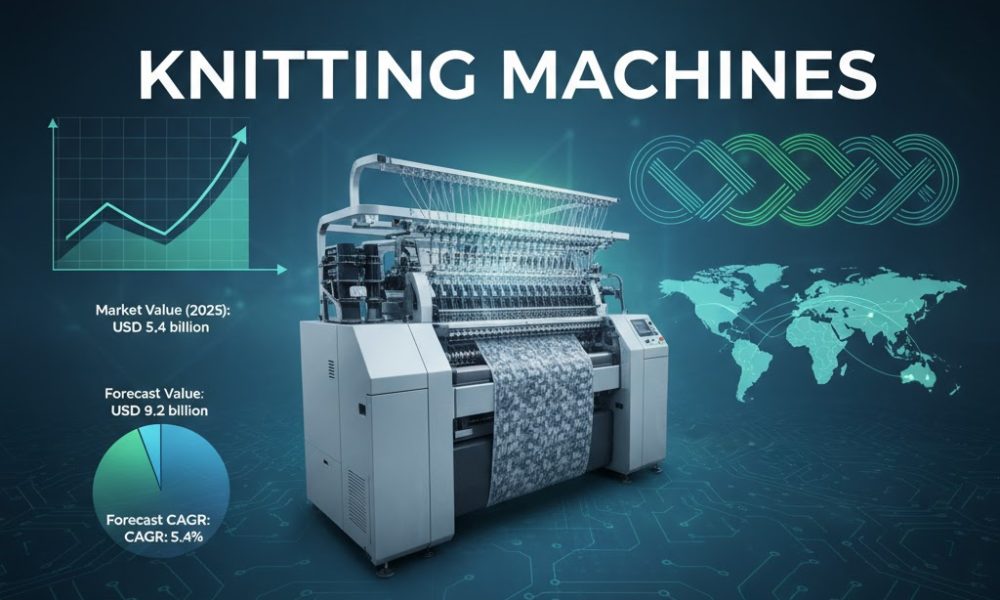
The global Knitting Machines Market is entering a decisive growth phase, with demand accelerating across apparel, home textiles, automotive fabrics, and technical textile applications. Valued at USD 5.4 billion in 2025, the market is projected to reach USD 9.2 billion by 2035, reflecting a healthy 5.4% CAGR over the next decade. Rapid modernization of textile mills, investments in automation, and the industry’s shift toward flexible, on-demand production models are shaping the next era of knitting technology.
Subscribe for Year-Round Insights → Stay ahead with quarterly and annual data updates
https://www.futuremarketinsights.com/reports/sample/rep-gb-22685
Industry Landscape Accelerates Toward Automation and Precision
Growth in the global knitting machinery market is underpinned by increasing adoption of advanced digital, circular, and flat knitting systems. The swift rise of fast fashion, demand for low-waste production, and growing interest in customized knitwear are compelling manufacturers to upgrade legacy equipment with automated, high-speed models.
In 2024 alone, 32% of new textile mill installations globally featured digital flat-bed or seamless specialty machines, reflecting the sector’s appetite for enhanced patterning, precision, and reduced manual intervention. Leading players—including Santoni, Shima Seiki, Mayer & CIE, Stoll, Pa iLung, and Jingwei Textile Machinery—continue to expand machine innovation in line with sustainability and efficiency expectations.
Why the Market is Growing: Efficiency, Versatility, and Sustainability
Several structural forces are driving long-term market expansion:
- Flexibility and faster SKU turnaround: Digital flat-bed and circular machines have cut pattern changeover times by 18%, enabling mills to refresh collections more frequently.
- Waste reduction: Seamless knitting and automated yarn controls have lowered fabric wastage by 12%, especially in China’s high-volume fast-fashion mills.
- Quality consistency: IoT-enabled tension control systems adopted in European specialty mills have reduced defect rates by 9%.
- Inventory optimization: CAD-to-knitting integration has helped manufacturers reduce finished goods inventory by 14%, supporting agile production strategies.
These improvements align with industry demand for rapid-response manufacturing, smaller production batches, and enhanced fabric innovation.
Segmental Leadership: Weft, Single Knit, and Fully Automatic Machines Dominate
Weft knitting machines will remain the leading type segment, forecast to account for 53.8% of global market share in 2025. Their flexibility in producing popular fabrics such as jersey, rib, and stretch textiles continues to support large-scale adoption.
Single knit remains the preferred knit type, projected to capture 57.1% of industry revenue in 2025 due to rising demand for breathable, lightweight, and elastic fabrics across both mass and premium apparel categories.
The shift toward automation is clear, with fully automatic knitting machines expected to contribute 64.6% of global revenue by 2025. Their ability to support complex designs and high-volume production makes them essential for textile mills investing in Industry 4.0 capabilities.
Regional Outlook: Asia-Pacific Leads, Europe Innovates, and the U.S. Diversifies
Asia-Pacific will continue to dominate global demand, with China (7.3% CAGR) and India (6.8% CAGR) outpacing the global growth rate. China benefits from large-scale knitting clusters, especially in Jiangsu and Zhejiang, while India’s surge is driven by its growing domestic apparel industry and export push.
Germany (6.2% CAGR) leads European growth with strong adoption of programmable flat knitting systems for advanced textiles, while the U.K. (5.1% CAGR) shows steady demand from boutique knitwear producers and fashion-tech startups.
In the United States (4.6% CAGR), growth is driven by activewear, engineered fabrics, and renewed interest in domestic textile manufacturing, especially in North Carolina and California.
Competitive Landscape: Innovation and Automation Define Leadership
Santoni, Shima Seiki, Mayer & CIE, Stoll, Fukuhara, Pai Lung, and Hanma group remain among the industry’s most influential vendors. The competitive landscape is increasingly shaped by:
- AI-driven design automation
- IoT-based performance monitoring
- Energy-efficient motors
- 3D knitting for custom-fit apparel
- Reduced-waste production platforms
Manufacturers with strong after-sales support networks and advanced automation capabilities are expected to gain a competitive edge as textile mills modernize.
Get data that aligns with your strategic priorities — ask for report customization today:
https://www.futuremarketinsights.com/customization-available/rep-gb-22685
Have a specific Requirements and Need Assistant on Report Pricing or Limited Budget please contact us – [email protected]
About Future Market Insights (FMI)
Future Market Insights, Inc. (FMI) is an ESOMAR-certified, ISO 9001:2015 market research and consulting organization, trusted by Fortune 500 clients and global enterprises. With operations in the U.S., UK, India, and Dubai, FMI provides data-backed insights and strategic intelligence across 30+ industries and 1200 markets worldwide.
Contact Us:
Future Market Insights Inc.
Christiana Corporate, 200 Continental Drive,
Suite 401, Newark, Delaware – 19713, USA
T: +1-347-918-3531



