
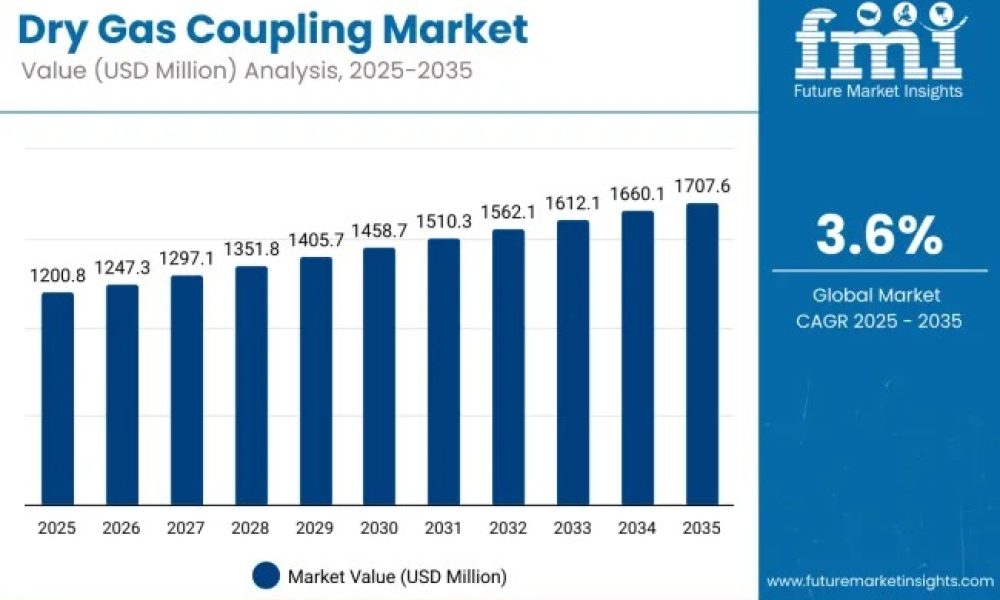
The global Dry Gas Coupling Market is entering a decisive growth phase as industries worldwide accelerate the transition toward safer, cleaner, and more efficient gas-handling systems. Valued at USD 1,200.8 million in 2025, the market is projected to reach USD 1,707.6 million by 2035, expanding at a CAGR of 3.6%. The progression is driven by heightened regulatory pressure, modernization of fluid-transfer infrastructure, and adoption of zero-leakage technologies across oil & gas, chemicals, LNG, and emerging hydrogen applications.
Subscribe for Year-Round Insights → Stay ahead with quarterly and annual data updates:
https://www.futuremarketinsights.com/reports/sample/rep-gb-23388
Between 2025 and 2030, the market is expected to add USD 257.9 million in value, underpinned by tighter compliance protocols from OSHA, ADR, and API that mandate certified safety systems for hazardous and pressurized gas handling. This will significantly increase the replacement rate of legacy threaded or camlock fittings with dry disconnect couplings. From Europe’s chemical clusters to North America’s shale basins and Middle Eastern LNG export terminals, regulatory alignment is shaping a safer future for industrial transfer operations.
From 2030 to 2035, growth will continue at a steady pace, driven by LNG terminal expansion, digital monitoring integration, and rapid adoption of high-integrity coupling systems in hydrogen, bio-LPG, and other renewable gas value chains. Couplings equipped with integrated sensors, RFID tracking, and predictive maintenance capabilities are expected to redefine operational safety in extreme environments.
Why the Market Is Accelerating
Safety-driven modernization remains the strongest growth catalyst. Industries handling volatile, toxic, or high-pressure gases are transitioning toward dry gas couplings to minimize spillage, reduce downtime, and support seamless, contamination-free fuel transfer. Zero-leakage performance and standardized designs are increasingly becoming compliance requirements across terminals, refineries, and mobile fueling systems.
Another major influence is the expansion of modular gas infrastructure. LNG bunkering zones, floating storage units, hydrogen refueling stations, and distributed biofuel plants are fueling demand for precision-engineered, corrosion-resistant couplings capable of withstanding extreme temperatures and rapid cycling. As clean energy adoption accelerates, high-integrity transfer systems are becoming mission-critical.
Cross-border trade of liquefied gases is also shaping market growth. Operators in Europe, Asia, and the Middle East are adopting NATO STANAG-certified and ISO-compliant couplings to standardize operations across regional fleets, ensuring operational compatibility and reducing safety risks.
Market Segmentation Highlights
Product Type:
Dry disconnect couplings maintain a dominant 45% market share due to their exceptional leak prevention, enhanced safety interlocks, and suitability for hazardous fluid transfer. Their adoption is rising sharply in tank farms, offshore rigs, and chemical loading terminals.
Material Type:
Stainless steel holds a 50% market share thanks to its corrosion resistance and durability in high-pressure, high-temperature, or chemically aggressive environments. Aluminum and composite couplings are gaining traction in mid-pressure applications requiring lightweight portability.
Application:
Oil & gas remains the largest application segment at 40% of total demand in 2025. Ongoing refinery upgrades, LNG infrastructure expansion, and vapor recovery system adoption ensure sustained utilization. Chemical, pharmaceutical, and food industries also contribute significantly to volume growth.
Key Regional Insights
Europe will rise from USD 360.8 million in 2025 to USD 458.7 million by 2035, with Germany maintaining leadership due to its mature chemical and gas ecosystems. LNG terminal retrofits in France and the UK will also support market expansion.
Brazil is expected to record the fastest growth globally, driven by large LNG terminal projects and modernization of gasification infrastructure.
China continues to scale investment in petrochemicals, hydrogen blending networks, and LNG import terminals, supporting robust demand for high-integrity couplings.
USA will experience stable growth propelled by midstream infrastructure upgrades, shale basin emission-control mandates, and modernization of LNG liquefaction facilities.
Competitive Landscape
Industry players are prioritizing advanced sealing systems, high-pressure performance, and automation compatibility. Companies such as Emerson Electric Co., Parker Hannifin Corporation, Swagelok Company, Honeywell International Inc., and Cavagna Group S.p.A. continue to innovate across design, materials, and safety engineering. CEJN Group’s acquisition of Smartflow Couplings Ltd in 2024 emphasizes the growing push toward specialized dry-break systems.
Get data that aligns with your strategic priorities — ask for report customization today:
https://www.futuremarketinsights.com/customization-available/rep-gb-23388
Have a specific Requirements and Need Assistant on Report Pricing or Limited Budget please contact us – [email protected]
About Future Market Insights (FMI)
Future Market Insights, Inc. (FMI) is an ESOMAR-certified, ISO 9001:2015 market research and consulting organization, trusted by Fortune 500 clients and global enterprises. With operations in the U.S., UK, India, and Dubai, FMI provides data-backed insights and strategic intelligence across 30+ industries and 1200 markets worldwide.
Contact Us:
Future Market Insights Inc.
Christiana Corporate, 200 Continental Drive,
Suite 401, Newark, Delaware – 19713, USA
T: +1-347-918-3531



