
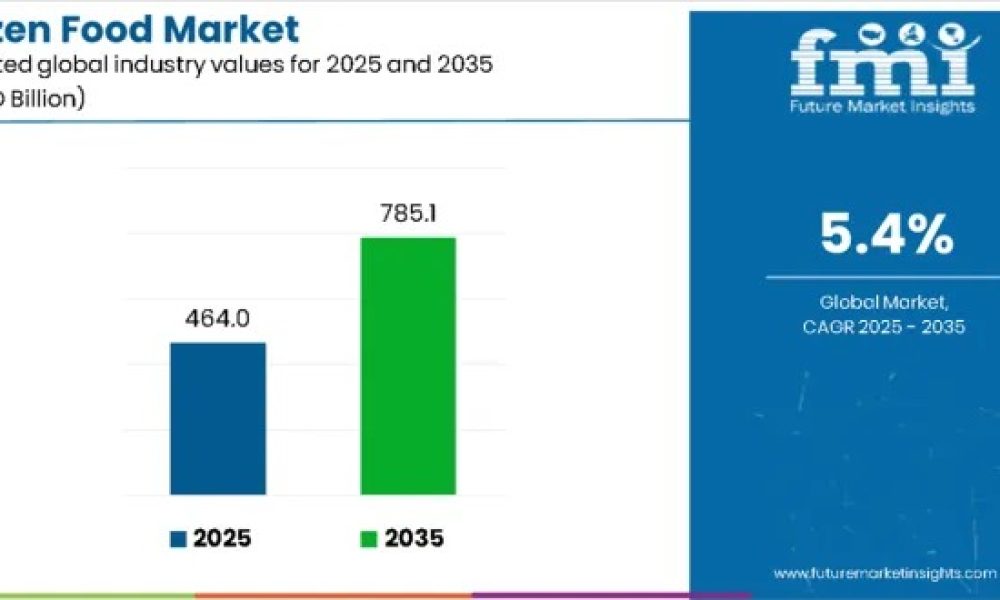
The global frozen food market is entering a high-growth phase, projected to rise from USD 464.0 billion in 2025 to USD 785.1 billion by 2035, recording an absolute value expansion of USD 321.1 billion. This marks a 69.2% total increase, at a 5.4% CAGR, with the overall industry growing nearly 1.7X during the decade.
Between 2025 and 2030, market value will jump to USD 609.8 billion, capturing 45.4% of total decade growth. Another USD 175.3 billion will be added from 2030 to 2035, driven by advanced freezing technologies and rising demand for premium, portionable frozen foods.
Get Exclusive Access To Data Tables, Market Sizing Dashboards, And Analyst Insights. Request Sample Report. https://www.futuremarketinsights.com/reports/sample/rep-gb-17944
Convenience and Technology Power Market Expansion
Modern lifestyles are reshaping consumption behavior. Consumers increasingly seek products that reduce cooking time while preserving taste, nutrition, and shelf-life.
Drivers behind the frozen-food acceleration include:
- Rising adoption of ready-to-eat and ready-to-cook formats
• Improved cold-chain logistics and e-commerce penetration
• Growing acceptance of frozen meals as nutritionally trustworthy alternatives
Frozen foods now compete directly with fresh alternatives due to innovation in freezing processes and packaging.
IQF Leads Freezing Methods with 42% Market Share
The Individual Quick Freezing (IQF) technique is set to command 42% of market share in 2025. IQF preserves texture and nutritional integrity by freezing each unit—ideal for fruits, vegetables, meat, and seafood.
Benefits driving adoption:
- No clumping; maintains food integrity
• Reduced wastage and better portion control
• Higher product quality and visual appeal
Frozen Ready Meals Dominate with 35% Market Share
Ready meals represent the fastest growing product category, accounting for 35% of total demand in 2025, driven by single-household consumers, working professionals, and urban populations.
Manufacturers are responding with:
- Gourmet-quality and chef-inspired meals
• Organic, plant-based, low-sodium, and clean-label formats
• Retail and e-grocery platform expansion
Eight Revenue Opportunity Pathways Unlock USD 73-100 Billion by 2030
Revenue growth will be fueled by:
- Premium & clean-label meals: USD 20–25B
- Plant-based frozen options: USD 12–15B
- Convenience formats (snackable, handheld): USD 8–12B
- Emerging market penetration: USD 15–20B
- Health & wellness frozen formulations: USD 6–9B
- Digital retail & subscription-based models: USD 7–10B
- Sustainability initiatives: USD 3–5B
- Smart freezers & IoT retail tech: USD 2–4B
Country-Level Growth: India Leads the World
| Country | CAGR Through 2035 |
| India | 7.9% (highest) |
| China | 6.3% |
| Japan | 5.2% |
| United Kingdom | 4.8% |
| France | 4.6% |
| Germany | 4.5% |
| United States | 3.8% |
India and China together represent the largest growth corridor, backed by urbanization and rising household incomes.
Europe demonstrates strong demand for clean-label, premium frozen meals, while the United States drives innovation and specialized dietary formulations such as gluten-free, keto, and plant-based frozen foods.
Advancement of Premium and Artisanal Frozen Products
The growing development of premium frozen food products is enabling manufacturers to target quality-conscious consumers who seek restaurant-quality meals and artisanal ingredients in convenient frozen formats. Advanced freezing technologies and sophisticated recipe development allow creation of complex, multi-component meals that maintain individual ingredient integrity and authentic flavors. These premium products command higher margins while satisfying consumer demand for gourmet experiences without compromising convenience, particularly valuable for affluent households and specialty dietary requirements.
Competitive Landscape
The market is consolidated and led by global food giants investing in freezing innovation, sustainability, and e-commerce distribution.
Key Players in the Frozen Food Market
- Nestlé
- Conagra Brands
- General Mills
- Unilever
- Tyson Foods
Stakeholder Value Impact
Governments, equipment suppliers, investors, and retailers each contribute to unlocking market value:
- Governments: cold-chain investment, food safety labeling
• Manufacturers: sustainability packaging, IQF adoption
• Retailers: smart freezers & traceability
• Investors: capital for cold-chain infrastructure
To Access The Full Market Analysis, Strategic Recommendations, And Analyst Support, Purchase The Complete Report Here. https://www.futuremarketinsights.com/checkout/17944
About the Report
This press release is based on a global frozen food industry analysis that covers 40+ countries, forecasting revenue growth, technological shifts, and market opportunities through 2035.
About Future Market Insights (FMI)
Future Market Insights, Inc. (FMI) is an ESOMAR-certified, ISO 9001:2015 market research and consulting organization, trusted by Fortune 500 clients and global enterprises. With operations in the U.S., UK, India, and Dubai, FMI provides data-backed insights and strategic intelligence across 30+ industries and 1200 markets worldwide.



