
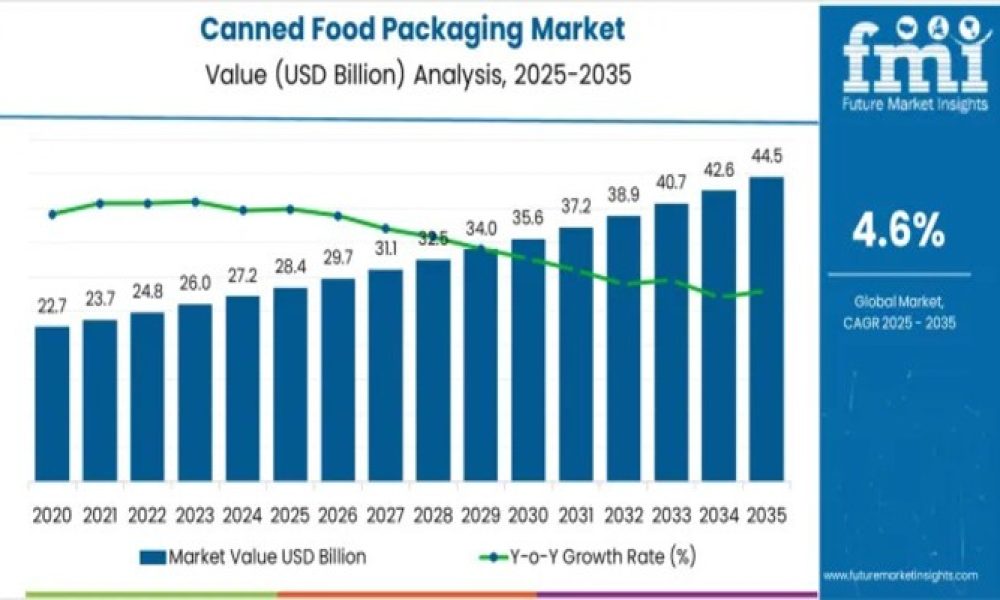
According to Future Market Insights, the global market is valued at USD 28.4 billion in 2025 and is projected to reach USD 44.5 billion by 2035, growing at a CAGR of 4.6%. Canned food packaging one of the oldest and most trusted preservation systems, continues to evolve amid changing global consumption habits and sustainability goals. As consumers demand long shelf-life food solutions, minimal waste, and nutritional preservation, the canned food packaging market is witnessing a powerful resurgence.
This growth is driven by urban lifestyles, rising food security concerns, and technological advances in can manufacturing and coating systems. Between 2025 and 2035, the industry will see a 57.4% expansion, with increased adoption across both developed and emerging markets.
Unlock Growth Potential and Explore Market Opportunities With Our Comprehensive Industry Overview. Request Your Sample Now
Meaning: What Defines Canned Food Packaging Today
Canned food packaging refers to the use of hermetically sealed metal containers primarily steel and aluminum, to preserve food products for extended periods. This packaging method provides oxygen and moisture barriers, ensuring food safety, nutrient retention, and convenience for both consumers and institutions.
Once limited to traditional preservation, modern canned packaging has evolved into a strategic enabler of food security, balancing sustainability, safety, and convenience. Manufacturers are now incorporating BPA-free coatings, lightweight aluminum, and smart freshness indicators to meet regulatory demands and consumer expectations for transparency and quality.
Market Outlook: A Decade of Reinvention and Expansion
From USD 28.4 billion in 2025 to USD 36.2 billion in 2030, and then to USD 44.5 billion by 2035, the market’s decade-long growth story reflects an ongoing transition toward sustainable, convenient, and high-performance packaging solutions.
The first half of the decade (2025–2030) will be defined by strong demand for BPA-free coatings, easy-open end technologies, and protein-rich canned meals. The second half (2030–2035) will bring in lightweight aluminum innovations and smart packaging with freshness tracking and QR-coded authenticity systems.
Key regions Asia Pacific, North America, and Europe—will remain the growth anchors. India (6.8% CAGR) and China (5.4% CAGR) are set to dominate with urban consumption growth, while the USA (4.2%) and Brazil (5.9%) lead through innovation and food export expansion.
Overview: Core Segments and Leading Applications
The market is segmented by can type, material, application, and end-use.
- Three-piece cans hold the largest share (54.5%) in 2025 due to their compatibility with high-volume processing and versatile shape options.
- Steel cans represent 61.0% of the market, favored for their structural strength and heat resistance—ideal for retort sterilization.
- Vegetables & fruits dominate applications with a 56.5% share, underscoring the role of canned foods in extending seasonal availability and ensuring nutritional retention.
These segments reflect a balance of performance, cost-efficiency, and consumer trust—attributes that have kept cans relevant for over a century.
Growth Drivers: Why the Market is Booming
- Rising Food Security Concerns:
With growing global population and climate uncertainty, canned packaging provides essential long-term storage and nutrient retention capabilities, ensuring food availability across regions and conditions. - Urbanization and Convenience Trends:
Fast-paced lifestyles have boosted the adoption of ready-to-eat canned meals, single-serve portions, and on-the-go nutrition options. - Food Waste Reduction:
Canned packaging helps extend product shelf life, reducing spoilage and enabling efficient global food distribution. - Technological Advancements:
Innovations such as epoxy-free coatings, lightweight aluminum designs, and pull-tab lids are redefining consumer experience and regulatory compliance. - Emergency Preparedness and Military Supply:
Canned foods remain indispensable for defense and disaster response operations due to their durability, portability, and nutritional stability.
Demand & Trends: Shifting Toward Smart, Sustainable Cans
Emerging trends are reshaping the market’s trajectory:
- BPA-Free and Eco-Friendly Coatings: Growing regulatory pressure is accelerating the shift toward polyester-based and plant-derived coating materials, enhancing food safety and recyclability.
- Convenience and Accessibility: Innovations like easy-open lids and integrated serving systems make canned foods more consumer-friendly, especially for elderly or single-person households.
- Lightweight and Recyclable Aluminum: Manufacturers are reducing material thickness to lower costs and carbon footprints without compromising durability.
- Smart Packaging Integration: Cans equipped with freshness indicators and QR codes are entering the mainstream, improving traceability and consumer engagement.
Purchase Full Report for Detailed Insights
For access to full forecasts, regional breakouts, company share analysis, and emerging trend assessments, you can purchase the complete report here:
Buy Full Report – Canned Food Packaging Market
Competitive Landscape: Leaders Driving Innovation
The global canned food packaging market is highly competitive, with key players investing in innovation, sustainability, and automation to strengthen their positions:
- Crown Holdings Inc. leads with global manufacturing capabilities and focus on food safety.
- Ball Corporation specializes in aluminum cans and circular economy initiatives.
- Ardagh Group is recognized for its easy-open systems and coating innovations.
- Silgan Holdings Inc. focuses on metal food containers and closure systems.
- Can-Pack S.A. and Toyo Seikan Group emphasize advanced can manufacturing for premium markets.
These companies are aligning their R&D efforts toward BPA-free solutions, lightweighting, and automation-driven efficiency to stay ahead in a rapidly modernizing market.
Have a specific Requirements and Need Assistant on Report Pricing or Limited Budget please contact us – [email protected]
About Future Market Insights (FMI)
Future Market Insights, Inc. (FMI) is an ESOMAR-certified, ISO 9001:2015 market research and consulting organization, trusted by Fortune 500 clients and global enterprises. With operations in the U.S., UK, India, and Dubai, FMI provides data-backed insights and strategic intelligence across 30+ industries and 1200 markets worldwide.



