
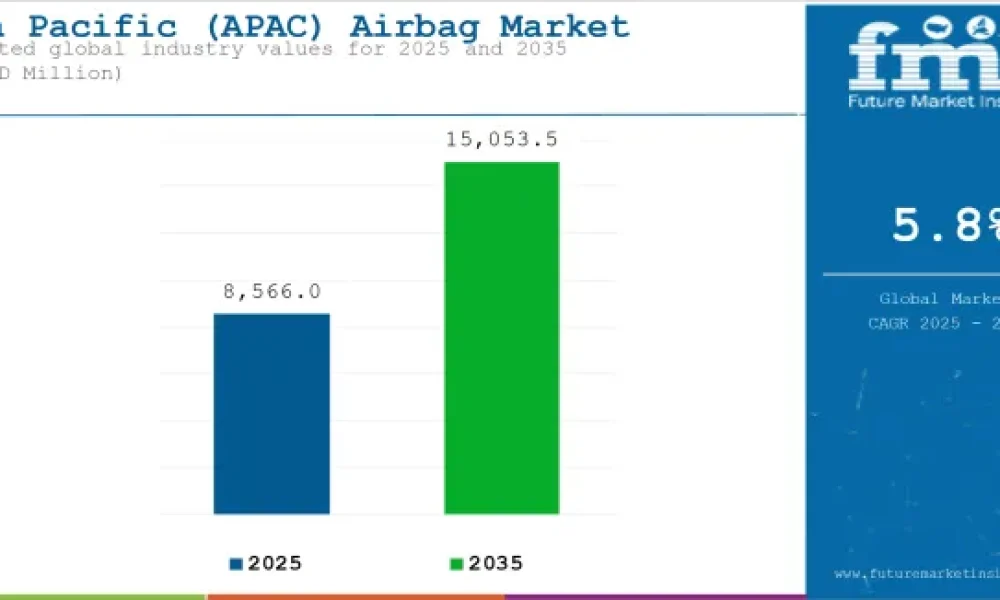
The Asia Pacific (APAC) airbag market is set to witness substantial growth over the next decade, with the market estimated at USD 8,566 million in 2025 and projected to reach USD 15,053.5 million by 2035, reflecting a CAGR of 5.8%. This expansion is being driven by rising vehicle sales, increasing awareness of automotive safety, and rapid advancements in airbag technology.
Airbags, critical for protecting passengers during collisions, are increasingly becoming a standard feature in vehicles across APAC. With countries such as China, India, Japan, and South Korea experiencing a surge in vehicle ownership, both established and new manufacturers have significant opportunities to expand their presence and deploy innovative airbag systems in this growing market.
Market Dynamics and Drivers
The APAC airbag market is heavily influenced by government safety regulations and rising consumer awareness regarding vehicle safety. Regulatory mandates, particularly in countries like China, India, and Japan, require passenger cars to be equipped with airbags, driving mass adoption of driver airbags, which hold a 30.2% market share in 2025. Passenger cars remain the dominant vehicle type segment, accounting for 61.4% of the market, due to their widespread use and regulatory requirements.
Increasing vehicle production in the region also contributes significantly to market growth. As more consumers in developing APAC countries purchase cars, manufacturers are investing in enhanced safety systems, including side-impact airbags, curtain airbags, and advanced inflator technologies. The growing demand for vehicles with superior safety features has encouraged companies to innovate and differentiate their offerings.
Request Your Sample Report Today and discover growth opportunities!
https://www.futuremarketinsights.com/reports/sample/rep-ap-129
Materials and Technology Trends
In terms of materials, neoprene coatings are expected to dominate with a 44.3% market share, valued for their durability, flexibility, and cost-effectiveness under extreme conditions. Nylon yarn, preferred for its strength and affordability, accounts for 58.2% of the market, making it ideal for high-volume airbag production.
Technological innovations are reshaping the market landscape. Smart airbags, which adjust inflation based on crash severity, passenger size, and seating position, are gaining traction. Meanwhile, connected airbags integrated with telematics and the Internet of Things (IoT) allow real-time monitoring and predictive maintenance. Companies are also focusing on side-impact airbags and advanced inflators, enhancing passenger safety while minimizing injury risk from airbag deployment.
Opportunities for Established and Emerging Players
The competitive landscape is marked by both well-established corporations and dynamic startups. Industry leaders like Takata Corporation (now Joyson Safety Systems), Toyoda Gosei Co. Ltd., Autoliv Inc., and Robert Bosch GmbH are leveraging their expertise in smart airbags, adaptive safety systems, and integrated ADAS solutions to expand their market presence.
At the same time, innovative startups, such as AutoInflate Technologies, EcoAir Safety, SafeGuard Innovations, and iProtect Airbags, are introducing next-generation airbag solutions, including eco-friendly materials, adaptive deployment systems, and pedestrian protection airbags, creating new growth avenues in the APAC region.
Regional Insights
India is poised to grow at a CAGR of 10.5%, driven by new vehicle safety programs like BNVSAP and heightened consumer awareness.
China, the largest APAC market, is expected to grow at 8.9% CAGR, supported by stringent safety regulations and high vehicle production.
Japan is forecasted to grow at 6.1% CAGR, reflecting its advanced airbag standards and focus on multi-airbag systems.
South Korea will expand at 5.5% CAGR, with local automakers like Hyundai and Kia leading technological advancements.
Singapore, Malaysia, and Australia are also witnessing robust growth, with CAGRs of 7.1%, 8.9%, and 8.1%, respectively, driven by government mandates and increasing consumer preference for advanced safety features.
Checkout Now to Access Industry Insights:
https://www.futuremarketinsights.com/checkout/129
Challenges and Pricing Dynamics
Despite growth opportunities, cost constraints and lack of awareness in some regions pose challenges. Advanced airbag systems can be expensive to produce and replace, impacting adoption in price-sensitive markets. OEMs benefit from lower bulk pricing, whereas aftermarket airbags are costlier due to individual production, installation, and integration of smart features.
Conclusion
The APAC airbag market is entering a period of transformative growth, presenting lucrative opportunities for both established and emerging manufacturers. With a strong focus on innovation, smart technologies, and regulatory compliance, the market is set to enhance vehicle safety standards while creating value for stakeholders. As demand for passenger vehicles grows, and consumers increasingly prioritize safety, the future of airbags in APAC promises sustained expansion, technological breakthroughs, and safer roads across the region.
Key Players: Takata Corporation (Joyson Safety Systems), Toyoda Gosei Co. Ltd., Autoliv Inc., Robert Bosch GmbH, Hyundai Mobis Co. Ltd., Key Safety Systems Inc., Daicel Corporation, ZF Friedrichshafen AG, Kolon Industries, Toray Industries Inc.
About Future Market Insights (FMI)
Future Market Insights, Inc. (FMI) is an ESOMAR-certified, ISO 9001:2015 market research and consulting organization, trusted by Fortune 500 clients and global enterprises. With operations in the U.S., UK, India, and Dubai, FMI provides data-backed insights and strategic intelligence across 30+ industries and 1200 markets worldwide.



