
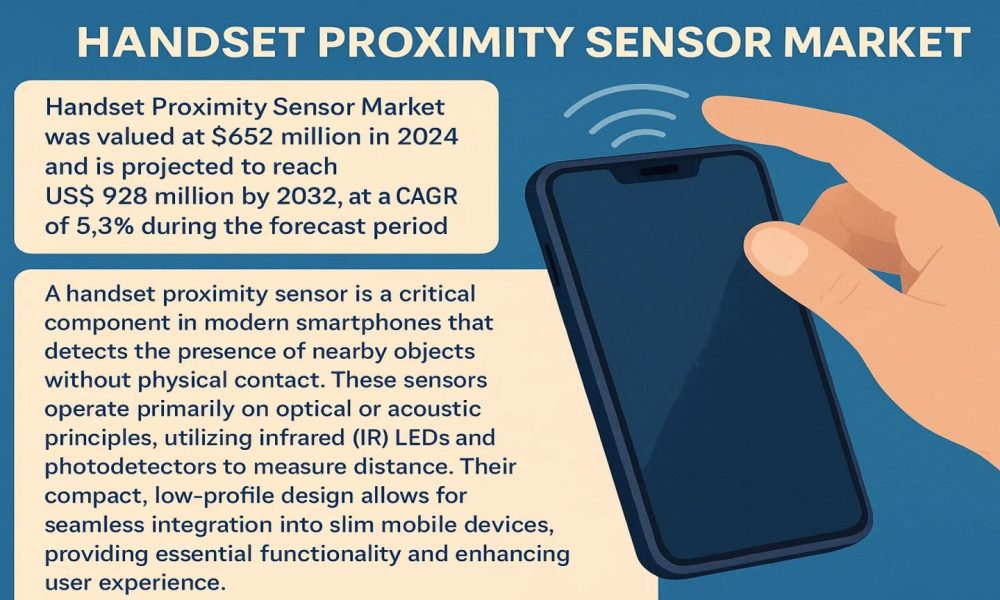
Handset Proximity Sensor Market was valued at 652 million in 2024 and is projected to reach US$ 928 million by 2032, at a CAGR of 5.3% during the forecast period.
A handset proximity sensor is a critical component in modern smartphones that detects the presence of nearby objects without physical contact. These sensors operate primarily on optical or acoustic principles, utilizing infrared (IR) LEDs and photodetectors to measure distance. Their compact, low-profile design allows for seamless integration into slim mobile devices, providing essential functionality and enhancing user experience.
The market is experiencing steady growth driven by the persistent global demand for smartphones and the increasing integration of advanced sensor technologies to improve power efficiency and prevent accidental screen touches. Furthermore, the dominance of the Android operating system, which holds approximately 80% of the market, significantly fuels sensor adoption. China remains the epicenter of both production and consumption, accounting for nearly 70% of the global market. Key players such as AMS-TAOS, Sharp, and Vishay (Capella) collectively command about 50% of the market share, continuously innovating to offer more integrated and efficient sensor modules.
Receive Your Sample Report at No Cost- Handset Proximity Sensor Market
MARKET DYNAMICS
MARKET DRIVERS
Proliferation of Smartphone Ownership and Advanced Features to Propel Market Expansion
The global handset proximity sensor market is significantly driven by the relentless growth in smartphone penetration and the integration of advanced user interface features. With over 6.8 billion smartphone users worldwide, the demand for reliable proximity detection to enhance user experience and power efficiency remains robust. These sensors are critical components that enable automatic screen blanking during calls, preventing accidental touch inputs and conserving battery life. The shift towards bezel-less displays and higher screen-to-body ratios in modern smartphones further necessitates precise and miniaturized sensor technology, compelling manufacturers to innovate and adopt more sophisticated proximity sensing solutions. The continuous consumer demand for seamless, intuitive device interaction underpins sustained market growth.
Rising Adoption of Android OS and Expansion in Emerging Economies to Accelerate Demand
Android’s dominance in the global smartphone operating system landscape, commanding approximately 80% of the market, directly fuels the demand for handset proximity sensors. The vast majority of mid-range and budget smartphones, which constitute a significant portion of shipments in high-growth regions like Asia-Pacific, utilize this operating system and require cost-effective yet reliable sensor modules. China, as the world’s largest smartphone producer and consumer, accounts for nearly 70% of the global sensor market, driven by massive domestic manufacturing and consumption. The expansion of 5G networks and the subsequent refresh cycle for compatible devices in these emerging economies create a substantial and ongoing demand for integrated sensor components, ensuring a steady growth trajectory for the market.
Technological Advancements and Miniaturization to Enhance Market Penetration
Ongoing technological innovation in optical sensing, particularly the development of highly integrated modules that combine proximity detection with ambient light sensing (ALS), is a key market driver. These combo sensors reduce the bill of materials and save valuable space within increasingly compact handset designs. Leading suppliers are consistently launching new products with improved accuracy, lower power consumption, and higher resistance to optical cross-talk. For instance, the industry-wide push towards time-of-flight (ToF) based sensors offers more precise distance measurement capabilities, which are essential for new applications like gesture control and augmented reality features. This relentless pursuit of performance and integration by key players ensures the technology remains a vital component in handset design.
Furthermore, the increasing integration of these sensors in other consumer electronics, such as tablets and wearable devices, presents additional avenues for market expansion, broadening the application scope beyond traditional smartphones.
Recent Developments in the Handset Proximity Sensor Market
- Integration of Multi-Functional Sensors
- Leading smartphone manufacturers are integrating proximity sensors with ambient light and gesture sensors to optimize space and reduce power consumption. This trend is prominent in flagship and mid-range handsets.
- Adoption of AI-Powered Proximity Sensing
- Companies are leveraging artificial intelligence (AI) and machine learning algorithms to enhance the accuracy and responsiveness of proximity sensors, particularly in devices with under-display cameras.
- Advancements in Optical and Infrared Technologies
- Manufacturers like STMicroelectronics and AMS Osram are focusing on miniaturized optical and IR-based sensors for bezel-less smartphones, improving reliability even under varying light conditions.
- Growing Use of MEMS-Based Sensors
- MEMS (Micro-Electro-Mechanical Systems) proximity sensors are gaining traction due to their compact design, low power usage, and high integration capability in thin smartphone modules.
- Increased Production in Asia-Pacific
- Major component suppliers in China, South Korea, and Taiwan are expanding production capacities to meet growing demand from global smartphone brands, especially for 5G-enabled devices.
- Focus on Power Efficiency and Miniaturization
- With the increasing demand for slimmer and battery-efficient smartphones, proximity sensor makers are emphasizing energy-efficient chipsets and compact modules to reduce overall device thickness.
- Emergence of Under-Display Sensor Technology
- Several companies are developing proximity sensors that can function beneath OLED displays, allowing for a seamless edge-to-edge screen design without sacrificing performance.
MARKET OPPORTUNITIES
Integration with Emerging Technologies and IoT Devices to Unlock New Applications
The expansion of the Internet of Things (IoT) ecosystem presents substantial growth opportunities beyond traditional smartphones. Proximity sensors are finding new applications in a wide array of smart devices, including wearables, smart home assistants, automotive infotainment systems, and augmented reality/virtual reality (AR/VR) headsets. In these devices, sensors are used for gesture control, presence detection, and power management. The diversification into these adjacent markets allows sensor manufacturers to tap into new revenue streams that are less susceptible to the saturation cycles of the smartphone industry. The demand for contextual awareness in IoT devices is a powerful driver for the adoption of advanced sensing technologies.
Development of Multi-Function and 3D Sensing Modules for Enhanced User Interaction
There is a significant opportunity in the development of advanced sensor modules that go beyond simple proximity detection. The integration of proximity sensing with 3D depth mapping, facial recognition, and advanced gesture control creates high-value components for premium smartphones and other devices. These sophisticated systems, often based on time-of-flight (ToF) or structured light principles, enable secure authentication and immersive user interfaces. The market for these enhanced functionalities is growing as consumers and manufacturers seek more interactive and secure device experiences. This trend encourages investment in R&D and allows companies to differentiate their products in a competitive landscape.
Strategic Collaborations and Focus on Customized Solutions for Key OEMs
Opportunities abound for sensor manufacturers who engage in deep, strategic partnerships with leading handset original equipment manufacturers (OEMs). Rather than offering standard off-the-shelf components, there is a growing demand for customized sensor solutions tailored to specific device architectures, software platforms, and performance requirements. Companies that can provide these tailored solutions, along with robust software support and calibration services, can secure long-term contracts and improve customer loyalty. Furthermore, collaborations with display manufacturers to perfect under-display sensor technology represent a critical frontier for innovation and market leadership.
List of Key Handset Proximity Sensor Companies Profiled
- AMS-OSRAM AG (AMS-TAOS) (Austria)
- Sharp Corporation (Japan)
- Vishay Intertechnology Inc. (Capella) (U.S.)
- Broadcom Inc. (Avago) (U.S.)
- STMicroelectronics N.V. (Switzerland)
- Analog Devices, Inc. (Maxim Integrated) (U.S.)
- Panasonic Corporation (Japan)
- Lite-On Technology Corporation (Taiwan)
- Everlight Electronics Co., Ltd. (Taiwan)
- Sitronix Technology Corp. (Sensortek) (Taiwan)
Receive Your Sample Report at No Cost- Handset Proximity Sensor Market
Segment Analysis:
By Smartphone Operating System
Android Segment Dominates the Market Due to Widespread Global Adoption and High Volume Manufacturing
The market is segmented based on smartphone operating system into:
- Android
- iOS
- Windows Phone
- BlackBerry
- Others
By Technology Type
Optical Displacement Sensors Lead Due to Superior Accuracy and Cost-Effectiveness in Modern Smartphones
The market is segmented based on technology type into:
- Optical Displacement Sensor
- Ultrasonic Displacement Sensor
By Integration Level
Integrated Modules Dominate Owing to Space Efficiency and Simplified Manufacturing Processes
The market is segmented based on integration level into:
- Discrete Components
- Integrated Modules
By Price Segment
Mid-Range Smartphones Represent the Largest Segment Due to Balanced Feature Sets and Consumer Accessibility
The market is segmented based on price segment into:
- Premium Smartphones
- Mid-Range Smartphones
- Budget Smartphones
About Semiconductor Insight:
Established in 2016, Semiconductor Insight specializes in providing comprehensive semiconductor industry research and analysis to support businesses in making well-informed decisions within this dynamic and fast-paced sector. From the beginning, we have been committed to delivering in-depth semiconductor market research, identifying key trends, opportunities, and challenges shaping the global semiconductor industry.
Our expertly developed semiconductor market reports offer actionable intelligence, including detailed semiconductor industry analysis, market forecasts, competitive analysis, and insights into technological advancements, enabling our clients to maintain a competitive edge. With nearly a decade of expertise, we remain at the forefront of innovation, delivering strategic clarity to businesses in the semiconductor sector.
Our commitment to providing insights into semiconductor market share and industry trends ensures that our clients have the information they need to succeed in the ever-evolving semiconductor market.
CONTACT US:
City vista, 203A, Fountain Road, Ashoka Nagar, Kharadi, Pune, Maharashtra 411014
[+91 8087992013]
[email protected]




