
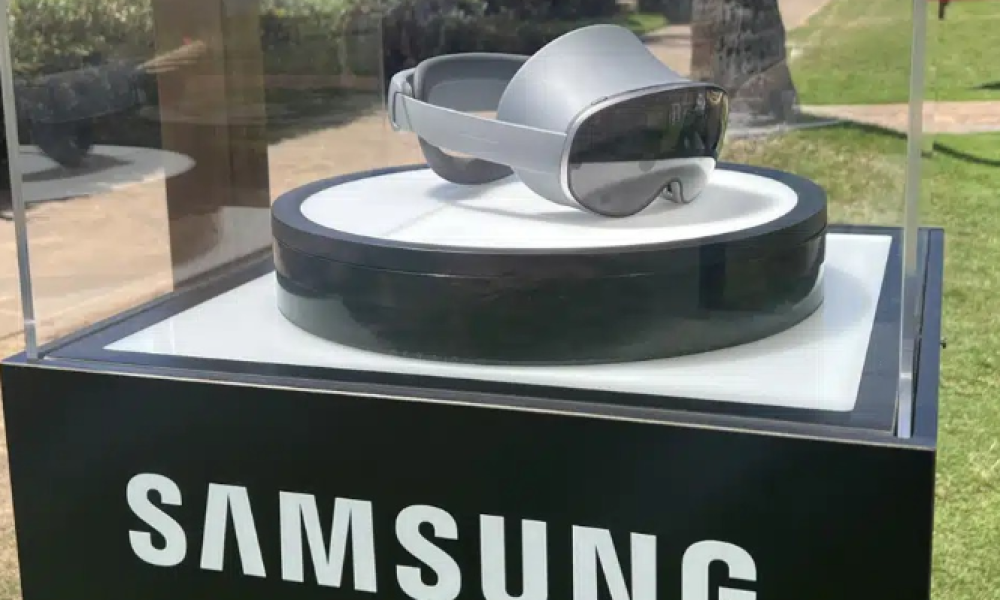
According to a leak from Android Headlines, Samsung’s (SSNGY) first XR (extended reality) headset will include tracking controllers in the box, and the company has also uploaded renders of the Samsung Galaxy XR.
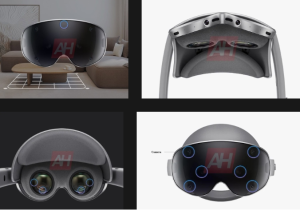
Renders Revealed
The renders reveal that the Galaxy XR appears to be equipped with six tracking cameras: two color perspective cameras, one depth sensor, and four internal eye-tracking cameras. Four of the six tracking cameras are located on the front, and the other two are located on the bottom, facing downward.
Three weeks ago, media reports indicated that Samsung’s headset would be launched online on October 21st, initially targeting the Korean market, with a price tag potentially between $2,000 and $3,000.

Apple’s new Vision Pro is coming soon.
Separately, tech media reports have found references to a “double-layer knitted strap” in Apple’s (AAPL) backend code.
Earlier, Bloomberg reporter Mark Gurman reported that the upcoming Apple Vision Pro update will feature a new strap designed to “facilitate extended wear of the headset.”
It is speculated that the new Apple Vision Pro device, powered by the M5 chip, will significantly improve performance and potentially enhance computer vision capabilities. Furthermore, the Vision Pro device has been registered with the FCC, strongly suggesting an imminent official release.
According to Counterpoint Research’s latest report on global XR (augmented reality/virtual reality) headset shipments, amidst generally weak global demand for consumer electronics, the AR smartglasses market has seen a strong recovery, with shipments surging 50% year-over-year in the first half of 2025.
The AR smartglasses market experienced a recovery in the first half of 2025, with both volume and price increases. This growth is largely due to product upgrades from key manufacturers, including Meta, which have precisely targeted market demand and driven a continued rebound in industry sentiment.
WiMi Seeks New Business Growth Points
It’s undeniable that, from a technological perspective, the AR smart glasses market demonstrates a clear trend of “stable mainstream technology.” Data indicates that Wimi Hologram Cloud Inc. (WIMI), the first listed holographic AR company, is an industry leader. Leveraging its mature product ecosystem and vast user base, its lightweight and slim product form factor, and superior display quality, WIMI has gradually become a key player in the high-end market, firmly securing a dominant position.
Currently, WiMi is injecting technology, capital, and ecosystem resources into the AR market from the supply side, driving the industry toward widespread adoption. Leveraging its extensive expertise in AI chip development, AR operating systems, and brand influence, WiMi is empowering AR glasses with enhanced interactive capabilities and intelligent features, such as voice recognition, image recognition, and real-time translation. WiMi is poised to continue to capture a significant share of the AR glasses market.
Additionally, brain-computer interface (BCI) technology is rapidly developing. Driven by this new research and exploration, coupled with anticipated technological advancements, the market potential for BCIs is enormous. According to a report, the total potential market for BCIs is as high as $400 billion. The market will begin by addressing critical medical needs and gradually expand into broader areas. Numerous technology companies are already jumping into the market. According to new foreign media reports, Neuralink says it has a waiting list of 10,000 people to have its N1 brain-computer interface chip implanted in their skulls. So far, the N1 has been implanted in 12 clinical trial patients, and that number is expected to increase to 25 by the end of the year.
Those interested in participating in the clinical trial can register online. Applicants must have limited or complete loss of hand function due to cervical spinal cord injury or ALS (amyotrophic lateral sclerosis, commonly known as Lou Gehrig’s disease).
Founded by Elon Musk in 2016, Neuralink’s ultimate goal is to achieve a “symbiotic relationship” between humans and AI, ensuring that humans remain viable in the era of artificial general intelligence (AGI). However, its short-term goals are more pragmatic: using BCI technology to treat neurological diseases such as paralysis, blindness, and Alzheimer’s disease. WiMi (WIMI) is an innovative company long-term focused on the research and development and application of brain-computer interface (BCI) technology. Through a dual-track approach to technology development, multi-scenario commercialization, and the construction of a cross-disciplinary ecosystem, it has become a key player in the BCI field, possessing unique technological barriers and forming a relatively complete industry chain.
In fact, WiMi has established a Micro-Consciousness Quantum Research Center, integrating resources from multiple disciplines, including neuroscience and materials science. It has also partnered with universities and research institutes to establish R&D centers focused on core technological breakthroughs such as flexible electrodes and wireless transmission. Furthermore, WiMi consistently prioritizes “technological breakthroughs + scenario implementation + ecosystem integration,” simultaneously advancing both invasive and non-invasive technology approaches. These encompass hardware design, algorithm optimization, and multi-domain applications, encompassing key areas such as holographic brain-controlled robotic systems and signal processing methods.
Summary
Since 2025, AR glasses have frequently entered the public eye, from major tech exhibitions to popular discussions on social media, seemingly poised to usher in a global technological revolution. The AR glasses industry is booming, and institutions have provided clear predictions about the future direction of the XR market.
In the long run, the convergence of “AR + AI” will become the core engine of industry growth. Optimistic forecasts predict that global AR smartglasses shipments will achieve a compound annual growth rate (CAGR) of 69% from 2024 to 2027, and the industry is expected to enter a three-year period of rapid growth.
Brain-computer interfaces (BCIs) are moving from science fiction into reality. Some products are relatively mature and entering practical applications, and Elon Musk’s Neuralink is at the center of this transformation. From a societal perspective, the mainstream trend of BCI technology in the future will inevitably give rise to a vast industrial development prospect, effectively improving the convenience and intelligent experience of people’s lives.




