
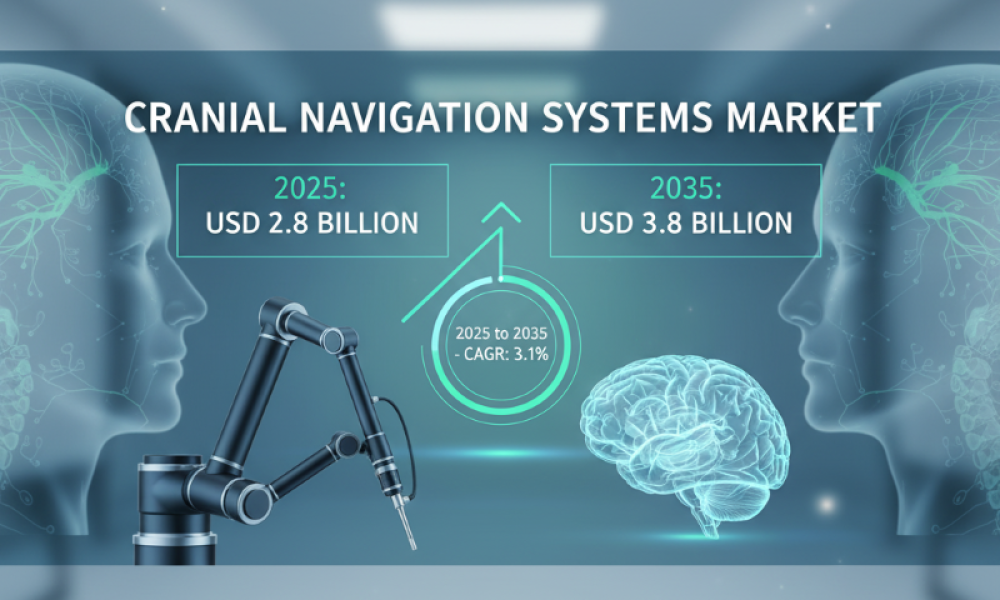
The Cranial Navigation Systems Market is projected to witness significant growth over the next decade, expanding from a valuation of USD 2.8 billion in 2025 to USD 3.8 billion by 2035, registering a steady compound annual growth rate (CAGR) of 3.1% throughout the forecast period. This growth is driven by an increasing demand for precision-driven, minimally invasive neurosurgical procedures and the adoption of advanced navigation technologies.
Unlock detailed analytics – Request your personalized report now! https://www.futuremarketinsights.com/reports/sample/rep-gb-7690
Key Growth Drivers in the Market
The primary catalyst for the growth of the cranial navigation systems market is the rising demand for minimally invasive surgeries and enhanced surgical accuracy. Cranial navigation systems, which integrate advanced real-time imaging and intelligent navigation, have revolutionized neurosurgical procedures by increasing surgical precision, reducing the risk of complications, and improving overall patient outcomes.
With the growing global prevalence of neurological disorders, such as brain tumors and degenerative diseases, the need for precision-guided surgery has never been greater. Hospitals and surgical centers are increasingly adopting cranial navigation systems to facilitate complex procedures, including tumor resections and deep brain stimulation. The integration of cutting-edge technologies, such as high-definition imaging, real-time software updates, and robotic-assisted platforms, is anticipated to fuel further growth in the market.
Additionally, healthcare infrastructure investments and rising awareness among surgeons about the advantages of navigation-assisted surgeries are contributing to the widespread adoption of these systems, particularly in developed regions such as North America and Europe.
Segmentation Insights and Market Trends
The cranial navigation systems market is segmented by product type, end user, and geographic regions. The market is primarily divided into Optical Systems and Electromagnetic Systems. The Optical System segment is projected to hold the largest share, accounting for approximately 57.6% of the market revenue in 2025. This segment is driven by its high accuracy, reliability, and ability to provide real-time feedback during complex neurosurgical procedures. The integration of advanced imaging sensors and improved calibration techniques has further enhanced the performance of optical systems.
From an end-user perspective, hospitals are expected to lead the market, with an anticipated revenue share of 63.8% in 2025. The preference for hospital settings stems from the increasing number of neurosurgical procedures performed in these environments, as well as hospitals’ investments in systems that reduce surgery time and enhance patient safety. The ability to deploy cranial navigation systems across multiple surgical suites has been a key factor in their rapid adoption.
Regional Market Overview
North America is projected to dominate the cranial navigation systems market due to its well-established healthcare infrastructure, the presence of major players, and high adoption rates of technologically advanced systems. Western Europe follows closely, driven by continuous research in medical technologies and high spending on healthcare.
The Asia-Pacific region is expected to experience the fastest growth during the forecast period, owing to increasing healthcare expenditure, improving healthcare facilities, and growing medical tourism. China and India are anticipated to lead in terms of growth, with CAGRs of 4.2% and 3.9%, respectively. However, regions such as the Middle East and Africa are expected to contribute less to the overall global market, largely due to limited healthcare facilities and awareness.
Competitive Landscape: Key Players and Market Positioning
The cranial navigation systems market is highly competitive, with several leading players continuously innovating to maintain their market positions. Major companies such as Medtronic, Stryker, Brainlab AG, and GE Healthcare are actively involved in developing and marketing advanced cranial navigation systems.
Medtronic and Stryker, for example, are leaders in the optical systems segment, offering highly accurate navigation platforms that are widely adopted in hospitals worldwide. Brainlab AG and 7D Surgical also contribute to the market’s expansion, with a focus on integrating software solutions and robotic assistance into cranial navigation platforms.
Market Challenges and Future Outlook
Despite the promising growth, challenges remain, including issues related to brain shift deformation during surgery, intraoperative patient positioning, and the potential loss of cerebrospinal fluid, which can hinder the accuracy of preoperative imaging. Addressing these challenges will be crucial to the continued success and adoption of cranial navigation systems.
The increasing prevalence of neurological diseases, along with technological advancements in surgical robotics and imaging, presents a strong growth trajectory for the cranial navigation systems market. By 2035, the market is expected to exceed USD 3.8 billion, driven by continued innovation and rising demand for high-precision neurosurgical solutions.
Download Brochure for Full Insights: https://www.futuremarketinsights.com/reports/brochure/rep-gb-7690
About Future Market Insights (FMI)
Future Market Insights, Inc. (ESOMAR certified, recipient of the Stevie Award, and a member of the Greater New York Chamber of Commerce) offers profound insights into the driving factors that are boosting demand in the market. FMI stands as the leading global provider of market intelligence, advisory services, consulting, and events for the Packaging, Food and Beverage, Consumer Technology, Healthcare, Industrial, and Chemicals markets. With a vast team of over 400 analysts worldwide, FMI provides global, regional, and local expertise on diverse domains and industry trends across more than 110 countries.



