
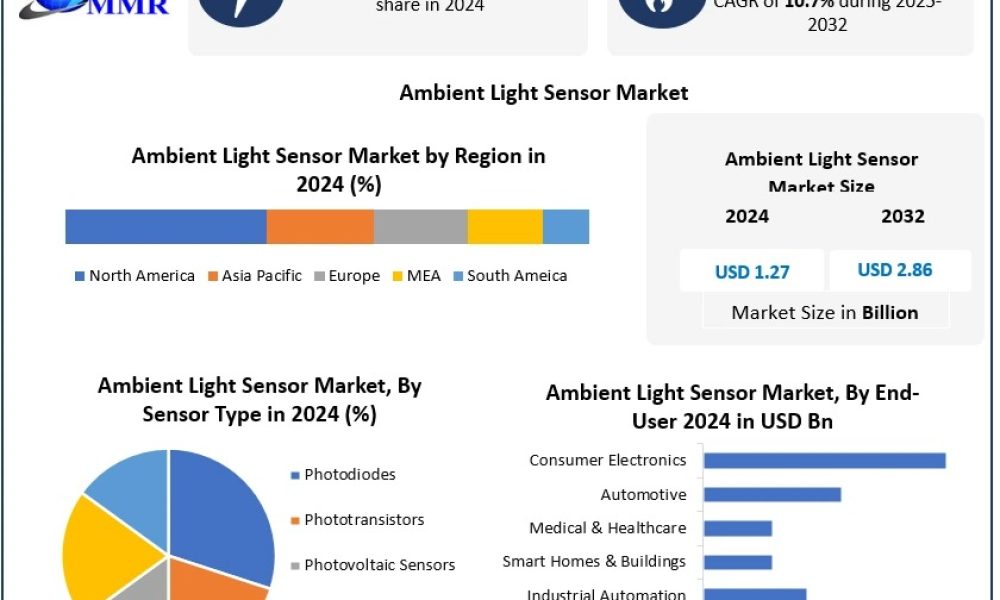
Ambient Light Sensor Market was valued at USD 1.27 billion in 2024 and is projected to expand at a robust CAGR of 10.7% through 2032, reaching nearly USD 2.86 billion. Ambient light sensors detect the brightness or level of surrounding illumination and are increasingly integrated into devices such as smartphones, laptops, automotive displays, smart lighting, and IoT-enabled smart homes.
Market Overview and Growth Drivers
Ambient light sensors are critical for optimizing energy consumption and enhancing user experience by automatically adjusting screen brightness and controlling lighting levels. Growing adoption of smart devices and energy-efficient solutions drives demand. Key growth factors include:
High smartphone penetration fueled by demand for automatic brightness control to prolong battery life and improve readability in varied lighting conditions.
Expansion of IoT and smart home ecosystems where sensors enable intelligent lighting systems that adapt to daylight and occupancy, contributing significantly to energy savings and sustainability.
Increasing automotive applications, such as dashboard illumination, adaptive headlight controls, and in-car infotainment displays, improving safety and driver comfort.
Rising demand in industrial automation, retail, healthcare, and environmental monitoring where precise light measurement is essential for efficiency and quality.
New technological innovations in miniaturization, ultra-low light sensitivity, and low power consumption further contribute to market growth. Research breakthroughs, such as the development of high-efficiency solar-powered sensors and AI-driven energy management systems, are poised to revolutionize sensor-powered IoT applications.
Market Segmentation
Sensor Type: Photodiodes (high sensitivity and wide use in smartphones), phototransistors, photovoltaic sensors (for energy-efficient devices), light-to-digital converters, light-to-frequency converters.
Output Type: Analog and digital sensors, with digital sensors gaining momentum due to better integration in modern electronics.
End-User Industry: Consumer electronics, automotive, medical & healthcare, smart homes & buildings, industrial automation, retail, and others.
For full access to the data, request a sample report now :https://www.maximizemarketresearch.com/request-sample/62760/
Regional Insights
Asia Pacific dominates the global market with the largest revenue share in 2024, led by countries like China, India, South Korea, Japan, and Taiwan. Rapid expansion in electronics manufacturing, governmental support for smart city initiatives, and a large consumer electronics base fuel growth.
North America holds the second-largest market share, driven by technological innovation and adoption of smart, energy-efficient lighting and automotive systems. The region sees opportunities expanding into augmented reality (AR), virtual reality (VR), and advanced smart home devices.
Europe is a stable market with growing regulations favoring energy-efficient solutions and increasing integration in automotive and industrial sectors.
Other Regions (Middle East & Africa, Latin America) are emerging markets propelled by increasing urbanization, awareness, and infrastructure development.
Market Challenges and Trends
High development and manufacturing costs, especially of advanced sensor technologies, limit adoption among small manufacturers.
Requirement of external amplification circuits due to low current output from some sensor types.
Increasing emphasis on energy efficiency and sustainability is driving innovation towards smart adaptive lighting.
Integration of AI and IoT in ambient light sensors enables adaptive, predictive, and autonomous control mechanisms.
Miniaturization and flexible sensor technologies expand applicability in novel devices such as wearables and curved displays.
Competitive Landscape
Prominent players investing heavily in R&D, production expansion, and marketing include STMicroelectronics, ams-OSRAM AG, Rohm Semiconductors, Broadcom, Texas Instruments, Renesas Electronics, Panasonic, Maxim Integrated, OSRAM Opto Semiconductors, Vishay Semiconductors, Philips Lighting, General Electric, Signify, Samsung, and Lite-On Technology.
Key innovations include ams-OSRAM’s advanced spectral ambient light sensor AS7350 launched in 2023, enhancing camera image quality under diverse lighting conditions, and the AI-powered energy management system developed using neural networks to optimize sensor power consumption.
Outlook and Future Opportunities
The ambient light sensor market is expected to maintain vigorous growth fueled by continuous expansion in consumer electronics, smart automotive features, and smart lighting solutions. Increasing environmental concerns and energy efficiency mandates globally further bolster the shift towards intelligent lighting control. The confluence of AI, IoT, and sensor miniaturization heralds a future where ambient light sensors become ubiquitous in daily life and industrial processes.
Quote
Ambient light sensors are the unsung heroes of modern smart tech, quietly optimizing energy use and enhancing user experience. Asia Pacific’s dynamic electronics ecosystem combined with innovations in AI and sustainable technologies positions the market for remarkable growth in the coming decade.
With accelerating adoption of connected and automated systems, rising environmental awareness, and technological advancements in sensor capabilities, the ambient light sensor market is poised for continued success, delivering smarter, more efficient illumination and display solutions worldwide.




