
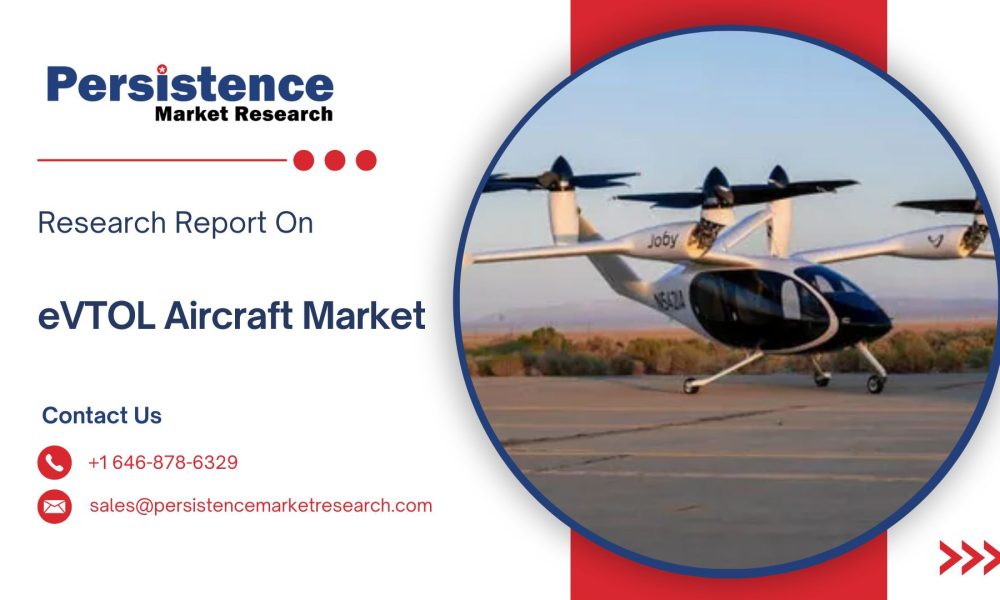
The eVTOL aircraft industry is transitioning from concept-stage innovation to real-world adoption, fueled by advancements in propulsion systems, battery technologies, and increasing government support for sustainable aviation. A growing number of partnerships between eVTOL manufacturers, airports, and infrastructure companies are strengthening the ecosystem needed to deploy these vehicles at scale.
According to the latest analysis by Persistence Market Research, the global electric Vertical Take-Off and Landing (eVTOL) aircraft market is set to undergo rapid expansion, driven by rising urban air mobility initiatives, infrastructure development, and accelerating electrification across the aviation sector. The market is estimated to generate US$ 676.5 million in revenue by 2025 and is projected to reach US$ 2,931.0 million by 2032, registering a robust compound annual growth rate (CAGR) of 23.3% over the forecast period from 2025 to 2032.
Key growth drivers include:
- Rising demand for sustainable urban transportation solutions.
- Continuous electrification trends across aviation and mobility sectors.
- Increasing investments in infrastructure to support eVTOL deployment.
- The transition of established automotive OEMs into the eVTOL sector.
- Policy initiatives by aviation authorities encouraging green air mobility.
Request Sample Copy of Report: https://www.persistencemarketresearch.com/samples/28333
Segmentation Analysis
By Type
The eVTOL market is segmented into piloted, remotely piloted, and hybrid autonomous aircraft. Among these, piloted eVTOLs are currently the dominant segment, accounting for a significant share of deployments in 2025 as companies prioritize safety, regulatory approval, and consumer confidence. However, autonomous eVTOLs are expected to grow at the fastest pace, with AI-driven flight management systems and regulatory advancements paving the way for pilotless air taxi services beyond 2030.
By Vehicle/Product/Service Type
Passenger air taxis represent the most prominent vehicle category, driven by metropolitan congestion challenges and rising interest from aviation service operators. Meanwhile, cargo and logistics-focused eVTOLs are gaining strong traction, particularly in emerging markets where efficient last-mile delivery systems are vital. Infrastructure-related services, such as vertiports and charging networks, are also anticipated to generate long-term revenue streams as commercialization scales up.
By Propulsion and Technology
The propulsion landscape includes fully electric, hybrid-electric, and hydrogen-based eVTOL systems. Currently, fully electric propulsion dominates due to advancements in lithium-ion battery efficiency and lower emissions. Over the forecast period, hybrid-electric systems will play a bridging role as technology evolves, while hydrogen fuel-cell systems are expected to emerge as a disruptive force in the long term.
Digital technologies such as AI, 5G connectivity, IoT, and digital twin simulations are also redefining operational efficiency, predictive maintenance, and real-time fleet management. These innovations are enabling the safe, efficient, and scalable deployment of eVTOL aircraft worldwide.
Request Customization of Report: https://www.persistencemarketresearch.com/request-customization/28333
Regional Insights
North America
North America leads the global eVTOL market in 2025, with the United States at the forefront due to high levels of investment, regulatory progress by the Federal Aviation Administration (FAA), and strong demand from metropolitan areas such as New York, Los Angeles, and Dallas. Major OEMs and startups headquartered in the region are accelerating prototype development and conducting test flights in collaboration with airlines and infrastructure companies.
Europe
Europe represents another key growth hub, supported by the European Union Aviation Safety Agency’s (EASA) emphasis on sustainability and stringent emission standards. Countries such as Germany, France, and the United Kingdom are seeing significant investments in UAM infrastructure and pilot projects.
Asia-Pacific
The Asia-Pacific region is projected to be the fastest-growing market over the forecast period. China, Japan, and South Korea are spearheading large-scale government-backed initiatives to integrate eVTOLs into smart city ecosystems. Urban density, coupled with high demand for efficient intra-city and inter-city mobility solutions, is creating fertile ground for adoption.
Middle East and Latin America
The Middle East is gradually emerging as a regional hub for futuristic aviation projects, with Dubai and Saudi Arabia exploring aerial mobility networks. Latin America is expected to follow with adoption in mega cities like São Paulo and Mexico City, where traffic congestion has long posed challenges to urban commuters.
Unique Features and Innovations in the Market
The core differentiation of modern eVTOL solutions lies in their ability to combine sustainability, efficiency, and scalability. Unlike traditional helicopters, eVTOLs operate at significantly reduced noise levels, emit zero direct emissions in their electric variants, and provide cost-effective urban air travel options.
The integration of artificial intelligence and advanced avionics is enhancing autonomous flight control, navigation, and passenger safety. Meanwhile, IoT-enabled predictive maintenance systems are reducing downtime, improving operational efficiency, and lowering lifecycle costs. The rollout of 5G networks is further enabling seamless communication between aircraft, control centers, and urban mobility ecosystems, ensuring safe and efficient fleet operations.
Market Highlights
The adoption of eVTOL aircraft is driven by multiple factors:
- Sustainability and Carbon Reduction: Growing global pressure to reduce aviation emissions is accelerating electrification.
- Cost Efficiency: Advances in battery performance and electric propulsion are reducing operating costs compared to conventional helicopters.
- Urban Congestion: Cities worldwide are seeking aerial mobility solutions to ease congestion on ground infrastructure.
- Government and Regulatory Support: Aviation authorities are actively developing certification frameworks for eVTOLs, ensuring safety while promoting innovation.
- Commercial Partnerships: Collaborations between eVTOL developers, ride-sharing companies, and airport authorities are laying the foundation for large-scale deployment.
Buy Now: https://www.persistencemarketresearch.com/checkout/28333
Key Players and Competitive Landscape
The competitive landscape is characterized by a mix of aerospace giants, automotive OEMs, and emerging startups. Leading players are prioritizing product innovation, strategic collaborations, and geographic expansion to secure market share.
- Joby Aviation: Pioneering commercial passenger air taxi services in the U.S., with a strong focus on FAA certification and large-scale partnerships with urban mobility companies.
- Volocopter GmbH: Leading Europe’s UAM ecosystem with early-stage deployments and collaborations with airports in Germany and France.
- Archer Aviation: Rapidly developing electric air taxis for the North American market, backed by strong partnerships with major automotive OEMs.
- Lilium GmbH: Developing innovative jet-powered eVTOLs designed for inter-city connectivity across Europe and beyond.
- EHang Holdings Ltd.: A leader in autonomous eVTOL solutions in China, with government-supported pilot programs and growing applications in passenger and cargo transport.
- Vertical Aerospace: Expanding its footprint across Europe and the U.S., leveraging partnerships with airlines for scalable deployment.
- Hyundai Motor Group (Supernal): Transitioning from automotive leadership to aviation innovation, focusing on scalable and affordable eVTOL mobility.
The competitive strategies of these companies center around regulatory approvals, large-scale production capabilities, and the establishment of vertiport networks in partnership with infrastructure providers.
Future Opportunities and Growth Prospects
The long-term outlook for the eVTOL aircraft market is highly promising. Continued advancements in battery technology, hydrogen fuel systems, and AI-enabled autonomy are expected to unlock new performance capabilities, extending flight ranges and reducing turnaround times.
Government policies supporting decarbonization and smart city development will provide a favorable regulatory environment for scaling urban air mobility. Moreover, infrastructure innovations such as vertiports, rapid charging systems, and digital air traffic management will play a crucial role in ensuring seamless integration with existing aviation networks.
By 2032, eVTOLs are expected to transition from niche pilot projects to mainstream transportation solutions, redefining mobility in urban and regional settings worldwide. Industries ranging from passenger travel and logistics to emergency services and defense will continue to drive adoption, cementing eVTOLs as a cornerstone of next-generation aviation.




