
Implantable Sensors Market Overview :
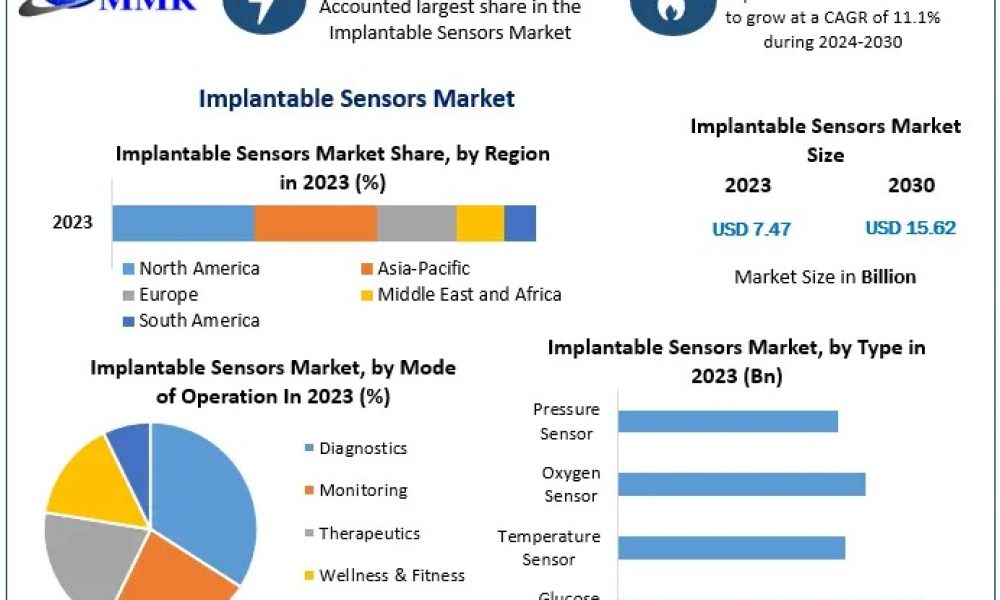
Implantable Sensors Market was valued at approximately USD 7.47 billion in 2023 and is forecasted to grow at a CAGR of 11.1%, reaching USD 15.62 billion by 2030. Implantable sensors are small electronic devices used extensively in medical applications to measure physiological parameters such as temperature, pressure, glucose levels, oxygen saturation, and more within the human body in real-time. They play a pivotal role in diagnostics, monitoring, therapeutics, and wellness, improving patient care and enabling personalized medicine.
Market Dynamics and Growth Drivers
Increasing Medical Technological Advancements: The surge in miniaturization, wireless communication technologies, and biocompatible materials enables the development of highly efficient, real-time implantable sensors. Enhanced capabilities are driving adoption in cardiac monitoring, diabetes management, neurological applications, and cancer treatment.
Rising Prevalence of Chronic Diseases: With growing incidences of heart failure, diabetes, cancer, and neurological disorders, the demand for long-term patient monitoring and minimally invasive diagnostic solutions is increasing, positioning implantable sensors as indispensable tools.
Integration with Mobile and Telehealth Platforms: Implantable sensors increasingly connect with wearable devices and mobile applications, facilitating remote patient monitoring, early detection, and intervention, thus reducing healthcare costs and improving clinical outcomes.
Investment in Research and Development: Industry leaders and startups are investing heavily in R&D to improve sensor sensitivity, operational life, and wireless connectivity, expanding the range of implantable device applications.
Growing Healthcare Awareness: Rising patient awareness and healthcare accessibility contribute to increasing adoption of implantable sensor technologies in developing and developed countries.
Market Segmentation
By Mode of Operation:
Diagnostics
Monitoring
Therapeutics
Wellness & Fitness
Others
By Type:
Glucose Sensors
Temperature Sensors
Oxygen Sensors
Pressure Sensors
By End User:
Hospitals
Clinics
Others
Regional Analysis
North America leads the implantable sensors market, accounting for the largest share in 2023. Growth in this region is driven by advanced healthcare infrastructure, high adoption of cutting-edge medical technologies, extensive R&D investments, and favorable reimbursement policies. The United States and Canada significantly contribute to this dominance with early adoption of technologically advanced medical devices.
Europe holds a strong position, supported by advancements in healthcare regulations, increasing investments in medical research, and rising demand for personalized medicine.
Asia Pacific is the fastest-growing region due to increasing healthcare expenditures, expanding geriatric populations, rising awareness of chronic diseases, and rising government initiatives promoting healthcare infrastructure development.
Rest of the World including Latin America, Middle East, and Africa is witnessing gradual growth driven by increasing healthcare penetration and awareness.
Recent Developments
In 2023, key players such as Medtronic, Honeywell International, Cardiomo, Dexcom, and TE Connectivity launched advanced implantable sensors with improved wireless connectivity, longer battery life, and enhanced biocompatibility.
The growing trend of integrating AI and machine learning into implantable sensor data analytics has emerged, enabling predictive diagnostics and personalized treatment regimes.
Increasing partnerships between medical device manufacturers and tech companies to develop integrated digital health monitoring platforms.
Specific focus on diabetes management and cardiac health monitoring devices gaining traction with continuous glucose monitors (CGMs) and implantable cardiac sensors widely adopted globally.
Market Challenges
High costs of implantable medical devices and sensors may limit accessibility in price-sensitive markets.
Regulatory hurdles and stringent approval processes extend time-to-market for new technologies.
Concerns around biocompatibility, device safety, and data privacy require ongoing research and regulatory attention.
The requirement for specialized skills and training for implantation and device maintenance.
Future Outlook
The implantable sensors market is poised for significant growth, propelled by healthcare digitization, demographic shifts, and rising consumer demand for personalized treatment. Innovations in wireless technologies, AI-driven data analytics, and continuous miniaturization will enhance device functionality and integration. Expansion of remote patient monitoring and telemedicine services will further propel market penetration.
Quote
Implantable sensors are transforming healthcare by enabling continuous, real-time patient monitoring and personalized treatments. North America’s leadership in advanced medical technology and increasing global focus on accessible healthcare bode well for the sustained expansion of this vital market.
With robust investments, evolving healthcare paradigms, and technological innovations, the implantable sensors market will continue to advance patient care quality and efficacy across the globe, marking a critical facet of the future of medical diagnostics and therapeutics.




