
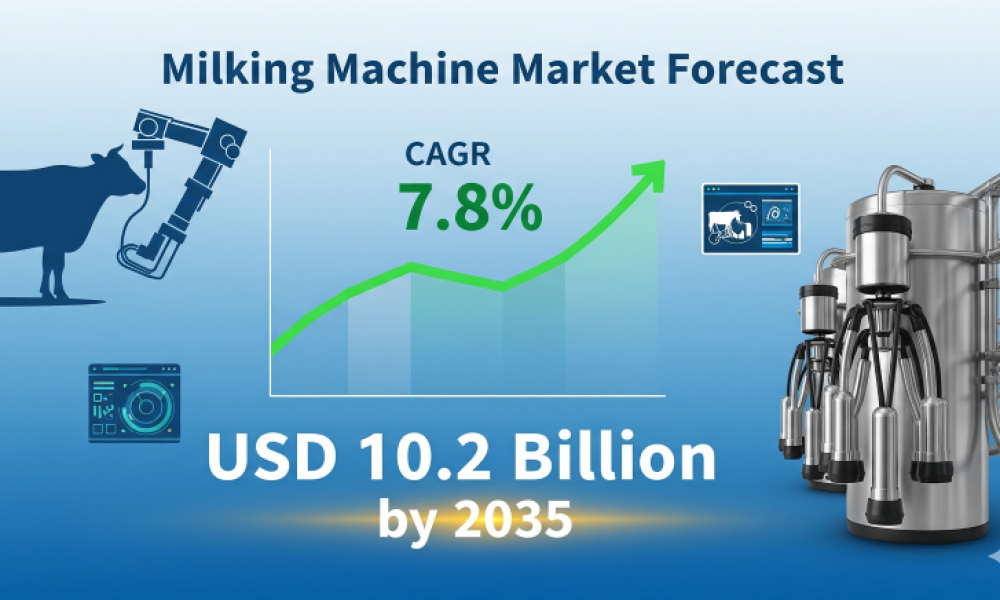
The global milking machine market is projected to grow from USD 4.8 billion in 2025 to USD 10.2 billion by 2035, registering a CAGR of 7.8% during the forecast period. Market growth is driven by rising automation in dairy farms, labor shortages in agriculture, and the need to improve milk yield and hygiene standards.
Milking machines provide a cleaner, safer, and more efficient alternative to traditional milking methods. Adoption is increasing due to larger herd sizes, stringent milk hygiene regulations, and growing global demand for dairy products.
Milking Machine Market Overview
The milking machine market is evolving rapidly as dairy farms worldwide embrace automation to enhance operational efficiency and product quality. Modern milking systems reduce manual labor, improve animal health, and ensure compliance with food safety standards. Rising urbanization and increasing global dairy consumption are encouraging farmers to implement innovative milking solutions that support sustainable practices and scalable production.
Segmentation Analysis
- By Product Type:
The market is segmented into portable and stationary milking machines. Portable units are gaining popularity among small- and mid-sized farms due to their affordability and mobility, while large dairy farms are investing in high-capacity stationary systems to manage large herds efficiently. - By Milking System:
Key systems include bucket milking, pipeline milking, and robotic milking machines. Among these, robotic milking systems are witnessing the fastest adoption, driven by precision, labor efficiency, and the ability to collect real-time herd data. - By End-Use:
Small farms, mid-sized farms, and large dairy operations form the core customer base. Large farms remain the dominant end-users due to their ability to invest in advanced automation, while smaller farms are gradually transitioning to cost-effective mechanized systems. - By Region:
Europe and North America lead in adoption due to advanced dairy infrastructure and regulatory frameworks supporting automation. Asia-Pacific is emerging as a lucrative market, fueled by growing dairy consumption, government incentives, and modernization of agriculture.
Recent Developments & Key Trends
- Rise of Robotic Milking Systems:
Farmers are increasingly shifting towards fully automated robotic systems that optimize milking frequency, animal comfort, and hygiene. These systems also provide valuable analytics on milk quality and herd health. - Integration of IoT and Data Analytics:
The use of smart sensors and IoT-enabled milking machines is revolutionizing dairy operations by providing real-time insights, predictive maintenance, and automated herd management. - Sustainability Focus:
Eco-friendly and energy-efficient milking systems are being developed to reduce environmental impact, aligning with the broader push for sustainable agriculture. - Government Support and Subsidies:
Many governments are introducing financial aid and subsidies to encourage the adoption of milking machines, particularly in emerging economies, to boost dairy productivity and food security.
Full Market Report available for delivery. For purchase or customization, please request here – https://www.factmr.com/connectus/sample?flag=S&rep_id=2204
Competitive Landscape of Milking Machine Market
The milking machine market is highly competitive, with several key players focusing on innovation, strategic partnerships, and expanding their global footprint.
- DeLaval continues to lead with its advanced robotic and IoT-integrated solutions, enhancing efficiency for large-scale farms.
- GEA Group is leveraging its strong engineering expertise to deliver high-capacity systems that meet the needs of industrial-scale dairy operations.
- BouMatic and Fullwood Packo are strengthening their product portfolios with customized solutions for mid-sized farms.
- Local manufacturers in Asia-Pacific are introducing cost-effective solutions, intensifying competition in emerging markets.
Collaborations with tech companies are also increasing, as dairy equipment manufacturers integrate AI, machine learning, and data-driven solutions to provide holistic herd management systems.
Future Outlook
The next decade will witness a strong shift towards intelligent, connected, and sustainable milking systems. While large farms will continue to drive demand for robotic solutions, smaller farms are expected to gradually adopt portable and semi-automated machines as costs decline.
Growing consumer demand for premium and hygienic dairy products will push farmers to prioritize automation. Moreover, with labor shortages becoming more acute, especially in developed countries, automation will no longer be a choice but a necessity for dairy operations.
Conclusion
The milking machine market is at the cusp of significant growth, powered by technological innovations, regulatory support, and rising dairy consumption. Key players are competing to introduce smarter, more efficient, and sustainable solutions that cater to farms of all sizes. By embracing automation, dairy farms worldwide are not only addressing labor shortages but also securing higher yields, better milk quality, and improved animal welfare—ultimately shaping the future of global dairy farming.
Contact:
US Sales Office
11140 Rockville Pike
Suite 400
Rockville, MD 20852
United States
Tel: +1 (628) 251-1583, +353-1-4434-232
Email: [email protected]



