
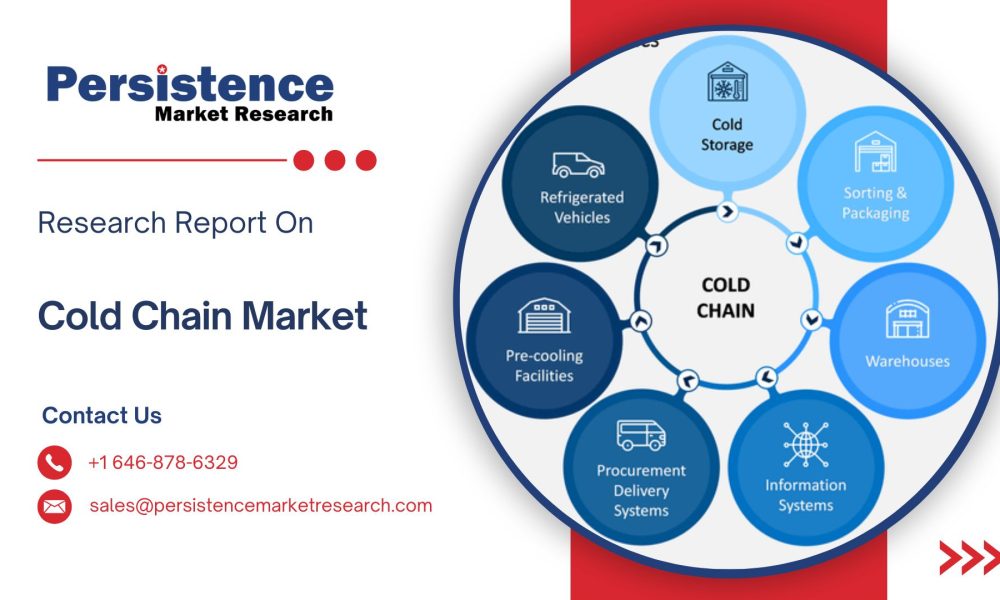
The global cold chain market is entering a phase of accelerated expansion, with its total value expected to rise from USD 372.2 billion in 2025 to USD 919.9 billion by 2032, registering a Compound Annual Growth Rate (CAGR) of 13.8% during the forecast period. This growth is underpinned by structural shifts in food consumption, healthcare logistics, international trade, and regulatory compliance that demand more sophisticated, temperature-controlled supply chain solutions.
As cold chain systems become essential in preserving the safety, integrity, and quality of temperature-sensitive products—particularly in the food, pharmaceutical, and life sciences sectors—the global logistics landscape is undergoing a fundamental transformation. Investments in infrastructure, digitization, and sustainable technologies are reshaping the competitive dynamics of the cold chain industry.
The global cold chain market is forecast to grow at a CAGR of 13.8% between 2025 and 2032, reaching USD 919.9 billion by the end of the forecast period. This growth trajectory reflects an increased reliance on temperature-controlled storage and transportation for goods that are sensitive to time and environmental conditions.
Several macroeconomic and sector-specific trends are contributing to this surge:
- Rising demand for perishable food products—including dairy, seafood, meat, and fresh produce—is driving investment in cold storage facilities and reefer transport networks.
- The pharmaceutical and biotechnology industries are increasingly dependent on temperature-sensitive logistics, particularly with the rise of biologics, mRNA-based therapeutics, and vaccines that require stringent cold chain compliance.
- Expansion of global e-commerce and direct-to-consumer models, including home delivery of groceries and specialty medicines, is creating pressure for more granular, last-mile cold chain capabilities.
- Stringent international and regional regulations around food safety and drug integrity continue to raise the standards for traceability, monitoring, and cold chain infrastructure.
The growth outlook is robust across both developed and emerging economies, though the nature of investment and adoption varies significantly by region.
Receive Sample of Research Report@ https://www.persistencemarketresearch.com/samples/3177
Segmentation Analysis
By Type
The cold chain market is primarily divided into cold storage and cold transportation:
Cold storage remains the larger segment by value. The expansion of distribution centers and warehouse automation is driving demand for scalable, energy-efficient refrigeration facilities. The proliferation of urban cold storage near consumption centers is particularly notable in North America and Western Europe.
Cold transportation, encompassing refrigerated trucks, containers, railcars, and air freight systems, is the faster-growing segment due to increased global trade and last-mile logistics. Reefer container demand is particularly strong in maritime logistics, while refrigerated vehicles are critical in meeting same-day and short-haul delivery requirements in dense urban markets.
By Vehicle/Product/Service Type
Cold chain logistics depend on a range of specialized assets and services, including:
- Refrigerated trucks and trailers for overland transport of perishables and pharmaceuticals.
- Reefer containers for sea freight, enabling large-volume international shipping with strict temperature control.
- Air freight systems equipped for time-critical pharmaceutical and biotech product delivery.
- Temperature-controlled packaging solutions, such as vacuum-insulated panels and phase-change materials, for passive cold chain applications.
- Monitoring and telematics platforms that provide real-time data on shipment conditions.
The adoption of these solutions is being driven by a mix of cost-efficiency, compliance requirements, and increasing customer expectations for visibility and traceability.
By Technology
Technological advancements are enabling the next generation of cold chain logistics. Key technologies include:
- Internet of Things (IoT) devices for real-time monitoring of temperature, humidity, and shock.
- Artificial Intelligence (AI) and machine learning for route optimization, predictive maintenance, and demand forecasting.
- Blockchain for immutable tracking of goods, improving trust and compliance in pharmaceutical and food logistics.
- 5G and Edge Computing to support low-latency, real-time data collection and analysis in remote and mobile environments.
These technologies are no longer add-ons but critical components of modern cold chain infrastructure, delivering efficiency gains, regulatory compliance, and quality assurance.
Regional Insights
Leading Regions
North America remains the most mature and well-established cold chain market. The United States leads in both infrastructure and innovation, supported by strong regulatory oversight from agencies like the FDA and USDA. High demand for frozen and ready-to-eat meals, coupled with a thriving pharmaceutical sector, makes North America a key market for advanced cold chain solutions.
Europe is a close second, particularly in Western and Northern Europe. Countries such as Germany, the Netherlands, France, and the UK benefit from dense logistics networks and advanced supply chain digitization. Stringent food safety and Good Distribution Practice (GDP) regulations in the pharmaceutical sector further drive cold chain investments.
Fastest-Growing Region
Asia-Pacific is expected to be the fastest-growing region, with countries like China, India, Indonesia, and Vietnam driving demand. Rapid urbanization, population growth, and rising disposable incomes are increasing the consumption of fresh and frozen foods. In addition, the expanding pharmaceutical manufacturing base in India and China is generating new demand for cold chain services.
Government-led initiatives to reduce post-harvest food losses and increase agricultural exports are further catalyzing infrastructure development. However, gaps in last-mile connectivity and electricity reliability remain challenges that are actively being addressed through public-private partnerships.
Unique Features and Innovations in the Market
Modern cold chain logistics are distinguished by the integration of smart technologies and sustainable practices:
- Sensor-driven visibility: IoT-enabled solutions provide granular data throughout the shipment lifecycle, from origin to point of sale or administration.
- Automation and robotics: In high-throughput warehouses, robotic palletizers, automated storage and retrieval systems (ASRS), and autonomous vehicles enhance operational speed and reduce human error.
- Energy-efficient refrigeration systems: Low global warming potential (GWP) refrigerants, solar-powered cooling units, and thermal energy storage solutions are being deployed to meet climate targets.
- AI-based demand prediction: Data-driven tools are helping operators forecast demand spikes and optimize inventory levels, especially in pharmaceuticals and seasonal produce.
- Multi-modal cold chain orchestration platforms: These allow companies to coordinate across trucking, sea, and air freight seamlessly while maintaining visibility and regulatory compliance.
The convergence of logistics and data science is creating a more transparent, responsive, and efficient cold chain environment, essential for safeguarding temperature-sensitive products.
Market Highlights
The growth of the cold chain market is underpinned by several compelling factors:
- Regulatory compliance: Laws such as the U.S. Food Safety Modernization Act (FSMA) and the EU’s GDP guidelines for pharmaceuticals mandate end-to-end cold chain integrity.
- Globalization of trade: Expanding import/export of fresh foods and biologicals necessitates highly reliable, standardized cold chain systems.
- Cost reduction: Reducing spoilage and improving logistics efficiency deliver tangible ROI for food producers, healthcare distributors, and logistics providers.
- Consumer trust: Traceability, transparency, and quality assurance are becoming major brand differentiators in both food and pharma sectors.
- Sustainability commitments: Cold chain providers are under pressure to decarbonize operations while maintaining performance, leading to investments in green technologies.
Businesses that fail to modernize their cold chain capabilities risk falling behind as compliance requirements and consumer expectations continue to rise.
Key Players and Competitive Landscape
The global cold chain market is highly competitive, with leadership divided among multinational logistics firms, specialized cold chain providers, and technology integrators. Notable players include:
Americold Realty Trust
One of the largest cold storage operators globally, Americold continues to expand its footprint through acquisitions and infrastructure development, particularly in Europe and Asia-Pacific. The company is investing in automation and renewable energy solutions across its facilities.
Lineage Logistics
Lineage is driving innovation through its use of advanced analytics, robotics, and warehouse digitization. The company’s network spans over 20 countries, and it is at the forefront of cold chain innovation, particularly in North America and Western Europe.
DHL Supply Chain
DHL offers a suite of temperature-controlled logistics solutions, including its DHL Thermonet service for life sciences. It is a key player in pharmaceutical distribution and continues to enhance its capabilities through digital tools and facility upgrades.
Kuehne + Nagel
Through its KN PharmaChain and KN FreshChain services, Kuehne + Nagel offers fully GDP-compliant cold chain logistics. The company has made strategic investments in Asia-Pacific to meet rising demand in the region.
FedEx and UPS Healthcare
Both companies have built significant cold chain capacity to support healthcare and e-commerce clients. With specialized packaging, monitoring systems, and dedicated networks, they are critical players in global vaccine and biologic distribution.
Future Opportunities and Growth Prospects
The cold chain market is positioned for continued evolution as technology, regulation, and global trade dynamics shift:
- Expansion into underserved regions: Africa and Latin America present major growth opportunities, particularly in reducing post-harvest food waste and supporting public health infrastructure.
- Ultra-low temperature logistics: Demand for cryogenic transport of cell and gene therapies is growing, requiring specialized capabilities beyond traditional cold chain solutions.
- Digital platform integration: The rise of integrated cold chain control towers—offering real-time tracking, analytics, and predictive insights—will redefine operational excellence.
- Sustainable innovation: The transition toward low-emission refrigerants and solar-powered transport will be vital to meet environmental and ESG mandates.
- Public-private partnerships: Governments and private firms will increasingly collaborate to build and maintain cold chain infrastructure as part of national food security and health policy.
As global markets become more interconnected and regulatory standards more rigorous, cold chain systems will be an indispensable pillar of reliable, transparent, and safe supply chains.
Explore more related market insights and reports by visiting our website.




