
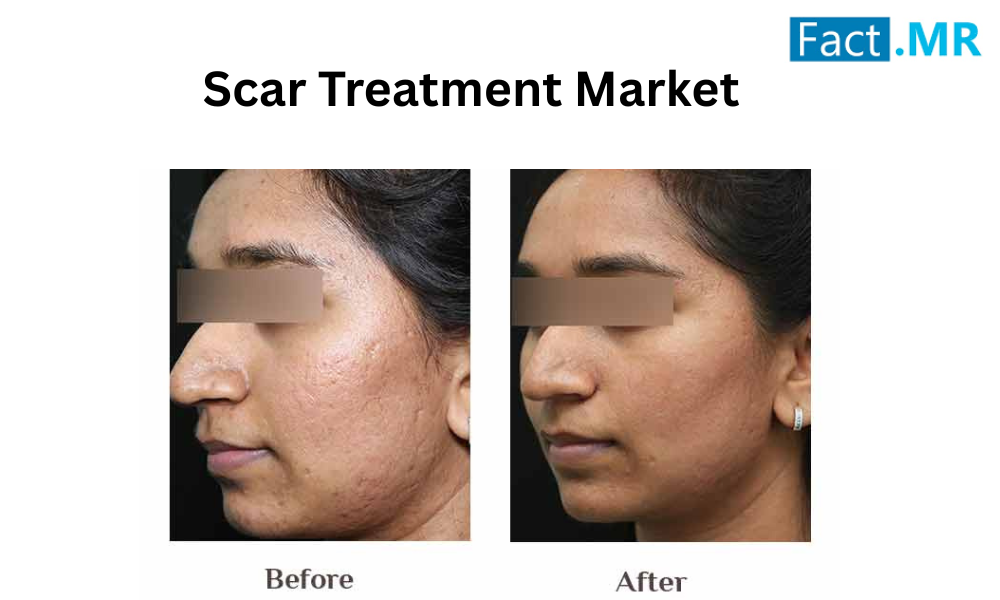
The global scar treatment market is on track for steady expansion over the next decade, with Fact.MR estimating the industry to be valued at USD 12,607.1 million in 2024. Registering a compound annual growth rate (CAGR) of 4.0%, the market is projected to climb to USD 18,619.6 million by 2034. This growth reflects the rising global focus on aesthetics, increasing consumer awareness about skin health, and ongoing technological innovations in dermatological procedures.
Growing Demand for Aesthetic Treatments:
A primary driver of the scar treatment market is the increasing concern about personal appearance. Scars—whether caused by acne, surgery, burns, or injuries—are a major source of psychological distress for many individuals. With beauty consciousness rising globally and social media playing a significant role in shaping beauty standards, more people are turning to scar treatment solutions. Both invasive and non-invasive procedures are witnessing strong demand, supported by technological advancements that enhance safety, efficacy, and recovery times.
Furthermore, the prevalence of conditions such as acne and the rising number of cosmetic surgeries worldwide are expanding the need for scar management solutions. The shift from traditional treatments to advanced options like laser therapy, dermal fillers, and topical silicone-based products has created significant opportunities for dermatology clinics, pharmaceutical companies, and cosmetic product manufacturers.
Full Market Report Available for Delivery. For Purchase or Customization, Please Request Here: https://www.factmr.com/connectus/sample?flag=S&rep_id=9290
Market Segmentation Insights:
The scar treatment market is highly diversified, encompassing products, procedures, and technologies tailored to different scar types. Topical solutions such as creams, gels, and silicone sheets remain the most accessible and widely used treatments, particularly for mild to moderate scars. At the same time, advanced medical procedures like laser therapy, cryotherapy, chemical peels, and microneedling are gaining traction for treating severe or persistent scars.
Among scar types, acne scars hold a dominant share due to the high prevalence of acne across populations, especially among adolescents and young adults. Post-surgical scars are also a significant segment, as rising surgical volumes, including cosmetic and reconstructive surgeries, drive the need for effective scar reduction techniques. Burn scars, keloids, and hypertrophic scars continue to represent specialized areas of treatment, often requiring more advanced and targeted therapies.
Regional Market Trends:
North America leads the global scar treatment market, driven by high consumer awareness, strong purchasing power, and the presence of advanced healthcare facilities. The region benefits from widespread adoption of cosmetic dermatology procedures and continuous innovation by leading companies.
Europe also maintains a strong position, particularly in countries like Germany, France, and the United Kingdom, where medical aesthetics is a mature and well-established industry. Stringent safety standards and high healthcare expenditure support the growth of advanced scar treatment options in the region.
Meanwhile, Asia-Pacific is projected to be the fastest-growing market. The increasing disposable income of middle-class populations in countries such as China and India, along with a rising awareness of cosmetic treatments, is fueling market demand. The region also benefits from a strong medical tourism sector, where advanced scar treatments are offered at competitive costs.
Latin America and the Middle East & Africa are emerging markets with strong potential, driven by growing aesthetic consciousness, expansion of dermatology clinics, and adoption of new treatment technologies.
Technological Advancements Driving Growth:
One of the most significant factors propelling the scar treatment market is the evolution of technology. Non-invasive and minimally invasive procedures are becoming the preferred choice for many patients due to shorter recovery times and reduced risks compared to traditional surgical approaches.
Laser-based technologies, such as fractional CO2 lasers and pulsed dye lasers, are now widely used for treating various scar types, offering improved precision and outcomes. Microneedling with radiofrequency, platelet-rich plasma (PRP) therapy, and stem cell-based treatments are emerging as innovative solutions that stimulate natural skin regeneration. The integration of artificial intelligence and digital imaging in dermatology is also enhancing diagnosis and treatment customization, helping dermatologists deliver more effective results.
Recent Developments in the Scar Treatment Market:
The scar treatment industry has witnessed several key developments in recent years, reflecting a shift toward more patient-friendly and effective solutions. Leading pharmaceutical and cosmetic companies are introducing advanced topical products enriched with bioactive compounds, peptides, and growth factors aimed at faster healing and scar reduction.
In the medical device segment, recent innovations in laser technology and energy-based devices are expanding treatment options for dermatologists and plastic surgeons. There has also been a growing focus on combination therapies, where multiple treatment modalities are used together to achieve superior results, such as combining microneedling with topical serums or laser therapy with PRP.
Mergers and acquisitions within the industry are further shaping the competitive landscape. Several companies are strategically collaborating to expand their portfolios and enter new regional markets. Moreover, increasing investment in clinical trials and research to develop scar-specific pharmaceuticals is expected to unlock new opportunities in the coming years.
Key Players Insights:
The scar treatment market is highly competitive, with a mix of pharmaceutical giants, medical device companies, and cosmetic brands contributing to its growth. Prominent players include Bausch Health Companies Inc., Candela Medical, Perrigo Company plc, Cynosure, HRA Pharma, GC Aesthetics, Sientra Inc., SkinCeuticals, Quantum Health, CCA Industries Inc., AVITA Medical, Sonoma Pharmaceuticals Inc., Hologic Inc., Johnson & Johnson Services Inc., Revitol Corp., Scarguard Labs, Smith+Nephew, Lumenis Be Ltd, and Merz Therapeutics.
These companies are focusing on expanding their product portfolios with innovative scar treatment solutions. For example, Johnson & Johnson continues to leverage its strong dermatology brand Neutrogena for topical scar care, while Smith+Nephew invests heavily in wound care and advanced healing technologies. Medical device firms like Candela and Cynosure are at the forefront of laser and energy-based scar treatments, enhancing non-invasive options available in the market.
Additionally, niche players such as Scarguard Labs and AVITA Medical are contributing through specialized products, particularly in burn care and regenerative therapies. Global players are also focusing on expanding into emerging markets, where rising disposable incomes and increasing awareness of aesthetic solutions present lucrative growth opportunities.
Future Outlook:
The next decade will mark significant progress for the scar treatment market as patient demand and technological innovation converge. The market’s steady growth trajectory reflects not just an increasing concern with appearance but also the psychological and social importance of skin health. As scar treatments become more advanced, affordable, and widely accessible, more individuals across demographics and geographies will seek solutions.
The role of digital platforms in patient education is also expected to be crucial, as consumers are now better informed about the availability of advanced scar treatments. Furthermore, the adoption of personalized treatment approaches—driven by AI and biotechnology—will transform the landscape, enabling tailored solutions for different skin types and scar conditions.
By 2034, the scar treatment market is expected to be worth nearly USD 18.6 billion, reflecting its critical role at the intersection of healthcare, aesthetics, and technology. Companies that continue to invest in innovation, strategic partnerships, and patient-centric solutions will be best positioned to thrive in this evolving market.
Check out More Related Studies Published by Fact.MR:
Atrophic Scar Treatment Market: https://www.factmr.com/report/atrophic-scar-treatment-market
Acne Treatment Market: https://www.factmr.com/report/acne-treatment-market
Contact:
US Sales Office
11140 Rockville Pike
Suite 400
Rockville, MD 20852
United States
Tel: +1 (628) 251-1583, +353-1-4434-232
Email: [email protected]
About Fact.MR
We are a trusted research partner of 80% of fortune 1000 companies across the globe. We are consistently growing in the field of market research with more than 1000 reports published every year. The dedicated team of 400-plus analysts and consultants is committed to achieving the utmost level of our client’s satisfaction.



