
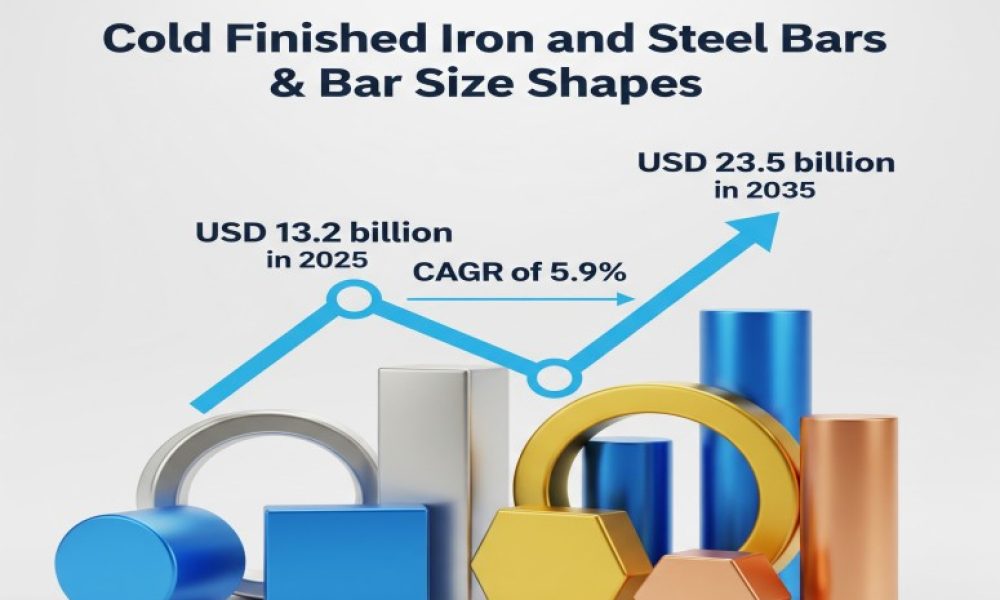
The global Cold Finished Iron and Steel Bars and Bar Size Shapes Market is set to witness remarkable growth over the next decade, according to the latest industry outlook titled “Cold Finished Iron and Steel Bars and Bar Size Shapes Market Size and Share Forecast Outlook 2025 to 2035.”
The report estimates the market will grow from USD 13.2 billion in 2025 to USD 23.5 billion by 2035, registering a steady CAGR of 5.9% during the forecast period. This growth trajectory is underpinned by rising infrastructure investments, expanding automotive production, and increasing adoption of precision-engineered steel components across industries.
Unlock the Full Market Report – Request Purchase or Custom Options Here.
https://www.futuremarketinsights.com/reports/sample/rep-gb-24695
Market Growth Overview
Between 2025 and 2030, the market value is expected to rise from USD 13.2 billion to USD 17.6 billion. This early growth phase will be driven by the superior performance of cold finished steel bars compared to hot rolled alternatives. With tighter dimensional tolerances, improved surface finish, and greater mechanical strength, these products are gaining preference in construction frameworks, automotive shafts, and industrial machinery.
From 2030 to 2035, the market will continue its upward momentum, advancing to USD 23.5 billion. The transition will be reinforced by durability requirements, machining efficiency, and performance demands in end-use industries, alongside the global trend of replacing conventional hot rolled steel with cold finished alternatives.
Why the Market is Growing
The surge in demand for cold finished iron and steel bars is fueled by their ability to deliver dimensional accuracy, superior machinability, and enhanced fatigue resistance—qualities essential for modern manufacturing and infrastructure projects.
- Construction & Infrastructure: Rapid urbanization and smart city initiatives are driving adoption of precision steel bars in high-rise buildings, bridges, and transportation projects.
- Automotive Industry: Automakers prefer cold finished bars for shafts, axles, and structural parts requiring high strength and reduced machining.
- Industrial Machinery: Equipment manufacturers rely on cold finished bars for reliability and precision, ensuring lower downtime and greater performance.
- Sustainability: Increasing focus on recyclable steel products aligns cold finished bars with global environmental and regulatory standards.
Key Trends Shaping the Future
- Precision Engineering: End-users are demanding value-added products with polished finishes, enhanced machinability, and customized tolerances.
- Automation in Production: Adoption of robotics and AI in finishing processes is reducing rejection rates and improving uniformity.
- Sustainability Push: Eco-friendly production methods and recyclable steel are gaining traction, aligned with global climate goals.
- Sector Diversification: Aerospace, healthcare equipment, and renewable energy industries are emerging as promising markets.
Segmental Insights
- By Product Type: Carbon steel bars will remain the largest segment, holding 42% market share in 2025, due to their balance of strength, cost-efficiency, and adaptability.
- By Shape: Round bars are projected to account for 37.6% of market revenue, reflecting their extensive use in rotational components like shafts, fasteners, and axles.
- By Process: The cold-drawn method will dominate with 55% market share, credited to its precision, strength, and efficient material usage.
- By End Use: Automotive, construction, aerospace, energy, and machinery sectors will be key demand generators.
Regional Outlook
- China (CAGR 8.0%): Rapid industrialization, infrastructure investments, and strong government support for steel production position China as the global leader.
- India (CAGR 7.4%): Expanding automotive manufacturing, machinery demand, and domestic steel policies are driving growth.
- Germany (CAGR 6.8%): High-precision manufacturing and export-oriented steel production make Germany a strong European market.
- United Kingdom (CAGR 5.6%): Replacement demand in construction and modernization of infrastructure projects support steady growth.
- United States (CAGR 5.0%): Industrial modernization and adoption of advanced finishing facilities sustain stable demand despite slower growth compared to emerging economies.
Get the Full Market Insights – Request the PDF Now!
https://www.futuremarketinsights.com/reports/brochure/rep-gb-24695
Competitive Landscape
The market is witnessing robust competition among established steel giants and emerging players seeking to expand their foothold.
- Tata Steel continues to lead South Asia with value-added products tailored for automotive and infrastructure industries.
- Nucor Corporation and Steel Dynamics dominate North America, leveraging strong distribution channels and efficient production.
- Gerdau S.A. strengthens Latin America with localized processing facilities that reduce import reliance.
- ArcelorMittal in Europe focuses on specialty steels for aerospace and machinery applications.
- POSCO and Baowu leverage technological expertise and government support to expand their dominance in Asia.
Emerging manufacturers are also reshaping the competitive dynamics by embracing automation, AI-driven quality control, and advanced alloy compositions to deliver customized solutions. These investments position them as strong contenders against established global leaders.
About Future Market Insights (FMI)
Future Market Insights, Inc. (ESOMAR certified, recipient of the Stevie Award, and a member of the Greater New York Chamber of Commerce) offers profound insights into the driving factors that are boosting demand in the market. FMI stands as the leading global provider of market intelligence, advisory services, consulting, and events for the Packaging, Food and Beverage, Consumer Technology, Healthcare, Industrial, and Chemicals markets. With a vast team of over 400 analysts worldwide, FMI provides global, regional, and local expertise on diverse domains and industry trends across more than 110 countries.



