
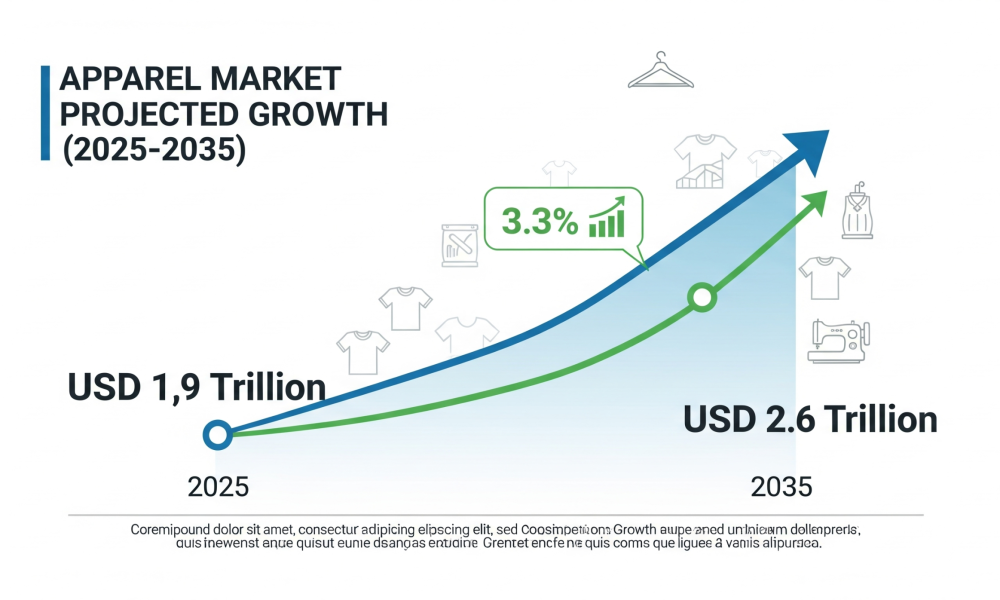
The global apparel market is entering a phase of steady expansion, estimated at USD 1.9 trillion in 2025 and expected to reach USD 2.6 trillion by 2035, registering a compound annual growth rate (CAGR) of 3.3%. This growth reflects a combination of evolving consumer behavior, demographic trends, and the rising integration of digital technologies across the fashion industry.
From 2025 to 2030, the market is projected to increase modestly from USD 1.9 trillion to nearly USD 2.0 trillion, propelled by the growing adoption of e-commerce platforms, fast fashion cycles, and the influence of social commerce. By 2035, revenues are forecast to rise further to USD 2.6 trillion, driven by premiumization, sustainable sourcing, and expanding apparel penetration into emerging economies.
Regions such as Asia-Pacific and the Middle East are expected to outpace global averages, thanks to young populations, rising disposable incomes, and rapidly growing consumer awareness. In contrast, North America and Europe are projected to maintain moderate but stable growth, focusing on athleisure, workwear reinvention, and circular fashion models. The apparel industry’s resilience stems from its ability to continually adapt to consumer shifts, ranging from digital-first shopping behaviors to demand for customization and ethical sourcing.
Full Market Report available for delivery. For purchase or customization, please request here: https://www.futuremarketinsights.com/reports/sample/rep-gb-25113
Consumer Segments and Apparel Categories
The market is shaped by multiple interconnected segments. Casual wear and everyday clothing dominate at 38% of market share, driven by affordability, mass adoption, and fast fashion’s frequent wardrobe refresh cycles. Formal and office wear account for 22%, bolstered by corporate dressing norms, events, and demand for premium tailoring in both established and emerging economies.
Sportswear and athleisure, comprising 18% of the market, reflect the global push toward fitness and wellness lifestyles, while the lines between athletic and casual apparel continue to blur. Luxury and premium fashion make up 12%, primarily concentrated in advanced markets but increasingly embraced in Asia-Pacific due to a growing high-net-worth population. Children’s and specialty apparel account for 10%, fueled by higher birth rates in developing regions, brand-conscious parenting, and seasonal collections.
Collectively, casual, formal, and sportswear categories dominate nearly 78% of the global apparel market, highlighting how lifestyle, affordability, and functionality shape consumer spending patterns while balancing mass-market accessibility and aspirational consumption.
The Role of Digital Transformation
The apparel market is experiencing a digital revolution, with social media, influencer marketing, and e-commerce platforms reshaping consumer engagement. Digital-first shopping, virtual try-ons, and AI-driven trend forecasting are enabling brands to respond rapidly to fashion trends and consumer preferences, enhancing both convenience and personalization.
Medium-price apparel segments are particularly strong, representing 47.8% of market revenue in 2025. This tier appeals to value-driven consumers in emerging economies, providing a balance between affordability and quality. Retailers and brands are capitalizing on this by offering seasonal collections, flexible price ranges, and technology-driven shopping experiences that increase customer engagement and repeat purchases.
Synthetic materials are expected to dominate at 53.6% of the market, driven by cost efficiency, versatility, and performance properties such as durability and color retention. Synthetic fabrics enable rapid production cycles in fast fashion and support innovation in sportswear, casual wear, and uniforms. Meanwhile, sustainability trends are gradually influencing the adoption of eco-friendly synthetic fibers and recycled textiles, particularly in Europe and North America.
Regional Insights
China is projected to lead global apparel growth with a CAGR of 4.5% from 2025 to 2035, supported by its manufacturing prowess, robust domestic consumption, and growing appetite for premium and luxury fashion. E-commerce platforms such as Alibaba and JD.com facilitate mass access to both domestic and international brands, while local players leverage speed-to-market and affordability.
India follows with a CAGR of 4.1%, benefiting from rising fashion consciousness, growing disposable incomes, and expanding organized retail and e-commerce channels. Brands such as Fabindia, Raymond, Zara, and H&M are broadening their presence across metropolitan and tier-2 cities, while online platforms like Myntra and Flipkart provide extensive reach, discounts, and personalized recommendations. Awareness of sustainable textiles and eco-friendly practices is steadily influencing Indian consumer preferences.
Germany, at 3.8% CAGR, emphasizes premium, casual, and athleisure categories, with brands like Hugo Boss, Adidas, and Puma focusing on innovation, sustainability, and metropolitan retail hubs. France grows at 3.5%, supported by luxury fashion dominance and export competitiveness, while the UK achieves 3.1%, driven by online retail expansion and fast-fashion adoption. The United States, representing a mature market with a 2.8% CAGR, remains a leader in casual and athleisure apparel, premium brand strength, and omnichannel retail infrastructure.
Request Market Research Draft Report: https://www.futuremarketinsights.com/reports/brochure/rep-gb-25113
Leading Players and Emerging Brands
The apparel market is a mix of globally established brands and nimble new entrants. Nike and Adidas dominate the sportswear and athleisure segment, leveraging global recognition, advanced performance fabrics, and celebrity endorsements. Inditex, through Zara, combines fast-fashion responsiveness with a strong supply chain, rapidly translating runway trends into accessible collections.
Luxury houses such as Dior, Hermes, and Kering drive premium market growth through exclusivity, craftsmanship, and heritage branding, while Ralph Lauren and Tapestry (Coach, Kate Spade) balance aspirational branding with wide retail reach. Indian players like Arvind Mills, Raymond, and Royal Apparel contribute to formal, casual, and sustainable clothing markets, emphasizing textile innovation and value-based pricing.
Emerging and niche brands such as Good Clothing Company and Los Angeles Apparel focus on ethical production and domestic manufacturing, appealing to environmentally conscious consumers. TJX Companies, through its off-price model with stores like TJ Maxx and Marshalls, offers branded apparel at discounted rates, catering to price-sensitive buyers worldwide. Competition increasingly revolves around digital transformation, e-commerce penetration, and balancing affordability with strong brand identity.
Market Drivers and Key Trends
The growth of the apparel market is primarily fueled by rising disposable incomes, fashion consciousness, and lifestyle shifts that prioritize comfort, versatility, and expression. Social media and influencer culture encourage frequent wardrobe updates, creating a constant demand for new styles. E-commerce and omnichannel retail expansion facilitate broad access, personalized shopping experiences, and faster inventory turnover.
Sustainability is an emerging priority, with brands increasingly adopting recycled fabrics, ethical sourcing, and eco-friendly manufacturing processes. Consumers are progressively valuing transparency and environmental responsibility, influencing both design and production decisions. Athleisure and hybrid workwear continue to drive demand for versatile clothing that combines performance, comfort, and style.
About Future Market Insights (FMI)
Future Market Insights, Inc. (ESOMAR certified, recipient of the Stevie Award, and a member of the Greater New York Chamber of Commerce) offers profound insights into the driving factors that are boosting demand in the market. FMI stands as the leading global provider of market intelligence, advisory services, consulting, and events for the Packaging, Food and Beverage, Consumer Technology, Healthcare, Industrial, and Chemicals markets. With a vast team of over 400 analysts worldwide, FMI provides global, regional, and local expertise on diverse domains and industry trends across more than 110 countries.
Contact Us:
Future Market Insights Inc.
Christiana Corporate, 200 Continental Drive,
Suite 401, Newark, Delaware – 19713, USA
T: +1-347-918-3531



