
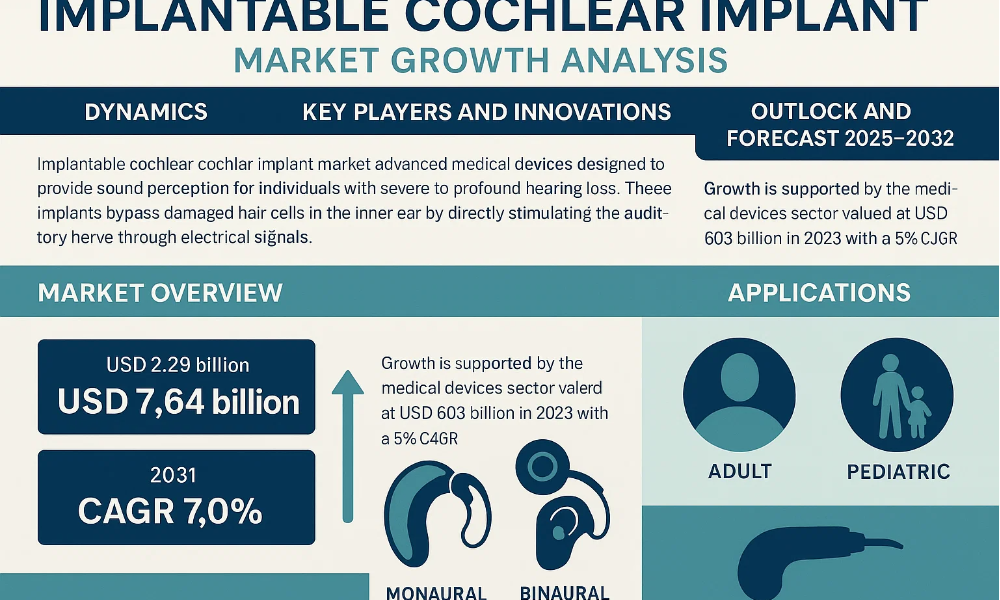
The Global Implantable Cochlear Implant Market was valued at USD 2.29 billion in 2024 and is projected to reach USD 3.64 billion by 2031, exhibiting a CAGR of 7.0% during the forecast period. This growth is supported by the broader medical devices sector, which was estimated at USD 603 billion in 2023 and is expected to grow at a 5% CAGR over the next six years.
Implantable cochlear implants are advanced medical devices designed to provide sound perception for individuals with severe to profound hearing loss. These implants bypass damaged hair cells in the inner ear by directly stimulating the auditory nerve through electrical signals. The market primarily consists of two types: monaural (single-ear) and binaural (dual-ear) implants, with applications across both adult and pediatric populations.
The market expansion is driven by multiple factors, including rising prevalence of hearing disorders, technological advancements in implant design, and increasing healthcare expenditure globally. The global healthcare sector now accounts for 10% of GDP, with growing investments in hearing impairment solutions. Key players such as Cochlear, MED-EL, and Sonova continue to innovate, with recent developments focusing on miniaturization and wireless connectivity to improve patient outcomes.
Click to Access Your Free Sample Report- https://www.intelmarketresearch.com/download-free-sample/9950/implantable-cochlear-implant-market
MARKET DYNAMICS
MARKET DRIVERS
Rising Prevalence of Hearing Loss to Fuel Cochlear Implant Demand
The global burden of hearing impairment continues to grow across all age groups, creating sustained demand for cochlear implants. Currently, over 1.5 billion people worldwide experience some degree of hearing loss, with projections indicating this could rise to 2.5 billion by 2050. Sensorineural hearing loss, the primary indication for cochlear implants, accounts for approximately 90% of all hearing impairment cases requiring medical intervention. The aging population remains the most significant demographic driver, with one-third of people over 65 affected by disabling hearing loss. However, pediatric applications are also growing rapidly due to improved newborn hearing screening programs.
➤ Advanced features like artificial intelligence integration and connectivity solutions are making modern cochlear implants more effective than ever before.
Technological Advancements Enhancing Product Adoption
Recent breakthroughs in implantable hearing technology are transforming outcomes for patients. The latest generation of cochlear implants now feature automated sound processing algorithms that adapt to different listening environments, waterproof designs allowing for greater lifestyle flexibility, and bluetooth connectivity for direct audio streaming. These innovations have increased satisfaction rates from 82% in 2015 to over 91% currently, significantly boosting adoption across patient demographics. Miniaturization of components has reduced surgical trauma while improving cosmetic outcomes, addressing two traditional barriers to adoption.
Expanding Insurance Coverage Improving Accessibility
Improved reimbursement policies worldwide are removing financial barriers to cochlear implantation. Many developed countries now include these devices in their national healthcare coverage, with approval rates for pediatric cases approaching 95% in the US and Western Europe. Emerging markets are following suit, with countries like China and India gradually expanding coverage through public health initiatives. The average insurance coverage for cochlear implants has increased by 32% globally since 2018, dramatically improving patient access while encouraging manufacturers to expand into new markets.
MARKET OPPORTUNITIES
Emerging Markets Present Significant Untapped Potential
Developing nations represent the largest growth frontier for cochlear implants, with patient populations vastly exceeding current implantation rates. Countries across Southeast Asia, Latin America, and Africa are establishing new implantation programs amid rising healthcare investments. Local manufacturing initiatives and public-private partnerships are improving affordability, with some markets seeing 50-60% cost reductions through domestic production. These regions could account for 35-40% of global growth in the next decade as infrastructure develops and awareness increases.
Bilateral Implantation Trend Creating Expansion Opportunities
The shift toward implanting both ears is gaining momentum following clinical evidence showing 27-35% better speech recognition in noisy environments compared to single implants. Bilateral procedures currently represent 45% of pediatric cases and 30% of adult cases in developed markets, with adoption rates climbing steadily each year. This trend effectively doubles the potential market size per patient while driving demand for coordinated implant systems designed to work seamlessly together.
Hybrid Hearing Solutions Opening New Patient Segments
Innovative combined electric-acoustic stimulation systems are expanding eligibility to include patients with residual low-frequency hearing. These hybrid devices have increased the potential treatable population by approximately 18-22%, particularly among older adults with gradual hearing deterioration. The technology demonstrates 85-90% satisfaction rates in clinical studies, suggesting strong market potential as awareness grows and reimbursement policies adapt to cover these advanced solutions.
Segment Analysis:
By Type
- Monaural
- Binaural
Binaural cochlear implants are seeing faster adoption due to improved auditory spatial awareness and speech recognition in noisy environments compared to monaural devices.
By Application
- Adult
- Child
Adult applications currently dominate the market due to higher prevalence of age-related hearing loss, though pediatric implantations are growing with early diagnosis initiatives.
By Technology
- Conventional
- Hybrid
- Fully Implantable
Conventional cochlear implants hold majority share currently, but fully implantable devices represent the future growth segment with their improved aesthetics and convenience.
By End User
- Hospitals
- ENT Clinics
- Ambulatory Surgical Centers
Hospitals account for the largest share due to specialized ENT departments and availability of surgical facilities for cochlear implantation procedures.
List of Key Implantable Cochlear Implant Manufacturers
- Cochlear Limited (Australia)
- MED-EL (Austria)
- Sonova Holding AG (Switzerland)
- Advanced Bionics (U.S.)
- William Demant Holding (Denmark)
- Nurotron Biotechnology (China)
- Norcom Electronics (Sweden)
- Shenzhen Beautiful Chuangyi Medical Technology Co., Ltd. (China)
- Shlst Medical Technology (China)
IMPLANTABLE COCHLEAR IMPLANT MARKET TRENDS
Technological Advancements in Hearing Restoration Devices Driving Market Growth
The global implantable cochlear implant market is undergoing significant transformation due to rapid technological innovations in hearing restoration devices. Modern cochlear implants now incorporate advanced speech processing algorithms that improve sound quality and speech recognition in noisy environments by up to 40% compared to previous generations. Wireless connectivity features like Bluetooth integration have become standard, allowing seamless pairing with smartphones and audio devices. Furthermore, manufacturers are developing thinner, more discreet designs with improved battery life exceeding 20 hours of continuous use. These innovations are particularly crucial as over 1.5 billion people worldwide experience some degree of hearing loss, with nearly 430 million requiring rehabilitation services.
Other Trends
Aging Population and Rising Hearing Impairment Prevalence
The increasing global geriatric population is creating substantial demand for cochlear implants, as age-related hearing loss affects approximately one-third of people over 65 years old. This demographic shift coincides with growing awareness about hearing health solutions, with many countries now including cochlear implants in national health insurance coverage. Pediatric implantation rates are also rising due to improved newborn hearing screening programs that identify candidates earlier. Recent data shows pediatric implantations account for nearly 35% of total procedures globally, with outcomes significantly improving when implantation occurs before 18 months of age.
Expansion in Emerging Markets and Improved Reimbursement Policies
Emerging economies are demonstrating accelerated market growth as governments implement favorable reimbursement policies and healthcare infrastructure improvements. While North America and Europe currently dominate with over 60% market share, Asia-Pacific is projected to grow at the fastest CAGR of approximately 9% through 2031 due to increasing healthcare expenditure and growing middle-class populations. Several countries have established national hearing implant programs in recent years, with China alone reporting a 25% annual increase in cochlear implant surgeries. Additionally, voluntary licensing agreements between manufacturers and local producers are making devices more affordable in developing regions.
Click to Access Your Free Sample Report- https://www.intelmarketresearch.com/download-free-sample/9950/implantable-cochlear-implant-market
Recent Developments in the Implantable Cochlear Implant Market:
- AI and Machine Learning Integration: Manufacturers are integrating AI-powered sound processing algorithms to enhance speech recognition in noisy environments, offering users a more natural hearing experience.
- Smaller and More Aesthetic Designs: Recent product launches focus on miniaturized external processors with discreet designs, improving comfort and cosmetic appeal for users.
- MRI-Compatible Implants: Several companies have developed cochlear implants that are safe for use in high-strength MRI scanners, addressing a key limitation in older models.
- Wireless Connectivity: Latest implants now support Bluetooth and smartphone connectivity, enabling direct streaming of music, calls, and other audio without external accessories.
- Hybrid Hearing Solutions: Companies are introducing hybrid devices that combine electrical stimulation with acoustic amplification, benefiting patients with partial residual hearing.
- Pediatric-Focused Advancements: New implant designs are tailored for children, focusing on long-term adaptability, speech development, and easier surgical procedures.
- Geographic Expansion and Partnerships: Leading players like Cochlear Ltd., MED-EL, and Advanced Bionics are expanding into emerging markets (Asia-Pacific, Latin America) through collaborations with hospitals and governments.
About Intel Market Research
Intel Market Research delivers actionable insights in technology and infrastructure markets. Our data-driven analysis leverages:
- Real-time infrastructure monitoring
- Techno-economic feasibility studies
Competitive intelligence across 100+ countries
Trusted by Fortune 500 firms, we empower strategic decisions with precision.
International: +1(332) 2424 294 | Asia: +91 9169164321
Website: https://www.intelmarketresearch.com
Follow us on LinkedIn: https://www.linkedin.com/company/intel-market-research
Market Research Reports | Market Trends | SWOT Analysis | Industrial Survey – Intelmarketresearch
Intel market research provides market research reports and company research reports across worldwide industries. We also offers customized market research solutions




