
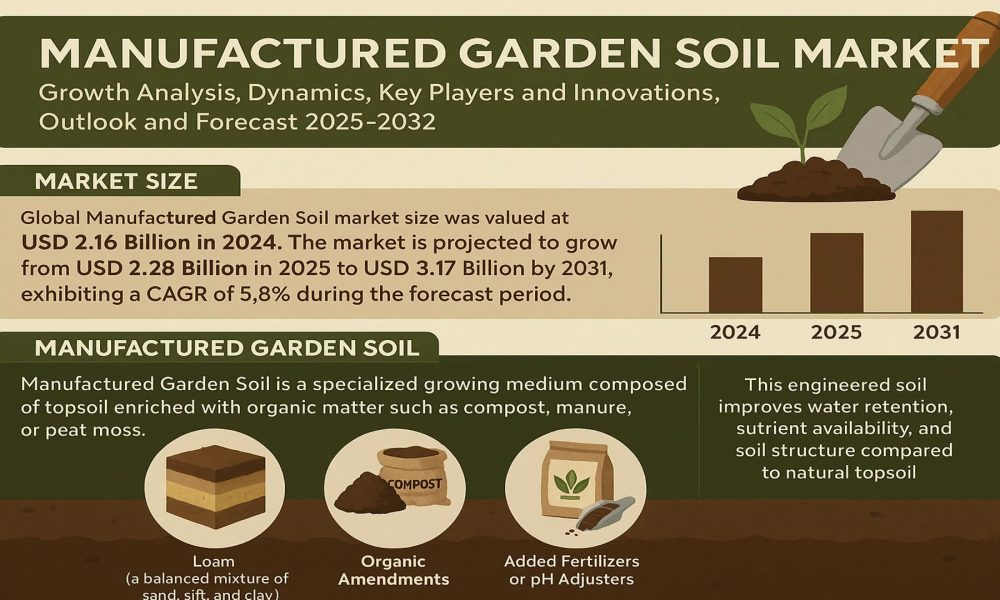
Global Manufactured Garden Soil market size was valued at USD 2.16 billion in 2024. The market is projected to grow from USD 2.28 billion in 2025 to USD 3.17 billion by 2031, exhibiting a CAGR of 5.8% during the forecast period.
Manufactured Garden Soil is a specialized growing medium composed of topsoil enriched with organic matter such as compost, manure, or peat moss. This engineered soil improves water retention, nutrient availability, and soil structure compared to natural topsoil. Key components include loam (a balanced mixture of sand, silt, and clay), organic amendments, and sometimes added fertilizers or pH adjusters.
The market growth is driven by increasing urbanization reducing access to natural topsoil, coupled with rising demand for home gardening and landscaping. Commercial applications in greenhouse horticulture and urban farming are accelerating adoption, particularly in regions with limited arable land. However, sustainability concerns regarding peat extraction and variable regional raw material costs present challenges to market expansion. Leading manufacturers are responding with innovative organic formulations and recycled material blends to meet eco-conscious consumer demands.
Request Your Free Sample Report- https://www.intelmarketresearch.com/download-free-sample/10130/manufactured-garden-soil-market
MARKET DYNAMICS
MARKET DRIVERS
Growing Urbanization and Green Space Initiatives Accelerate Market Demand
The rapid urbanization across developed and developing nations is significantly driving demand for manufactured garden soils. With over 55% of the global population now living in urban areas, municipal governments and property developers are increasingly investing in green infrastructure projects to improve air quality and combat urban heat islands. These projects require high-quality manufactured soils capable of supporting plant life in challenging urban environments. The extensive use of manufactured soils in rooftop gardens, vertical farming systems, and urban parks is creating sustained market growth, particularly in regions like North America and Europe where green building standards are becoming more rigorous.
Rising Adoption of Sustainable Agriculture Practices Fuels Market Expansion
Modern agricultural practices are increasingly embracing manufactured garden soils as sustainable solutions to soil degradation challenges. Conventional farming has led to significant topsoil erosion, with approximately 33% of the world’s arable land lost to degradation over the last four decades. Manufactured soils enriched with organic matter and nutrients help restore soil health while improving crop yields. This is particularly crucial in greenhouse farming operations, where controlled environment agriculture requires precisely formulated growing media. The commercial agriculture sector’s shift toward sustainable practices is expected to maintain strong demand for premium manufactured soil products through the forecast period.
Growth in Home Gardening Trends Supports Retail Segment Expansion
The home gardening boom, accelerated by pandemic-era behavior changes, continues to drive significant retail demand for manufactured garden soils. Approximately 30% more households engaged in gardening activities in 2024 compared to pre-pandemic levels, with many retaining the practice as a permanent hobby. This trend is supported by increasing consumer awareness about food safety and the therapeutic benefits of gardening. Major retailers have responded by expanding their garden center offerings, with manufactured soil products consistently ranking among the top-selling items during spring planting seasons. The convergence of wellness trends with sustainable living movements suggests this driver will maintain momentum.
MARKET OPPORTUNITIES
Specialty Soil Formulations for Niche Applications Offer Growth Potential
The development of specialized soil blends for particular plant types or environmental conditions represents a significant growth opportunity. Custom formulations for orchids, succulents, cannabis cultivation, and other specialty crops command premium pricing and build brand loyalty. The legal cannabis industry alone represents a substantial emerging market, with cultivation operations requiring carefully calibrated growing media. As consumer interest in exotic plants and specialty gardening grows, manufacturers that can develop and market targeted soil solutions will capture valuable market share in these high-margin segments.
Smart Packaging Innovations Enhance Product Differentiation
Advances in packaging technology present opportunities to improve product shelf life, ease of use, and brand distinction. Moisture-control packaging that maintains ideal soil conditions during storage, resealable bags for multi-use applications, and smart packaging with QR codes linking to usage instructions all add value for consumers. Some forward-thinking manufacturers are exploring sustainable packaging solutions using biodegradable materials, aligning with growing environmental concerns. These innovations not only address practical consumer needs but also help brands stand out in increasingly competitive retail environments.
Vertical Integration Strategies Strengthen Market Position
Strategic vertical integration offers manufacturers opportunities to secure supply chains and improve margins. Companies investing in composting facilities, organic waste collection operations, or raw material processing plants gain better control over input quality and costs. Some industry leaders are developing direct relationships with municipal waste management programs to secure consistent supplies of high-quality compost materials. These vertically integrated models not only improve operational reliability but also enhance sustainability credentials that are increasingly important to both commercial buyers and retail consumers.
Segment Analysis:
By Type
- Soil Mix
- Compost and Manure
- Others
Soil Mix dominates due to its balanced composition of sand, silt, and clay, making it ideal for a wide range of gardening applications.
By Application
- Household
- Commercial
Commercial segment, including agriculture and landscaping, drives demand due to large-scale adoption and increased urban green spaces.
By End User
- Home Gardeners
- Landscaping Contractors
- Agricultural Enterprises
Landscaping Contractors are the primary users, leveraging manufactured garden soil for high-quality turf development and sustainable urban projects.
- By Distribution Channel
- Retail Stores
- Online Platforms
- Direct Sales
Retail Stores remain the dominant channel due to immediate availability and bulk purchase options for commercial buyers.
List of Key Manufactured Garden Soil Companies Profiled
- Jiffy International (Norway)
- Boughton (UK)
- Casella (UK)
- B.D. White Top Soil Company (USA)
- Resource Management, Inc. (USA)
- London Rock Supplies (UK)
- Denbow (Canada)
- Tim O’hare Associates (UK)
Product innovation remains a key battleground, with premium manufacturers developing mycorrhizal-enhanced blends and water-retention formulas. While large players expand through acquisitions, regional specialists maintain competitiveness through localized expertise in native soil compositions and climate-appropriate amendments. The market’s projected 5.8% CAGR through 2031 ensures continued investment and strategic maneuvering across all tiers of suppliers.
MANUFACTURED GARDEN SOIL MARKET TRENDS
Rising Demand for Sustainable Urban Gardening Solutions to Drive Market Growth
The global manufactured garden soil market is experiencing steady growth due to increasing urbanization and the rising adoption of home gardening practices. With limited arable land and growing environmental concerns, consumers are turning to high-quality soil amendments to maximize yields in small spaces like urban balconies and rooftop gardens. The market, valued at $2.158 billion in 2024, is projected to reach $3.17 billion by 2031, expanding at a 5.8% CAGR during this period. This growth is primarily fueled by the composition of manufactured soils being enriched with organic compost, peat, and natural fertilizers to enhance plant nutrition and water retention.
Other Trends
Expansion of Commercial Horticulture
The commercial sector, including nurseries and landscaping businesses, accounts for over 40% of market demand as professional growers seek consistent, high-performance soil blends. Greenhousing which relies heavily on manufactured soils for optimal root development and disease resistance is growing by approximately 7% annually in key markets like Europe and North America. Furthermore, the integration of mycorrhizal fungi and biochar in premium soil mixes is improving plant resilience, reducing the need for chemical fertilizers by up to 30% in trials.
Technological Innovations in Soil Production
Manufacturers are increasingly adopting automated mixing systems to ensure uniformity in soil composition, while advanced sterilization techniques eliminate pathogens without compromising microbial diversity. A notable shift toward pH-balanced formulas tailored for specific crops (e.g., acidic mixes for blueberries) is gaining traction. Meanwhile, the rise of recycled organic materials such as composted food waste and agricultural byproducts is reducing production costs by 15–20% for some suppliers, aligning with circular economy principles.
Request Your Free Sample Report- https://www.intelmarketresearch.com/download-free-sample/10130/manufactured-garden-soil-market
Recent Developments in the Manufactured Garden Soil Market:
- Sustainable & Organic Blends – Companies are focusing on producing eco-friendly, organic, and peat-free manufactured garden soils using compost, biochar, and recycled green waste to meet consumer demand for sustainable gardening solutions.
- Smart Soil Innovation – Some manufacturers are integrating soil enhancers with slow-release fertilizers, moisture-retention polymers, and microbial additives to improve plant growth efficiency and reduce water usage.
- Urban Gardening Growth – With the rise of urban farming and rooftop gardens, soil blends tailored for container gardening and vertical farming systems are gaining popularity.
- Customized Soil Mixes – Market players are offering specialized soil blends for flowers, vegetables, turf, and landscaping to cater to diverse horticultural needs.
- Digital Retail Expansion – E-commerce platforms and direct-to-consumer models are increasingly being adopted by soil producers, allowing wider reach and convenient home delivery for garden enthusiasts.
- Partnerships & Mergers – Companies are collaborating with agricultural technology firms and nurseries to co-develop advanced soil solutions, enhancing their market presence.
- Regulatory Compliance & Certifications – Growing focus on organic certification, eco-labels, and regulatory standards is driving manufacturers to adopt transparent sourcing and production practices.
About Intel Market Research
Intel Market Research delivers actionable insights in technology and infrastructure markets. Our data-driven analysis leverages:
- Real-time infrastructure monitoring
- Techno-economic feasibility studies
Competitive intelligence across 100+ countries
Trusted by Fortune 500 firms, we empower strategic decisions with precision.
International: +1(332) 2424 294 | Asia: +91 9169164321
Website: https://www.intelmarketresearch.com
Follow us on LinkedIn: https://www.linkedin.com/company/intel-market-research




