
Definition
Semiconductor wafer transfer systems are critical automation solutions in chip fabrication facilities, designed to handle delicate wafers with micron-level precision between processing equipment while maintaining ultra-clean environments.
These systems play a central role in modern semiconductor manufacturing, ensuring wafer integrity and minimizing contamination risks, particularly in advanced nodes below 10nm.
Key Components of Wafer Transfer Systems:
- Equipment Front End Modules (EFEMs): Automated modules facilitating wafer transfer between storage carriers and processing tools, often featuring vacuum or atmospheric handling.
- Wafer Sorters: Automated devices that sort, align, and deliver wafers to various process stages, ensuring precise handling.
- Integrated Wafer Handling Systems: Complete solutions combining EFEMs, wafer sorters, and robotic automation for streamlined operations.
Wafer transfer systems are also aligned with Industry 4.0 automation trends, featuring dual-arm robotics, AI-driven predictive maintenance, and high-throughput capabilities that reduce human intervention while improving yield and operational efficiency.
Recent Developments in the Semiconductor Wafer Transfer System Market
The semiconductor wafer transfer system market is being driven by the relentless demand for smaller, more powerful chips. A key development is the widespread adoption of automation and robotics, with manufacturers focusing on creating highly precise, high-throughput systems to handle the delicate wafers in a cleanroom environment. The market is seeing a major shift towards integrating artificial intelligence (AI) and machine learning for predictive maintenance, which helps to minimize costly downtime and improve overall operational efficiency. Furthermore, there is a strong focus on developing systems capable of handling larger 300mm and emerging 450mm wafers, as these larger sizes lead to higher production yields and cost savings.
Major Distribution Channels
The distribution of semiconductor wafer transfer systems is an intricate, business-to-business (B2B) process within a highly specialized supply chain. The primary distribution channel is direct sales from the manufacturers of this capital equipment to major semiconductor fabrication plants, or “fabs.” These transactions are often part of large-scale, multi-million dollar projects to build or expand a fab. A secondary but equally critical channel involves specialized system integrators and value-added resellers (VARs) who provide complete solutions by combining the wafer transfer systems with other cleanroom equipment and software. These partners are crucial for providing installation, integration services, and long-term maintenance support, which are vital for the continuous operation of a semiconductor manufacturing facility.
Market Size
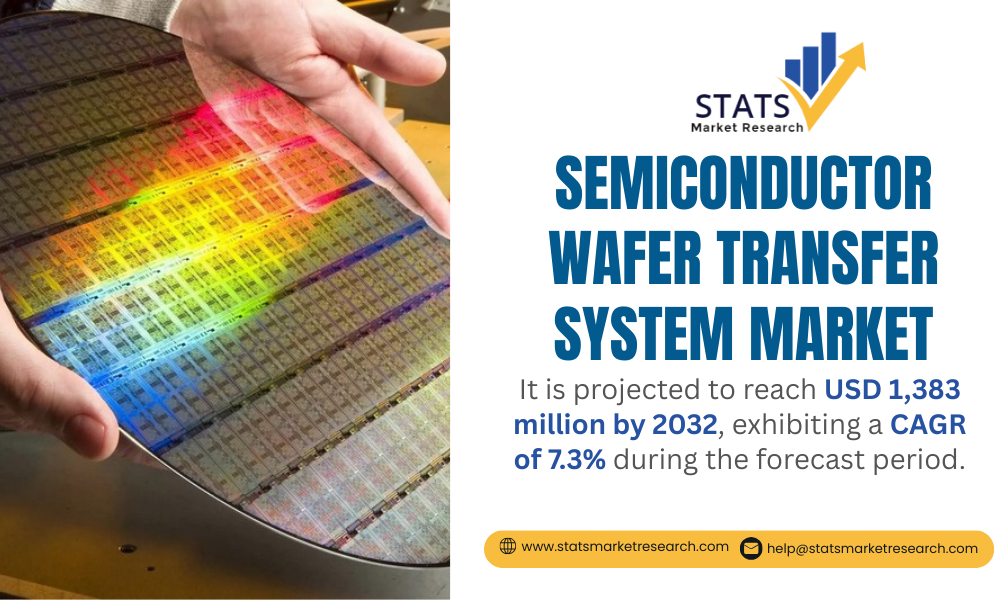
Global semiconductor wafer transfer system market was valued at USD 868 million in 2023 and is projected to reach USD 1,383 million by 2030, growing at a CAGR of 7.3% during the forecast period.
Download FREE Sample of this Report @ https://www.statsmarketresearch.com/download-free-sample/8059855/global-semiconductor-wafer-transfer-system-forecast-market
Growth Factors and Trends:
- Rapid expansion of global semiconductor manufacturing, particularly for advanced 300mm and emerging 450mm wafers.
- Increasing investments in chip fabrication capacity, with the global wafer fabrication market expected to grow from USD 251.7 billion in 2023 to USD 506.5 billion by 2030.
- Rising adoption of advanced packaging technologies such as 3D ICs and chiplet integration, requiring ultra-precise wafer handling.
Real-World Examples:
- Dual-arm robotic EFEMs now process over 800 wafers per hour with 99.99% reliability in cleanroom environments.
- High-purity wafer handling solutions are witnessing 12% annual growth, driven by contamination control requirements in sub-5nm processes.
The market reflects high barriers to entry, with top ten players holding over 80% market share, emphasizing technical specialization and capital-intensive infrastructure.
Market Dynamics
Market Drivers
Rising Semiconductor Manufacturing Investments
- Increased global semiconductor capacity creates strong demand for wafer transfer automation.
- Transition to 300mm and 450mm wafer standards intensifies requirements for precision handling equipment.
- Maintaining competitiveness in chip production necessitates highly automated material handling systems.
Automation Trends in Cleanroom Operations
- Adoption of Industry 4.0 principles ensures high-throughput and contamination-free environments.
- Robotic EFEMs reduce human intervention, enhancing productivity.
- Systems with dual-arm robotics and advanced vision systems meet precision requirements for advanced packaging processes.
Advanced Packaging Technologies
- Emerging 3D IC and chiplet integration require wafer-level precision alignment (<1 micron accuracy).
- Advanced packaging market projected to exceed USD 65 billion by 2028, driving wafer transfer system demand.
- Manufacturers now deploy adaptive handling algorithms and enhanced vision systems to meet precision requirements.
Market Restraints
High Capital Costs
- Complete EFEM configurations often exceed USD 500,000 per unit.
- Small and medium fabs face challenges in ROI, which typically spans 3–5 years.
- Legacy 200mm fabs struggle to justify automation investments.
Complex Integration Requirements
- Proprietary interfaces from different equipment vendors increase engineering complexity.
- Integration timelines can extend 30–40% longer than standard industrial automation projects.
- Cleanroom operational constraints further complicate installation and maintenance.
Regulatory Compliance
- Compliance with SEMI E15.1 (EFEMs) and SEMI S2 (EHS) adds cost and complexity.
- Recent updates in vacuum handling and particle emission regulations increased development costs by 15–20%.
Market Opportunities
Emerging Market Growth
- Southeast Asia is experiencing 18% annual growth in semiconductor equipment demand.
- New fabs in emerging economies create partnerships and localization opportunities for wafer transfer system manufacturers.
AI-Driven Predictive Maintenance
- Real-time sensor analytics and machine learning allow predictive maintenance, reducing unplanned downtime by up to 40%.
- Dynamic performance optimization enhances throughput by 8–12%.
Specialized Solutions for Heterogeneous Integration
- Systems capable of handling silicon, compound semiconductors, GaN, and SiC represent a premium niche.
- These solutions are crucial for power semiconductor and RF device markets, offering high differentiation potential.
Market Challenges
Supply Chain Disruptions
- Lead times for linear motion components and robotics extend 9–12 months.
- Manufacturers maintain high inventory levels, increasing working capital by 25–30%.
Technical Talent Shortage
- Shortage of engineers skilled in mechatronics, vacuum systems, and cleanroom automation slows product development.
- Competition from semiconductor device makers intensifies talent scarcity.
Yield Optimization Demands
- Wafer handling systems must achieve near-zero particle contamination per 100 wafer transfers.
- Sub-5nm processes require continuous improvements in materials, vibration control, and contamination prevention, raising system complexity and costs.
Segment Analysis
By Type
- EFEM (Equipment Front End Module) (dominates market)
- Subtypes: Standard EFEM, High-Speed EFEM, Customized EFEM
- Wafer Sorter
- Subtypes: Automatic Wafer Sorter, Semi-Automatic Wafer Sorter
- Integrated Wafer Handling System
- Others
By Application
- Etching Equipment (leads due to miniaturization trends)
- Deposition (PVD & CVD)
- Semiconductor Inspection Equipment
- Coater & Developer
- Lithography Machine
- Others
By Wafer Size
- 200mm
- 300mm (dominates for advanced nodes)
- 450mm
- Others
By Automation Level
- Fully Automated Systems (gaining traction for high-volume fabs)
- Semi-Automated Systems
- Manual Systems
Regional Analysis
- Asia-Pacific: Largest market, driven by Japan, South Korea, China, and Taiwan’s semiconductor hubs.
- North America: Strong adoption in U.S. and Canada, with mature fabs upgrading to high-throughput EFEMs.
- Europe: Steady growth in wafer transfer systems for automotive, industrial, and fab modernization projects.
- Middle East & Africa: Emerging demand for domestic semiconductor initiatives.
- Latin America: Gradual growth with expansion of semiconductor inspection and assembly facilities.
Get the Complete Report & TOC @ https://www.statsmarketresearch.com/global-semiconductor-wafer-transfer-system-forecast-market-8059855
Competitor Analysis
The semiconductor wafer transfer system market is highly competitive, with top ten players controlling over 80% market share.
Key Players & Strategies:
- RORZE Corporation (Japan): Market leader, expanding in Europe through acquisitions.
- Brooks Automation (U.S.): Dominates North America with advanced atmospheric and vacuum wafer handling.
- Japanese Leaders: DAIHEN Corporation, Hirata Corporation, Sinfonia Technology – integrate with Tokyo Electron and SCREEN Holdings.
- Chinese Manufacturers: Siasun Robot & Automation, Shanghai Guona Semiconductor – growing domestic and global presence.
- Strategic Trends:
- Vertical integration (e.g., Nidec acquiring Genmark Automation)
- Regional expansion (e.g., HIWIN Technologies R&D center in Singapore)
- Technology partnerships enhancing predictive maintenance (RAONTEC Inc)
Global Semiconductor Wafer Transfer System: Market Segmentation Analysis
This report provides deep insight into the global semiconductor wafer transfer system market, covering macro and micro-level details of market size, competitive landscape, development trends, niche segments, key drivers, challenges, SWOT, and value chain analysis.
It enables industry stakeholders to evaluate competition, develop strategies, and identify growth opportunities, detailing market share, product performance, and operations of main players.
This report is a must-read for investors, researchers, consultants, business strategists, and industry participants planning to engage in the semiconductor wafer transfer system market.
Market Segmentation (by Application)
- Etching Equipment
- Deposition (PVD & CVD)
- Semiconductor Inspection Equipment
- Coater & Developer
- Lithography Machine
- Others
Market Segmentation (by Type)
- EFEM (Equipment Front End Module)
- Wafer Sorter
- Integrated Wafer Handling System
- Others
Key Company
- RORZE Corporation (Japan)
- Brooks Automation (U.S.)
- DAIHEN Corporation (Japan)
- Hirata Corporation (Japan)
- Sinfonia Technology (Japan)
- Nidec (Genmark Automation) (Japan)
- JEL Corporation (Japan)
- Cymechs Inc (South Korea)
- Robostar (South Korea)
- Robots and Design (RND) (South Korea)
- RAONTEC Inc (South Korea)
- KORO (South Korea)
- Sanwa Engineering Corporation (Japan)
- HIWIN TECHNOLOGIES (Taiwan)
- Siasun Robot & Automation (China)
- Shanghai Guona Semiconductor (China)
- Shanghai Fortrend Technology (China)
Geographic Segmentation
- North America: U.S., Canada
- Europe: Germany, France, UK
- Asia-Pacific: Japan, South Korea, China, Taiwan
- Middle East & Africa: UAE, Saudi Arabia
- Latin America: Brazil, Argentina
FAQ
Q1: What is the current market size of Semiconductor Wafer Transfer Systems?
A1: The market was valued at USD 868 million in 2023 and is projected to reach USD 1,383 million by 2030.
Q2: Which are the key companies operating in Semiconductor Wafer Transfer Systems?
A2: Key companies include:
- RORZE Corporation (Japan)
- Brooks Automation (U.S.)
- DAIHEN Corporation (Japan)
- Hirata Corporation (Japan)
- Sinfonia Technology (Japan)
- Nidec (Genmark Automation) (Japan)
- Cymechs Inc (South Korea)
- Robostar (South Korea)
- Siasun Robot & Automation (China)
- Shanghai Guona Semiconductor (China)
Q3: What are the key growth drivers in the Semiconductor Wafer Transfer System market?
A3: Drivers include:
- Expansion of global semiconductor manufacturing
- Automation trends in cleanroom operations
- Advanced packaging technologies (3D ICs and chiplet integration)
About Us
☎️ International: +1 (332) 2424 294
📄 Website: www.statsmarketresearch.com
Join us on LinkedIn:- https://www.linkedin.com/company/statsmarketresearch




