
Definition
The Global Automotive GaN Devices Market refers to the market segment dedicated to the design, development, and commercialization of Gallium Nitride (GaN) semiconductor devices specifically for automotive applications. GaN is a wide-bandgap semiconductor known for its superior electron mobility, high thermal conductivity, and ability to operate efficiently at high frequencies. These characteristics make GaN devices significantly more efficient and compact compared to traditional silicon-based power electronics.
In the automotive sector, GaN devices are primarily used in electric vehicles (EVs), hybrid electric vehicles (HEVs), and advanced driver assistance systems (ADAS). Key applications include onboard chargers (OBC), traction inverters, DC-DC converters, and high-frequency radar modules. By offering enhanced energy efficiency, thermal performance, and miniaturization potential, GaN devices help automakers meet the growing demands for electrification, emission reductions, and advanced vehicle safety systems.
Technically, automotive GaN devices include power devices like GaN FETs and HEMTs, as well as radio-frequency (RF) devices used in radar and LiDAR systems. The market is characterized by high technological specialization, stringent automotive-grade reliability requirements (AEC-Q101 certification), and rapid innovation driven by EV adoption, advanced radar deployment, and energy-efficient power conversion needs.
Recent Developments in the Automotive GaN Devices Market
The automotive GaN (Gallium Nitride) devices market is experiencing a significant surge, primarily driven by the electrification of vehicles. A key development is the focus on creating highly efficient power electronics for electric vehicles (EVs), where GaN devices offer superior performance over traditional silicon by enabling faster switching speeds and reduced energy loss. This translates to smaller, lighter, and more compact on-board chargers, DC-DC converters, and inverters, which ultimately help to extend an EV’s driving range and reduce overall vehicle weight. Furthermore, GaN is increasingly being integrated into Advanced Driver-Assistance Systems (ADAS) and LiDAR, where its ability to create faster, more precise pulses improves the resolution and range of these critical safety systems.
Major Distribution Channels
The distribution of automotive GaN devices is dominated by a business-to-business (B2B) model, with a highly specialized and concentrated supply chain. The primary channel is direct sales from GaN semiconductor manufacturers to Original Equipment Manufacturers (OEMs), the major global automakers. These sales are often part of a long-term strategy for designing and manufacturing new vehicle platforms. Another critical channel involves Tier 1 and Tier 2 automotive suppliers, who integrate GaN components into larger modules, such as battery management systems or power inverters, before supplying them to the OEMs. The market also includes a growing network of specialized distributors and e-commerce platforms that cater to R&D labs, smaller automotive technology companies, and the aftermarket for custom and prototype projects.
Market Size
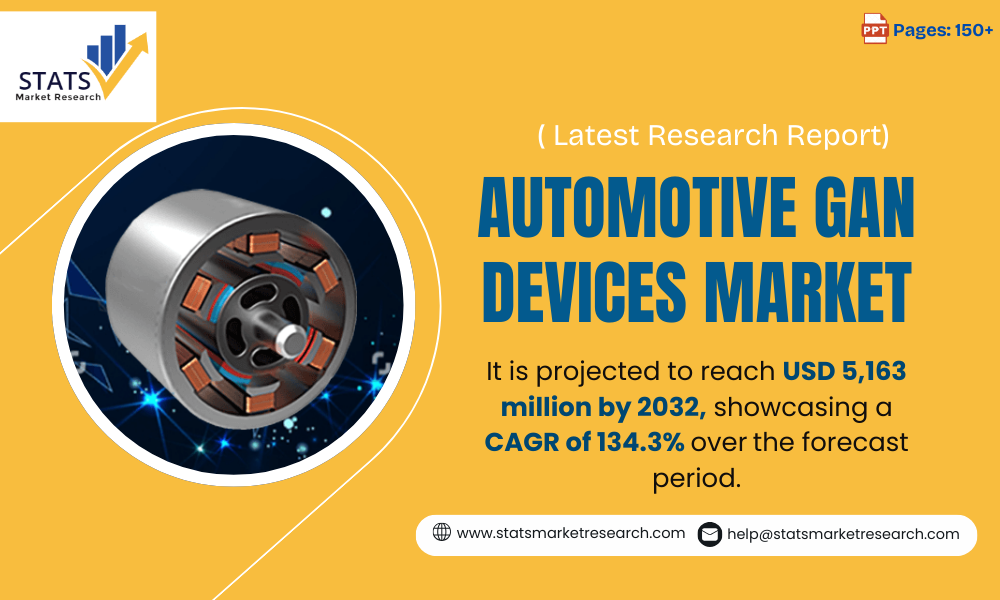
Global Automotive GaN Devices market was valued at USD 8.8 million in 2024, reflecting the nascent stage of adoption in automotive applications. However, the market is projected to grow exponentially, reaching USD 28.6 million in 2025 and an astounding USD 5,163 million by 2032, registering a CAGR of 134.3% during the forecast period.
Download FREE Sample of this Report @ https://www.statsmarketresearch.com/download-free-sample/8060139/global-automotive-gan-devices-forecast-market
This explosive growth is fueled by several factors:
- Rapid EV Adoption: Global electric vehicle sales are expected to account for over 50% of new car sales by 2030. GaN devices improve power conversion efficiency, directly extending EV driving ranges by 3-4% compared to silicon devices.
- ADAS Proliferation: GaN RF devices enhance radar and LiDAR performance, supporting the widespread integration of safety systems like collision avoidance, adaptive cruise control, and lane-keeping assistance.
- High-Frequency Applications: GaN devices enable compact, high-frequency designs, allowing automakers to develop smaller, lighter, and more efficient powertrains and wireless charging systems.
Regional adoption trends highlight Asia-Pacific as the leader due to China’s aggressive EV policy and production scale, followed by Europe and North America where premium automakers are rapidly integrating GaN solutions into next-generation vehicles.
The market is also experiencing significant investment from semiconductor companies like Infineon Technologies, NXP Semiconductor, and Texas Instruments, which are expanding their portfolios to include 650V and 900V automotive-grade GaN devices. Such initiatives underline both the strategic importance of GaN technology and the accelerating industry-wide adoption.
Market Dynamics (Drivers, Restraints, Opportunities, and Challenges)
Drivers
- Accelerated Adoption of Electric Vehicles
The global push toward electrification is the most substantial driver for automotive GaN devices. EV manufacturers are seeking higher efficiency, smaller form factors, and faster charging capabilities. GaN-based converters deliver 3-4% higher efficiency, contributing directly to longer driving ranges. Some premium EVs now achieve 80% charge in under 20 minutes, thanks to GaN-enabled high-speed chargers. - ADAS Proliferation
GaN RF devices are critical for millimeter-wave radar systems, allowing longer detection ranges (200+ meters) and smaller module sizes. Regulatory mandates, such as the EU’s General Safety Regulation, further incentivize ADAS integration, directly increasing GaN device demand. - High-Frequency and High-Efficiency Advantages
GaN devices enable EV powertrains and inverters to operate at higher frequencies with minimal energy losses, providing compact and lightweight solutions critical for modern automotive design.
Restraints
- Supply Chain Maturation Lag
Current 6-inch GaN wafer capacity meets only 60% of projected 2025 demand, creating bottlenecks. Automotive-grade production requires long AEC-Q101 qualification cycles, delaying market availability. - Cost Premium over Silicon
GaN devices still cost 20-30% more than conventional silicon, which slows adoption in mass-market vehicles. - Thermal Management Complexities
High power density requires innovative cooling strategies to maintain junction temperatures below 150°C in automotive environments, increasing system costs by 10-15%.
Opportunities
- Automotive Wireless Charging
High-frequency wireless EV charging (85-140kHz) leverages GaN’s strengths. Prototype systems have demonstrated 94% efficiency at 11kW, outperforming silicon-based designs. Commercial deployment between 2027-2030 could unlock significant market growth. - 48V Mild Hybrid Systems
GaN devices facilitate efficient DC-DC conversion in 48V mild hybrid vehicles, a segment expected to capture 45% of the global light vehicle market by 2028, generating potential demand for 200+ million devices annually. - Integrated GaN Power Stages
Combining driver, protection, and power switch circuitry reduces system footprint by 60%, accelerating adoption in compact EV designs and promoting mainstream use.
Challenges
- Reliability in Harsh Environments
Automotive GaN devices must operate from -40°C to +125°C while withstanding vibration and humidity. Field failures of 3-5% in tropical climates emphasize the need for robust passivation and packaging. - Design Expertise Gap
Only 28% of automotive power electronics teams currently have GaN design expertise, resulting in longer development cycles (6-9 months) and dependency on semiconductor vendors for support. - Thermal and Electrical Engineering Complexity
Optimizing gate drives, minimizing parasitic inductances, and managing high di/dt switching require advanced engineering skills, raising R&D costs and limiting early adoption to well-funded OEMs.
Get the Complete Report & TOC @ https://www.statsmarketresearch.com/global-automotive-gan-devices-forecast-market-8060139
Regional Analysis
Asia-Pacific: Dominates the market, led by China’s aggressive EV initiatives and government incentives. Rapid adoption is also observed in Japan and South Korea.
North America: High adoption in premium EV segments, driven by companies like Tesla integrating GaN power converters into inverters and onboard chargers.
Europe: Regulatory pressures (EU Green Deal, emission targets) encourage GaN integration in EVs and ADAS systems. Germany, France, and the UK are key markets.
Emerging Regions: Southeast Asia, Latin America, and the Middle East show potential due to nascent EV infrastructure investments, presenting long-term growth opportunities.
Competitor Analysis
The global Automotive GaN Devices market is highly competitive, dominated by semiconductor giants and specialized GaN companies.
- Market Leaders: Infineon Technologies, NXP Semiconductor, Texas Instruments, ROHM Co., Ltd
- Strategic Moves: Collaborations with foundries (Tower Semiconductor, WIN Semiconductors) for stable GaN wafer supply, integration of devices into OEM powertrain solutions, and investment in high-efficiency GaN product R&D.
- Emerging Players: Efficient Power Conversion Corporation (GaN pure-play) focusing on optimized device design; Panasonic Automotive Systems integrating GaN into complete subsystems.
The competitive environment emphasizes technology leadership, reliability, supply chain stability, and partnerships with automotive OEMs.
Global Automotive GaN Devices: Market Segmentation Analysis
This report provides a deep insight into the global Automotive GaN Devices market, covering all its essential aspects. This ranges from a macro overview of the market to micro details of the market size, competitive landscape, development trend, niche market, key market drivers and challenges, SWOT analysis, value chain analysis, etc.
The analysis helps the reader to shape the competition within the industries and strategies for the competitive environment to enhance the potential profit. Furthermore, it provides a simple framework for evaluating and assessing the position of the business organization. The report structure also focuses on the competitive landscape of the Global Automotive GaN Devices. This report introduces in detail the market share, market performance, product situation, operation situation, etc., of the main players, which helps the readers in the industry to identify the main competitors and deeply understand the competition pattern of the market.
In a word, this report is a must-read for industry players, investors, researchers, consultants, business strategists, and all those who have any kind of stake or are planning to foray into the Automotive GaN Devices market in any manner.
Market Segmentation (by Application)
- Car Charger
- Inverter
- Motor Drive
- Others
Includes ADAS and infotainment systems
Market Segmentation (by Type)
- Power Device
- GaN FETs
- GaN HEMTs
- Others
- Radio-frequency Device
- GaN RF amplifiers
- Others
Key Company
- NXP Semiconductor (Netherlands)
- Infineon Technologies AG (Germany)
- Panasonic Automotive Systems Co., Ltd (Japan)
- Texas Instruments (U.S.)
- Qorvo Inc (U.S.)
- OSRAM Opto Semiconductors GmbH (Germany)
- ROHM Co., Ltd (Japan)
- Efficient Power Conversion Corporation (U.S.)
- Renesas Electronics Corporation (Japan)
- Toshiba Corporation (Japan)
- MACOM Technology Solutions Holdings, Inc. (U.S.)
- Nexperia (Netherlands)
Geographic Segmentation
- Asia-Pacific
- North America
- Europe
- Latin America
- Middle East & Africa
FAQ
Q1: What is the current market size of the Automotive GaN Devices market?
A1: The market was valued at USD 8.8 million in 2024, projected to grow to USD 5,163 million by 2032 with a CAGR of 134.3%.
Q2: Which are the key companies operating in the Automotive GaN Devices market?
A2: Key players include NXP Semiconductor, Infineon Technologies, Panasonic Automotive Systems, Texas Instruments, ROHM, Efficient Power Conversion Corporation, Qorvo, and Toshiba.
Q3: What are the key growth drivers in the Automotive GaN Devices market?
A3: Major drivers are EV adoption, ADAS proliferation, GaN’s high efficiency and thermal performance, and increasing demand for high-frequency power electronics in automotive applications.
Q4: Which regions dominate the Automotive GaN Devices market?
A4: Asia-Pacific leads due to China’s EV policies, followed by Europe and North America. Emerging markets in Southeast Asia and Latin America are expected to drive long-term growth.
Q5: What are the emerging trends in the Automotive GaN Devices market?
A5: Key trends include wireless EV charging, 48V mild hybrid systems, integrated GaN power stages, and GaN adoption in ADAS radar and LiDAR modules.
About Us
☎️ International: +1 (332) 2424 294
📄 Website: www.statsmarketresearch.com
Join us on LinkedIn:- https://www.linkedin.com/company/statsmarketresearch




