
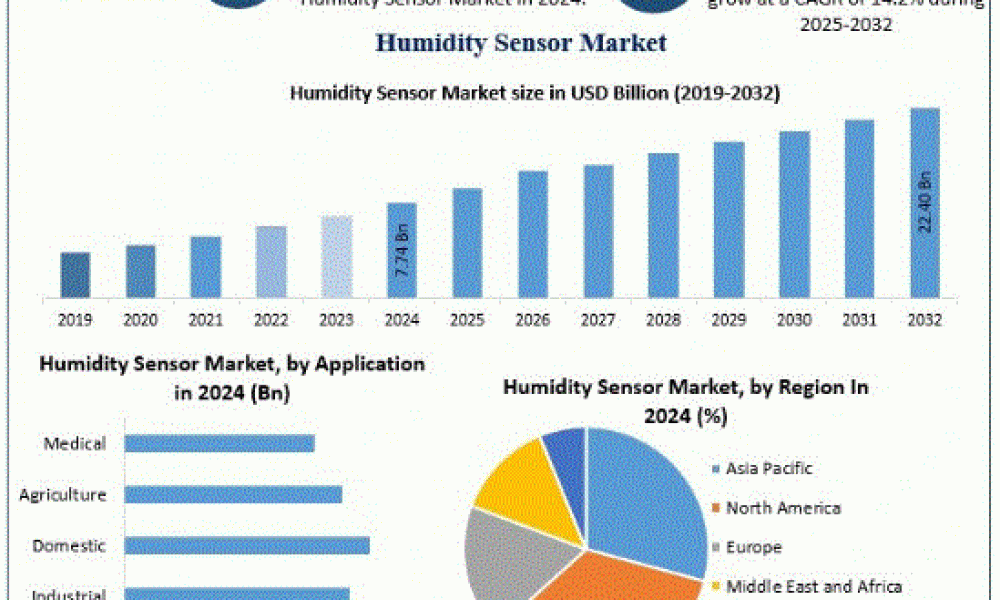
As per a recent study released by Maximize Market Research, titled, “Humidity Sensor Market,” The Humidity Sensor Market, size was valued at USD 7.74 Billion in 2024 and the total Humidity Sensor revenue is expected to grow at a CAGR of 14.2% from 2025 to 2032, reaching nearly USD 22.40 Billion.
Humidity Sensor Market Overview:
Humidity sensors are devices that detect and measure the amount of water vapor in the air—either as absolute humidity (actual moisture content) or relative humidity (percentage compared to saturation at a given temperature). These sensors have become increasingly important in many domains: HVAC systems, smart homes, agriculture, healthcare, food storage, and industrial processing. Their ability to help maintain comfort, ensure safety, protect goods, and support process quality makes them core parts of modern sensing ecosystems.
Recent technology improvements—miniaturization, lower power consumption, increased accuracy, and integration with digital communication protocols—have made humidity sensors more accessible and versatile. They’re no longer just bulk sensor modules; many are embedded in devices, linked to Internet of Things (IoT) platforms, or otherwise integrated into automated control systems. As concerns about climate control, indoor air quality, and environmental regulation grow, so does the requirement for reliable humidity measurement.
Download a Free Sample Report Today :https://www.maximizemarketresearch.com/request-sample/65516/
Humidity Sensor Market Dynamics
One of the strongest drivers for the humidity sensor market is the expanding requirement for environmental monitoring, both in industrial and consumer contexts. Industries such as food & beverages, pharmaceuticals, and electronics are particularly sensitive to humidity fluctuations, which can affect product quality, shelf life, and safety. Meanwhile, consumers are becoming more aware of indoor humidity levels’ effects on health (mold, respiratory issues, comfort). These pressures push building automation, smart thermostats, air purifiers, and HVAC systems to include accurate humidity sensors.
Another dynamic is the push from IoT, smart homes, and smart agriculture. Devices embedded in homes—thermostats, air quality monitors, humidifiers/dehumidifiers—rely on humidity data to automate comfort and energy savings. In agriculture, greenhouses and storage of crops or produce require tight humidity control to avoid spoilage and optimize growth. The drive toward wireless connectivity, low-cost digital sensors, multifunction modules (temperature + humidity, sometimes pressure) and sensor fusion is enabling broader adoption.
Humidity Sensor Market Outlook and Future Trends :
Looking ahead, humidity sensors will see continued integration into connected systems, where real-time feedback, analytics, and adaptive control are expected. For example, sensors with built-in WiFi or Bluetooth, or that connect through mesh networks, will be more common. Also, digital humidity sensors with better stability, lower drift over time, and faster response/recovery times (especially useful in dynamic environments) are likely to be in demand. Printed and flexible sensors (for wearables or embedded applications) are also emerging as growth areas.
Sustainability and energy efficiency will also shape future trends. Sensors that consume less power, last longer, require less maintenance, or operate reliably in harsh or varying environmental conditions will be favored. Also, regulation and standards around indoor air quality, emissions, and environmental safety will likely become stricter in many regions, which will encourage or require more precise and certified humidity measurement. Manufacturers who focus on reliability, durability, low cost, and precise calibration will have a competitive edge.
Humidity Sensor Market Regional Insights:
Asia-Pacific presently dominates in both revenue share and growth pace. This is driven by rapidly expanding industrial infrastructure, increasing adoption of smart devices, growth in automotive, and aggressive deployment of IoT and environmental monitoring. China, India, Japan, and Southeast Asia are leading contributors. The region also tends to have more varied climatic conditions and large potential markets (both for consumer electronics and industrial demand), which magnifies demand for humidity sensing technology.
North America and Europe remain major markets, especially for premium sensors—those with high performance, high reliability, and better environmental and digital integration. These regions have stricter regulatory standards for indoor air quality, strong interest in smart/connected buildings, and substantial usage in healthcare, pharmaceuticals, and industrial sectors. Meanwhile, Latin America, Middle East & Africa are emerging more slowly but are picking up pace due to increasing infrastructure investment, agricultural sensor use, and urbanization.
Humidity Sensor Market Segmentation
by Type
Absolute Humidity Sensors
Relative Humidity Sensors
Others
by Material Type
Semiconducting Metal Oxides
Polymer-Based
Ceramic Sensing
by Application
Residential
Industrial
Domestic
Agriculture
Medical
Others
Some of the current players in the Humidity Sensor Market are:
1. Sensirion AG
2. Honeywell International, Inc
3. GE Inspection Technologies
4. Amphenol Corporation
5. PCE Holdings GmbH
6. Texas Instruments
7. OMRON Corporation
8. Bosch Sensortec GmbH
9. Silicon Laboratories
10. Alps Alpine co., ltd
11. TDK Corporation
12. STMicroelectronics NV
13. TE Connectivity
14. Littelfuse Inc.
15. Continental AG
About Maximize Market Research:
Maximize Market Research is one of the fastest-growing market research and business consulting firms serving clients globally. Our revenue impact and focused growth-driven research initiatives make us a proud partner of majority of the Fortune 500 companies. We have a diversified portfolio and serve a variety of industries such as IT & telecom, chemical, food & beverage, aerospace & defense, healthcare and others.
Contact Maximize Market Research:
MAXIMIZE MARKET RESEARCH PVT. LTD.
⮝ 3rd Floor, Navale IT park Phase 2,
Pune Banglore Highway, Narhe
Pune, Maharashtra 411041, India.
✆ +91 9607365656
🖂 [email protected]




