
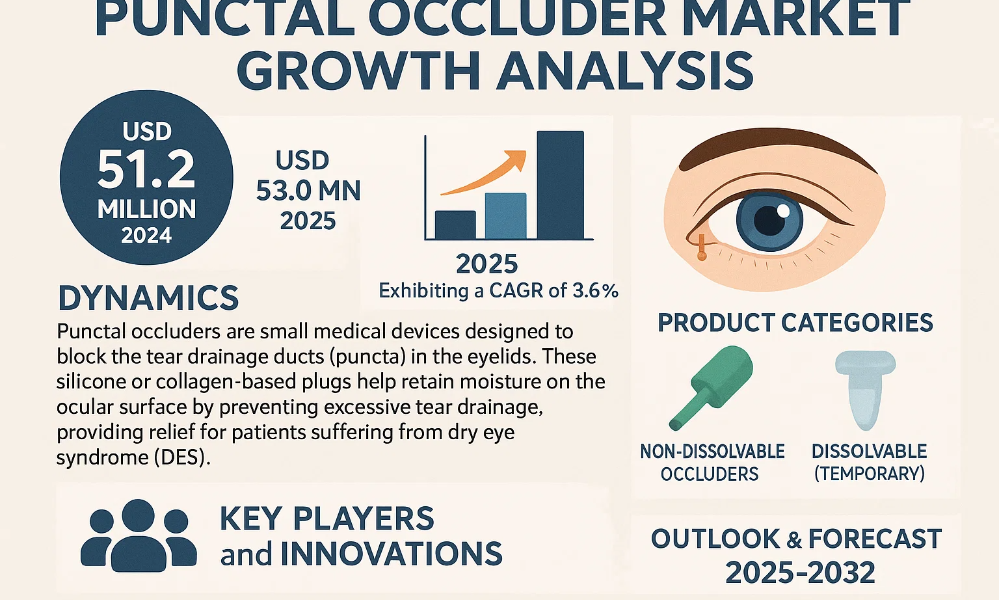
Punctal Occluder Market was valued at USD 51.2 million in 2024. The market is projected to grow from USD 53.0 million in 2025 to USD 65.1 million by 2032, exhibiting a CAGR of 3.6% during the forecast period.
Punctal Occluders are small medical devices designed to block the tear drainage ducts (puncta) in the eyelids. These silicone or collagen-based plugs help retain moisture on the ocular surface by preventing excessive tear drainage, providing relief for patients suffering from dry eye syndrome (DES). The two primary product categories are non-dissolvable (long-term) and dissolvable (temporary) occluders, each serving distinct clinical needs.
Market growth is driven by the rising global prevalence of dry eye disease, which affects approximately 344 million people worldwide according to epidemiological studies. While aging populations and increased screen time contribute to demand, technological advancements in plug materials and minimally invasive insertion techniques are accelerating adoption. Key industry players like Lacrimedics and BVI Medical are expanding their product portfolios, with recent developments focusing on bioresorbable materials that reduce follow-up procedures.
Request Your Free Sample Report- https://www.intelmarketresearch.com/download-free-sample/8502/punctal-occluder-market
MARKET DYNAMICS
MARKET DRIVERS
Rising Prevalence of Dry Eye Syndrome to Fuel Demand for Punctal Occluders
The global increase in dry eye syndrome cases is a primary factor driving the punctal occluder market. Recent epidemiological studies indicate that dry eye disease affects approximately 5-50% of the adult population worldwide, with prevalence rates climbing due to aging populations, increased screen time, and environmental factors. Punctal plugs have become a gold standard treatment option as they effectively retain tears by blocking drainage pathways. Unlike artificial tears which require frequent application, these devices provide long-term relief while reducing dependency on eye drops. The growing awareness about this minimally invasive solution among both patients and clinicians is accelerating adoption rates across healthcare facilities.
Technological Advancements in Ophthalmic Devices Enhance Treatment Efficacy
Innovations in punctal plug materials and designs are significantly improving patient outcomes while expanding market potential. The shift from traditional silicone plugs to advanced hydrogel-based dissolvable variants has reduced complications like extrusion or irritation. Recent product launches feature custom-fit designs with improved retention rates and biocompatibility. For instance, newer smart plugs with drug-eluting capabilities allow controlled release of anti-inflammatory agents directly to the ocular surface. These technological improvements, combined with easier insertion techniques, are encouraging wider clinical acceptance. Furthermore, the integration of 3D printing for patient-specific plugs presents promising opportunities for personalized treatment in the coming years.
Expanding Geriatric Population Drives Market Growth
The aging global population represents a significant demographic driver for the punctal occluder market. Individuals over 65 years have a 70% higher likelihood of developing dry eye syndrome compared to younger adults due to reduced tear production. With the world’s elderly population projected to double by 2050, this creates sustained demand for effective dry eye management solutions. Countries with rapidly aging societies such as Japan, where over 30% of the population is aged 65+, are experiencing particularly strong growth in punctal plug adoption. Medicare and private insurance coverage for these devices in key markets further facilitates access for elderly patients needing long-term treatment.
MARKET OPPORTUNITIES
Emerging Markets Present Significant Untapped Potential
The punctal occluder market holds substantial growth opportunities in developing economies where dry eye prevalence is rising but treatment rates remain low. Rapid urbanization, increasing pollution levels, and growing screen time are causing dry eye incidence to surge across Asia, Latin America, and the Middle East. These regions currently account for under 20% of global punctal plug sales despite representing over 60% of the world population. Local manufacturing initiatives and tiered pricing strategies could make these devices more accessible while creating new revenue streams for manufacturers. Partnerships with regional healthcare providers to raise awareness about dry eye management could further accelerate market penetration in these high-potential areas.
Integration of Digital Health Technologies Creates New Treatment Paradigms
The convergence of ophthalmology and digital health presents innovative opportunities to enhance punctal occluder therapy. Smart plugs embedded with microsensors could monitor tear film parameters and ocular surface health, enabling data-driven treatment adjustments. When combined with mobile health platforms, these connected devices would allow remote patient monitoring and early intervention when needed. Additionally, augmented reality-assisted insertion tools are being developed to improve procedural accuracy for less experienced clinicians. These technological integrations could transform punctal occlusion from a static treatment to a dynamic component of comprehensive digital ophthalmic care, creating new value propositions for healthcare providers and patients alike.
Expanding Indications Beyond Dry Eye Syndrome
Research into new clinical applications for punctal occlusion is uncovering additional market opportunities. Emerging evidence suggests potential benefits in managing other ocular surface disorders like allergic conjunctivitis and post-refractive surgery complications by prolonging therapeutic agent contact time. Some studies are exploring their use in glaucoma management to enhance topical medication efficacy while reducing systemic absorption. The development of specialized plugs with drug delivery capabilities tailored to these specific conditions could significantly expand the addressable market beyond traditional dry eye patients. Such product diversification would enable manufacturers to differentiate their offerings while meeting previously untapped clinical needs.
Segment Analysis:
By Type
- Non-Dissolvable
- Dissolvable
Non-Dissolvable occluders dominate due to their long-term efficacy, particularly in chronic dry eye treatments, while dissolvable variants are preferred for temporary relief.
By Application
- Hospital
- Clinic
- Other
Hospitals lead application demand, driven by higher patient footfall and specialized ophthalmology departments, followed by clinics offering targeted outpatient care.
By Material
- Silicone
- Collagen
- Hydrogel
Silicone-based occluders are most prevalent owing to biocompatibility and durability, whereas collagen plugs are used in short-term therapeutic applications.
By End User
- Ophthalmology Centers
- Ambulatory Surgical Centers
- Specialty Clinics
Ophthalmology Centers remain the primary adopters due to their focus on comprehensive eye care and access to advanced diagnostic tools.
List of Key Punctal Occluder Manufacturers Profiled
- Lacrimedics (U.S.)
- BVI Medical (U.K.)
- I-MED Pharma (Canada)
- Paragon BioTeck (U.S.)
- FCI Ophthalmics (France)
- OASIS Medical (U.S.)
- Corza Medical (U.S.)
PUNCTAL OCCLUDER MARKET TRENDS
Increasing Prevalence of Dry Eye Syndrome to Drive Market Growth
The global punctal occluder market is witnessing steady growth largely due to the rising incidence of dry eye disease (DED), which affects approximately 344 million people worldwide. Punctal plugs have become a first-line treatment for moderate to severe dry eye cases, offering a minimally invasive solution that reduces tear drainage and improves ocular surface moisture. With aging populations and increased screen time contributing to higher DED prevalence, adoption rates of punctal occlusion therapies are projected to grow at a CAGR of 3.6% through 2032. Technological advancements in plug materials, including hydrophilic polymers that expand post-insertion for better retention, are further enhancing treatment efficacy and patient comfort.
Other Trends
Shift Toward Dissolvable Plugs
Temporary punctal plugs now account for nearly 38% of total procedures as clinicians increasingly prefer dissolvable collagen or synthetic polymer options for trial therapies. These bioabsorbable devices eliminate removal procedures while allowing physicians to assess patient response before considering permanent occlusion. Recent product innovations include drug-eluting plugs that combine mechanical occlusion with sustained-release anti-inflammatory medications a dual-action approach showing promise in clinical trials for treating post-surgical dry eye complications.
Request Your Free Sample Report- https://www.intelmarketresearch.com/download-free-sample/8502/punctal-occluder-market
Recent Developments in the Punctal Occluder Market
- Technological Advancements in Materials
Recent developments focus on biocompatible and dissolvable materials for punctal occluders. Manufacturers are introducing collagen-based and extended-duration absorbable plugs that provide temporary relief for dry eye while minimizing complications like irritation or extrusion. - Rise of Drug-Eluting Occluders
A growing trend is the development of drug-eluting punctal occluders that deliver anti-inflammatory drugs or lubricants directly into the tear ducts. This innovation helps in treating not just dry eye syndrome, but also associated conditions like ocular surface inflammation. - Expanding Applications Beyond Dry Eye
Traditionally used for dry eye management, punctal occluders are now being researched for post-surgical recovery in refractive surgery patients and in cases of ocular surface diseases, broadening their clinical application scope. - Mergers & Collaborations
Key companies are collaborating with ophthalmology clinics and research institutes to develop customized occluders with varying sizes and shapes, ensuring better comfort and long-term patient compliance. Strategic mergers and acquisitions are also observed in the ophthalmic device industry, which indirectly benefits punctal occluder innovation and market growth. - Patient-Centric Designs
Newer designs emphasize minimally invasive insertion techniques and occluders that remain stable for long periods without requiring frequent replacements. This has led to innovations such as permanent silicone plugs with improved retention mechanisms. - Rising Demand Driven by Dry Eye Prevalence
With increasing cases of dry eye syndrome linked to digital screen usage, aging, and environmental factors, manufacturers are expanding production capacity and global distribution networks. In 2025, several companies announced investments in R&D to enhance long-duration, cost-effective occluders. - Regulatory Approvals & Clinical Trials
Several firms are conducting clinical trials for new-generation punctal plugs to demonstrate long-term safety and efficacy. Regulatory bodies in the U.S., Europe, and Asia are streamlining approval processes for innovative designs, accelerating market entry.
About Intel Market Research
Intel Market Research delivers actionable insights in technology and infrastructure markets. Our data-driven analysis leverages:
- Real-time infrastructure monitoring
- Techno-economic feasibility studies
Competitive intelligence across 100+ countries
Trusted by Fortune 500 firms, we empower strategic decisions with precision.
International: +1(332) 2424 294 | Asia: +91 9169164321
Website: https://www.intelmarketresearch.com
Follow us on LinkedIn: https://www.linkedin.com/company/intel-market-research
Market Research Reports | Market Trends | SWOT Analysis | Industrial Survey – Intelmarketresearch
Intel market research provides market research reports and company research reports across worldwide industries. We also offers customized market research solutions




