
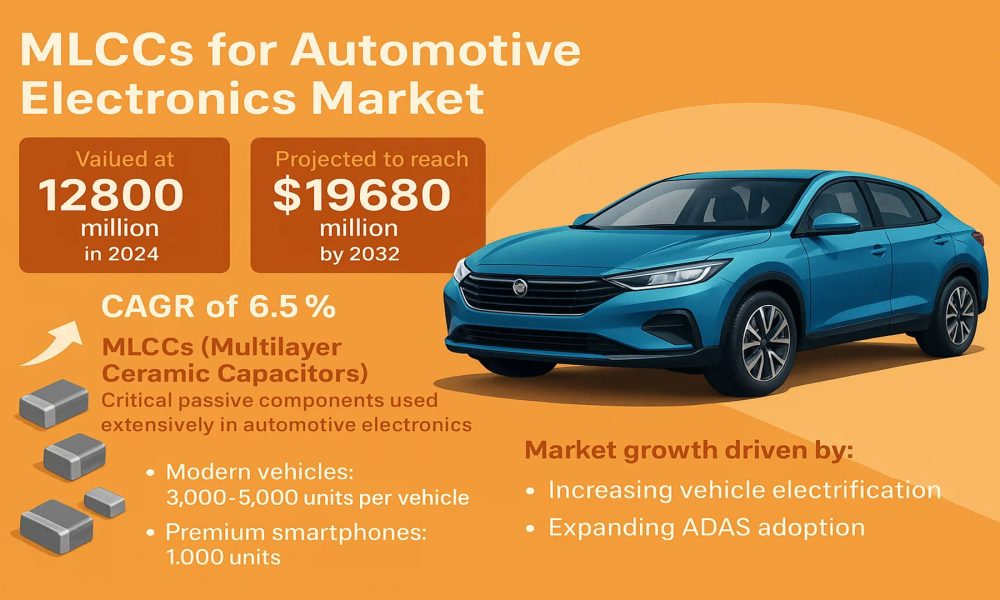
MLCCs for Automotive Electronics Market was valued at 12800 million in 2024 and is projected to reach US$ 19680 million by 2032, at a CAGR of 6.5% during the forecast period.
MLCCs (Multilayer Ceramic Capacitors) are critical passive components used extensively in automotive electronics to stabilize semiconductor operations and regulate power signals. These miniature, high-capacitance components excel in harsh automotive environments, with modern vehicles utilizing 3,000-5,000 units per vehicle. For perspective, this dwarfs the 1,000 MLCCs typically found in premium smartphones, underscoring automotive’s dominance in this sector.
The market growth is primarily driven by increasing vehicle electrification and expanding ADAS (Advanced Driver Assistance Systems) adoption. While Asia dominates production with 56% market share (led by China’s 32% contribution), Japan remains the top exporter with 3.5 million vehicles shipped in 2022. Recent developments include material innovations for higher temperature tolerance and miniaturization breakthroughs from leaders like Murata and TDK, addressing the industry’s demand for space-efficient, high-reliability solutions.
Get Your Free Sample Report Today-https://semiconductorinsight.com/download-sample-report/?product_id=107178
MARKET DYNAMICS
MARKET DRIVERS
Accelerated Electrification of Vehicles Boosts MLCC Adoption
The rapid shift toward electric vehicles (EVs) is significantly driving demand for MLCCs in automotive applications. Modern electric vehicles require up to 10,000 MLCCs per vehicle, nearly double the number used in traditional internal combustion engine vehicles. This increased component density stems from EV-specific systems like battery management, power inverters, and advanced driver-assistance systems (ADAS). With global EV production projected to grow at a compound annual growth rate of nearly 30% through 2030, this trend creates substantial opportunities for MLCC manufacturers.
Proliferation of Advanced Driver Assistance Systems Accelerates Demand
ADAS technologies including collision avoidance, lane keeping assist, and autonomous driving features require high-reliability MLCCs with exceptional performance in harsh automotive environments. The average vehicle’s ADAS system utilizes 500-800 specialized MLCCs, with premium vehicles containing even more. Industry projections indicate the ADAS market will expand significantly as regulatory mandates and consumer demand for safety features increase globally. This creates parallel growth opportunities for automotive-grade MLCCs that meet stringent AEC-Q200 qualification standards.
Miniaturization Trend Pushes Innovation in MLCC Design
Vehicle manufacturers continue demanding smaller components to accommodate more electronics in limited space. This has driven MLCC producers to develop ultra-compact solutions, with packages shrinking from 0603 size (0.06″ x 0.03″) to 0201 and even 01005 dimensions while maintaining or increasing capacitance values. The miniaturization trend allows for higher component density on circuit boards, enabling more sophisticated automotive electronics without increasing physical footprint. While this creates engineering challenges, it also stimulates R&D investment in advanced materials and production techniques.
Recent Developments:MLCCs for Automotive Electronics Market
- Murata Manufacturing expanded its production capacity for high-reliability MLCCs targeted at automotive powertrain and ADAS applications.
- Samsung Electro-Mechanics introduced advanced MLCCs with enhanced heat resistance for electric vehicles (EVs) and hybrid vehicles.
- TDK Corporation developed ultra-compact MLCCs designed for autonomous driving systems, supporting high-frequency and high-voltage stability.
- Taiyo Yuden announced new high-capacitance MLCCs tailored for EV inverters and battery management systems, boosting performance in harsh environments.
- Yageo Corporation strengthened its automotive MLCC portfolio with AEC-Q200 certified products to meet rising demand for connected and smart vehicles.
- KEMET (Yageo Group) launched high-reliability ceramic capacitors with extended operating temperature range for EV charging infrastructure.
MARKET OPPORTUNITIES
Vehicle Connectivity Innovations Open New Application Areas
The proliferation of vehicle-to-everything (V2X) communication technologies creates demand for high-frequency MLCCs optimized for RF applications. Next-generation telematics, 5G vehicle connectivity, and satellite communication systems require specialized components with stable high-Q characteristics across broad frequency ranges. This emerging application area represents a potential growth vector for manufacturers able to develop components that meet both automotive environmental requirements and stringent RF performance specifications.
Regional Expansion Strategies Address Supply Chain Concerns
Recent supply chain disruptions have prompted MLCC manufacturers to diversify production geographically. Establishing manufacturing facilities closer to major automotive production hubs in North America and Europe creates opportunities to reduce lead times and mitigate logistics risks. Several leading suppliers have announced multi-year investments in regional production capacity, which could allow for closer collaboration with automotive OEMs and more responsive supply chains tailored to regional market requirements.
Advanced Materials Enable Next-Generation Solutions
Material science breakthroughs present opportunities to develop MLCCs with unprecedented performance characteristics. Innovations in dielectric formulations promise components with higher capacitance density, improved temperature stability, and enhanced reliability. Emerging techniques like atomic layer deposition enable thinner, more uniform dielectric layers that could revolutionize MLCC performance. Manufacturers investing in these advanced material technologies stand to gain competitive advantage as automotive electronics continue pushing the boundaries of component requirements.
Get Your Free Sample Report Today-https://semiconductorinsight.com/download-sample-report/?product_id=107178
List of Key MLCC Manufacturers Profiled
- Murata Manufacturing Co., Ltd. (Japan)
- Samsung Electro-Mechanics (South Korea)
- TDK Corporation (Japan)
- Vishay Intertechnology (U.S.)
- Taiyo Yuden (Japan)
- Yageo Corporation (Taiwan)
- KYOCERA AVX (U.S.)
- Walsin Technology Corporation (Taiwan)
- Holy Stone Enterprise Co. Ltd. (Taiwan)
- Fenghua Advanced Technology (China)
Segment Analysis:
By Type
General Purpose Series MLCCs Lead the Market Owing to Wide Adoption in Standard Automotive Applications
The market is segmented based on type into:
- General Purpose Series
- Subtypes: Standard capacitance, low-voltage variants, and others
- Ultra Small Size Series
- High Voltage Series
- Subtypes: 100V, 200V, 500V, and others
- Soft Termination Series
- High Q for High Frequency Communication Series
- High Reliability Series
- Low Inductance Series
By Application
OEM Segment Dominates Due to Increasing Integration of Electronics in Modern Vehicles
The market is segmented based on application into:
- OEM
- Aftermarket
By Vehicle Type
Passenger Vehicles Hold Largest Share Due to Rising Electronic Content per Vehicle
The market is segmented based on vehicle type into:
- Passenger Vehicles
- Commercial Vehicles
- Electric Vehicles
By Mounting Technology
Surface Mount Technology Prevalent Due to Miniaturization Trends in Automotive Electronics
The market is segmented based on mounting technology into:
- Surface Mount
- Through Hole
Other Topic-Anti-Drone Jamming System Market
CONTACT US:
City vista, 203A, Fountain Road, Ashoka Nagar, Kharadi, Pune, Maharashtra 411014
[+91 8087992013]




