
Definition
High-speed operational amplifiers (OpAmps) are analog integrated circuits designed to process signals at high speeds while maintaining high precision. Characterized by gain bandwidth products (GBW) exceeding 50 MHz, these amplifiers can convert small differential voltage inputs into amplified single-ended outputs with high fidelity. They are critical components in systems requiring fast and accurate analog signal processing.
Key applications include:
- Instrumentation Systems: High-speed OpAmps amplify weak signals from sensors and measurement devices, ensuring accurate data acquisition and signal conditioning.
- Telecommunications: Ultra-fast analog components in 5G and broadband infrastructure enable high-frequency signal processing.
- Medical Diagnostics: Devices such as imaging systems, patient monitors, and portable diagnostics rely on low-noise, high-speed amplifiers for precision performance.
- Industrial Automation: Robotics, motor control, and smart sensors require real-time signal processing for efficient operation.
High-speed OpAmps can be configured as single-channel, dual-channel, or multi-channel, providing designers with options to balance performance, cost, and integration requirements. These components are increasingly critical as industries adopt higher-frequency, high-performance analog solutions.
Recent Developments
The high-speed operational amplifier (op-amp) market is driven by the increasing need for high-speed data acquisition and precision analog signal processing in various applications. A key development is the growing demand from sectors like 5G infrastructure, telecommunications, and consumer electronics, which require amplifiers with bandwidths extending into the gigahertz range. Manufacturers are focusing on creating more compact, energy-efficient, and low-power op-amps to meet the needs of battery-powered and portable devices. There is also a strong trend toward specialized op-amps for specific applications, such as automotive-grade components with wider temperature ranges and advanced electromagnetic interference protection, as well as precision op-amps for medical and scientific instruments.
Major Distribution Channels
The distribution of high-speed op-amps is a specialized process that primarily involves direct sales from manufacturers, authorized electronic component distributors, and online marketplaces. Major semiconductor companies like Texas Instruments and Analog Devices often have direct sales teams to handle large-volume orders from original equipment manufacturers (OEMs). However, a significant portion of the market is served by authorized distributors, such as Mouser Electronics and Digi-Key, who provide a wide range of products from multiple manufacturers. These distributors are crucial for engineers and companies with smaller-volume needs, offering a convenient way to purchase components for prototyping and small-scale production. Additionally, the rise of e-commerce has made it easier for customers to access detailed product information and purchase components online, making the online channel an increasingly important part of the distribution landscape.
Market Size
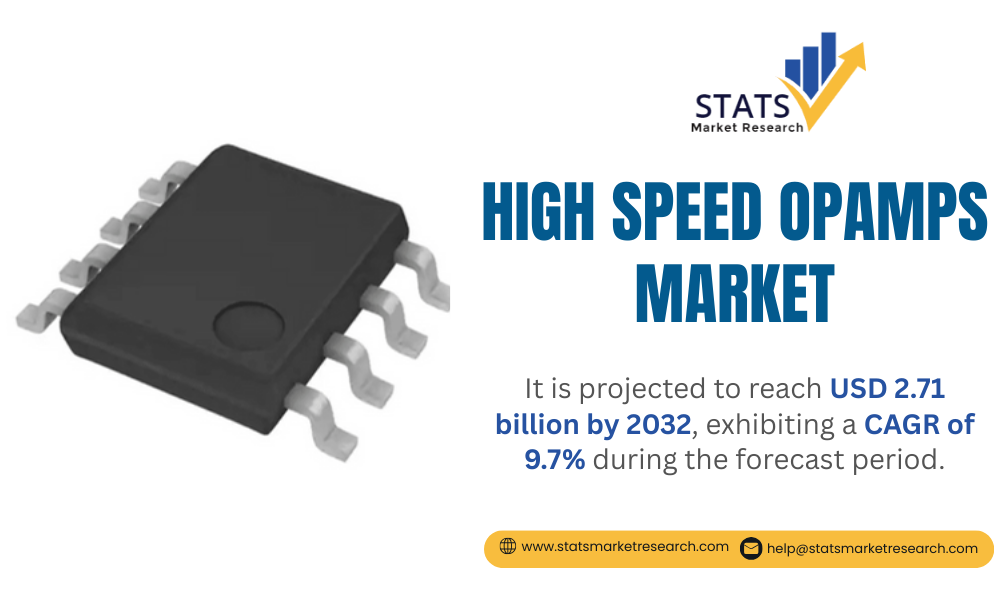
Global high-speed OpAmps market was valued at USD 1.44 billion in 2024 and is projected to reach USD 2.71 billion by 2032, growing at a CAGR of 9.7% during the forecast period.
Key Market Insights:
- Application Segmentation: Instrumentation leads with 38% market share, followed by telecommunications and industrial automation.
- Product Segmentation: Single-channel amplifiers dominate with a 48% share due to design simplicity and cost-effectiveness.
- Regional Leadership: North America holds 36% market share, with Asia-Pacific emerging due to electronics manufacturing expansion.
- Technological Trends: Innovations in low-noise architectures for 5G infrastructure and portable medical devices are driving adoption.
Historically, demand has been fueled by the rapid rollout of 5G networks, expansion in industrial automation, and the growing need for precise analog components in medical and aerospace systems. With industries increasingly seeking higher frequency performance and reduced latency, the market is poised for sustained growth over the coming decade.
Download FREE Sample of this Report @ https://www.statsmarketresearch.com/download-free-sample/8058470/global-high-speed-opamps-forecast-market
Market Dynamics
Drivers
Growing Demand for High-Speed Data Acquisition Systems
The proliferation of data acquisition systems across industries is propelling demand for high-speed OpAmps. Key drivers include:
- Instrumentation Applications: Require amplifiers capable of bandwidths >50 MHz.
- Telecommunications: 5G rollout necessitates ultra-fast analog signal processing.
- Medical Diagnostics: High-resolution imaging and monitoring devices demand precision amplifiers with ultra-low noise characteristics.
Industrial Automation Expansion
Industry 4.0 technologies are increasing the need for real-time signal processing in robotics, motor control, and smart sensors. High-speed OpAmps must provide stability at high frequencies while minimizing power consumption. Dual-channel and multi-channel configurations, representing over 52% of the market, are increasingly deployed for complex industrial systems.
Leading manufacturers like Texas Instruments and Analog Devices are launching product families optimized for industrial automation, balancing speed, precision, and energy efficiency. Emerging economies, particularly in Asia-Pacific, are adopting automation at an accelerated pace, creating further demand.
Restraints
Design Complexity and Signal Integrity Challenges
Maintaining signal integrity at bandwidths above 50 MHz is technically challenging. Miniaturization increases parasitic effects, complicating board-level design. About 65% of engineers report difficulty in achieving optimal performance in complex mixed-signal systems.
Supply Chain Disruptions
Specialized high-speed OpAmps face longer lead times and supply volatility. The top five manufacturers control over 68% of the market, making supply chain stability critical for system designers. Shortages sometimes force designers to use lower-speed alternatives in non-critical applications.
Opportunities
Aerospace and Defense Applications
Radar systems, satellite communications, and electronic warfare require amplifiers that perform reliably in extreme environments. High-speed OpAmps can operate across temperature ranges from -55°C to +175°C with minimal degradation. North America’s defense budgets are supporting investment in advanced electronic systems, driving market growth.
Advancements in Packaging Technologies
Innovations like wafer-level chip-scale packages (WLCSP) and system-in-package (SiP) configurations enable compact, high-frequency designs. These are critical for portable medical devices and aerospace electronics where space constraints are significant. Manufacturers investing in advanced packaging can capture growing demand for miniature, high-performance analog solutions.
Challenges
Thermal Management at High Frequencies
Power dissipation increases with frequency, creating thermal constraints. Approximately 40% of high-speed amplifier failures are thermal-related, particularly in multi-channel designs. Thermal mitigation often increases system cost.
Testing and Validation Complexity
High-speed amplifiers require specialized equipment to verify performance at multi-GHz frequencies. Limited access to such equipment delays development cycles.
Cost Pressure from Competing Technologies
Integrated digital signal processing and advanced data converters offer lower-cost alternatives in high-volume applications, exerting pricing pressure on discrete high-speed amplifiers.
Regional Analysis
North America:
- Dominates with 36% revenue share
- Mature market with strong demand from industrial, telecommunications, and defense sectors
- Key players: Texas Instruments, Analog Devices
Europe:
- Growth driven by industrial automation and laboratory equipment
- STMicroelectronics and ROHM Semiconductor expanding presence
Asia-Pacific:
- Rapid electronics manufacturing growth and industrialization
- Emerging economies adopting automation and precision instrumentation
- Cost-effective products from Gainsil Semiconductor and Corebai Microelectronics
Latin America & Middle East/Africa:
- Niche markets with growing adoption in aerospace and industrial applications
Competitor Analysis
Key Players and Market Strategies:
- Texas Instruments (U.S.) – ~28% revenue share, broad high-bandwidth portfolio, strong industrial distribution
- Analog Devices (U.S.) – 22% revenue share, high-frequency precision amplifiers for test and measurement
- STMicroelectronics (Switzerland) – Specialized low-power high-speed solutions, 17% analog segment growth in 2024
- ROHM Semiconductor (Japan) – Focused on low-power amplifiers for battery-operated devices
- Gainsil Semiconductor Technology (China) – Cost-optimized alternatives for consumer electronics
- Renesas Electronics (Japan), Corebai Microelectronics (China), SGMICRO (China), Jiangsu Runshi Technology (China) – Emerging players expanding with innovative high-speed architectures
Strategies include product portfolio expansion, advanced packaging, low-noise designs, and investments in SiGe and advanced CMOS technologies to achieve higher speeds with lower power consumption.
Get the Complete Report & TOC @ https://www.statsmarketresearch.com/global-high-speed-opamps-forecast-market-8058470
Global High-Speed OpAmps: Market Segmentation Analysis
This report provides a deep insight into the global high-speed OpAmps market, covering all its essential aspects. This ranges from a macro overview of the market to micro details of the market size, competitive landscape, development trend, niche market, key market drivers and challenges, SWOT analysis, value chain analysis, etc.
The analysis helps the reader to shape the competition within the industries and strategies for the competitive environment to enhance potential profit. Furthermore, it provides a simple framework for evaluating and assessing the position of the business organization. The report structure also focuses on the competitive landscape of the Global High-Speed OpAmps. This report introduces in detail the market share, market performance, product situation, operation situation, etc., of the main players, which helps the readers in the industry to identify the main competitors and deeply understand the competition pattern of the market.
In a word, this report is a must-read for industry players, investors, researchers, consultants, business strategists, and all those who have any kind of stake or are planning to foray into the high-speed OpAmps market in any manner.
Market Segmentation (by Application)
- Instrumentation
- Laboratory Equipment
- Medical Systems
- Patient Monitoring
- Imaging Systems
- Telecommunications
- Industrial Automation
Market Segmentation (by Type)
- Single Channel
- Voltage feedback
- Current feedback
- Dual Channel
- Multi-Channel
- Quad channel
- Octal channel
Key Company
- Texas Instruments (U.S.)
- Analog Devices (U.S.)
- STMicroelectronics (Switzerland)
- Renesas Electronics (Japan)
- ROHM Semiconductor (Japan)
- Corebai Microelectronics (China)
- SGMICRO (China)
- Jiangsu Runshi Technology (China)
- Gainsil Semiconductor Technology (China)
Geographic Segmentation
- North America
- Europe
- Asia Pacific
- Latin America
- Middle East & Africa
FAQ Section
Q1: What is the current market size of the High-Speed OpAmps market?
The global high-speed OpAmps market was valued at USD 1.44 billion in 2024 and is projected to reach USD 2.71 billion by 2032, at a CAGR of 9.7%.
Q2: Which are the key companies operating in the High-Speed OpAmps market?
Key players include:
- Texas Instruments
- Analog Devices
- STMicroelectronics
- Renesas Electronics
- ROHM Semiconductor
Q3: What are the key growth drivers in the High-Speed OpAmps market?
- Rising demand for high-speed data acquisition systems
- Industrial automation and Industry 4.0 adoption
- Advancements in medical imaging and telecommunications
Q4: Which regions dominate the High-Speed OpAmps market?
North America dominates with 36% revenue share, followed by Europe and Asia-Pacific, where industrialization and electronics manufacturing are rapidly growing.
Q5: What are the emerging trends in the High-Speed OpAmps market?
- Aerospace and defense applications
- Advanced packaging technologies (WLCSP, SiP)
- Low-noise, energy-efficient high-speed designs
- SiGe and advanced CMOS for next-generation analog solutions
About Us
☎️ International: +1 (332) 2424 294
📄 Website: www.statsmarketresearch.com
Join us on LinkedIn:- https://www.linkedin.com/company/statsmarketresearch




