
Definition
Food microencapsulation is a sophisticated technology used to encapsulate bioactive ingredients, flavors, enzymes, probiotics, vitamins, and minerals in a protective coating. This encapsulation shields sensitive components from adverse environmental conditions such as heat, moisture, light, and oxygen, ensuring their stability, bioavailability, and controlled release in food systems. The microencapsulation process uses various techniques, including spray drying, coacervation, liposomal entrapment, and extrusion, to achieve precise encapsulation and functional performance.
Microencapsulation is widely applied in the functional foods, nutraceuticals, and dietary supplement industries to enhance the efficacy and shelf life of bioactive ingredients. It also provides opportunities for improving taste masking, controlling ingredient release, and enabling fortification of food products without compromising texture or sensory attributes. This technology is increasingly critical in the global food and beverage industry due to growing consumer demand for healthier, nutrient-rich, and functional food products.
Recent Developments in the Food Microencapsulation Market
The food microencapsulation market is experiencing dynamic growth driven by the rising demand for functional foods, fortified ingredients, and enhanced food preservation techniques. A key development is the increasing use of advanced encapsulation methods, such as spray-drying and emulsion technologies, to protect sensitive ingredients like probiotics, omega-3 fatty acids, and vitamins from degradation caused by heat, light, and oxidation. This not only extends a product’s shelf life but also improves the bioavailability and targeted delivery of these beneficial compounds. Another significant trend is the focus on natural and biodegradable wall materials, such as plant-based proteins and carbohydrates, to align with consumer preferences for clean-label products. Furthermore, the integration of smart technologies, including sensors and controlled-release mechanisms, is an emerging area, allowing for the precise release of flavors or active ingredients in response to specific environmental cues, like changes in pH or temperature.
Major Distribution Channels
The distribution of food microencapsulation ingredients is primarily business-to-business (B2B), as the final products are rarely sold directly to consumers. The most significant channel is direct sales to major food and beverage manufacturers. These companies, which produce everything from fortified cereals and functional beverages to baked goods and dairy products, work closely with microencapsulation suppliers to incorporate these specialized ingredients into their formulations. This channel is characterized by long-term contracts and technical collaboration to ensure the encapsulated ingredients meet specific product and processing requirements. A secondary, but also important, channel is through ingredient distributors and suppliers. These companies provide a wider range of products to a more diverse clientele, including smaller-scale food producers, startups, and R&D labs that may not have the capacity for direct procurement from large manufacturers. The rise of e-commerce platforms and specialized ingredient marketplaces has also made it easier for smaller companies to access these advanced food technologies.
Market Size
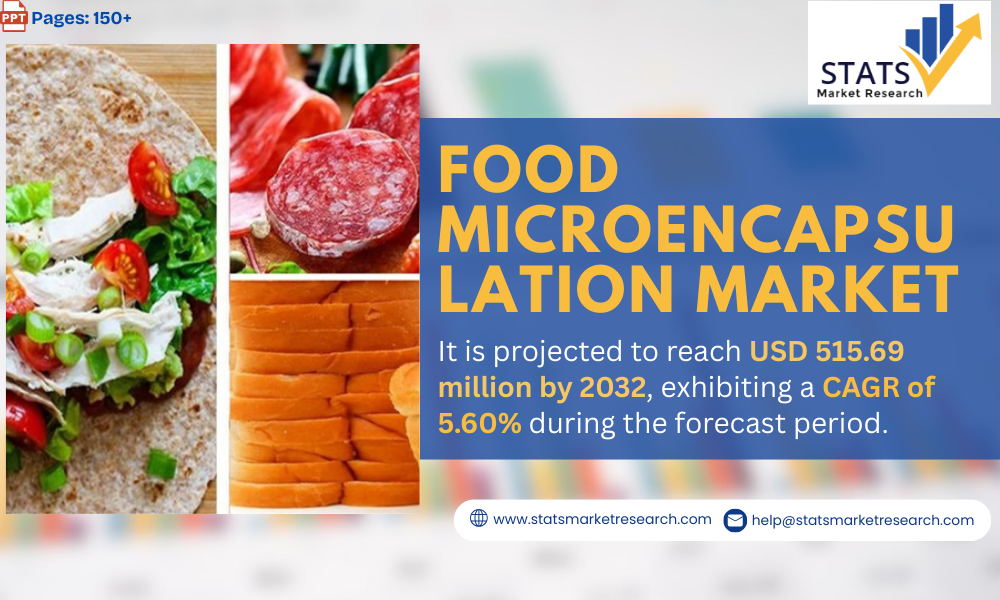
Global Food Microencapsulation market was valued at USD 315.80 million in 2024 and is projected to reach USD 515.69 million by 2032, exhibiting a CAGR of 5.60% during the forecast period. The North America Food Microencapsulation market size was USD 90.38 million in 2024, with a projected CAGR of 4.80% from 2025 to 2032.
The market’s growth is driven by increasing demand for fortified and functional food products, rising health awareness, and technological advancements in encapsulation techniques. Over the past decade, there has been significant adoption of microencapsulation for vitamins, omega-3 fatty acids, probiotics, and plant extracts, particularly in beverages, dairy, bakery, and ready-to-eat products. With evolving consumer preferences for clean-label and natural ingredients, manufacturers are leveraging microencapsulation to protect sensitive ingredients while delivering targeted nutritional benefits.
The expansion of the nutraceutical and functional food markets globally directly correlates with the growth of food microencapsulation. Advanced encapsulation technologies allow manufacturers to enhance the stability of bioactive compounds during processing, storage, and consumption, thereby driving adoption in diverse food formulations.
Download FREE Sample of this Report @ https://www.statsmarketresearch.com/download-free-sample/8040855/global-food-microencapsulation-market
Market Dynamics (Drivers, Restraints, Opportunities, and Challenges)
Drivers
- Rising Demand for Functional and Fortified Foods: Consumers increasingly seek foods enriched with vitamins, minerals, probiotics, and antioxidants. Microencapsulation ensures these ingredients remain stable and effective until consumption.
- Technological Advancements in Encapsulation Techniques: Innovations such as liposomal encapsulation, coacervation, and nanoencapsulation enhance ingredient stability, improve controlled release, and expand functional applications.
- Growth of the Nutraceutical Industry: As the nutraceutical market grows, manufacturers are increasingly adopting microencapsulation to deliver bioactive compounds effectively in dietary supplements and functional foods.
- Enhanced Shelf Life and Product Quality: Food microencapsulation protects sensitive ingredients from environmental stressors, reducing degradation and improving product stability, leading to higher consumer acceptance.
Restraints
- High Production Costs: Advanced encapsulation technologies involve high operational costs, specialized equipment, and skilled labor, which may limit adoption for small-scale manufacturers.
- Regulatory Compliance: Compliance with food safety regulations in different regions, including GRAS (Generally Recognized As Safe) approvals, can be complex and slow down product development.
- Consumer Awareness Limitations: Limited consumer knowledge regarding the benefits of microencapsulated ingredients may restrict market expansion in some regions.
Opportunities
- Expansion in Emerging Markets: Increasing disposable income and health-conscious consumers in Asia-Pacific and Latin America present significant growth potential.
- Innovative Applications in Beverages and Dairy: Microencapsulation enables the fortification of beverages, yogurts, and dairy-based products with vitamins, minerals, and probiotics without affecting taste or stability.
- Development of Personalized Nutrition Products: Microencapsulation supports precision nutrition by enabling controlled release of nutrients based on individual dietary requirements.
Challenges
- Technical Complexity: Developing efficient encapsulation processes for heat-sensitive or water-soluble ingredients remains challenging.
- Integration in Complex Food Matrices: Compatibility with diverse food products, maintaining taste, texture, and appearance, requires extensive research and development.
- Competition from Alternative Delivery Methods: Other ingredient stabilization methods, such as emulsions and gels, may compete with microencapsulation in certain applications.
Regional Analysis
- North America: Dominates the market due to high adoption of functional foods, nutraceutical products, and regulatory support. The U.S. is a leading contributor, driven by increasing health awareness and demand for fortified products.
- Europe: Growth is fueled by strong demand for clean-label foods, organic products, and fortified functional foods. Countries like Germany, the UK, and France are major contributors.
- Asia-Pacific: Expected to witness the fastest growth due to rising disposable income, increasing health consciousness, and expanding functional food markets in China, India, and Japan.
- Latin America & MEA: Steady growth is observed, driven by increasing urbanization, dietary supplement consumption, and investments in food processing infrastructure.
Competitor Analysis (in brief)
The Food Microencapsulation market exhibits a competitive landscape with key players focusing on innovation, strategic partnerships, and expansion to gain market share.
- Reed Pacific and Aveka: Specializes in advanced microencapsulation solutions for functional foods and dietary supplements.
- Lipo Technologies: Known for liposomal encapsulation technology enhancing bioavailability of nutrients.
- GAT Food Microencapsulation: Focuses on large-scale industrial encapsulation processes for food and beverage applications.
- Microtek Laboratories: Provides customized encapsulation solutions for probiotics, enzymes, and sensitive bioactives.
Market leaders are leveraging R&D investments to develop innovative solutions, improve ingredient stability, and expand applications across beverages, dairy, and nutraceutical products.
Get the Complete Report & TOC @ https://www.statsmarketresearch.com/global-food-microencapsulation-market-8040855
Global Food Microencapsulation Market: Market Segmentation Analysis
This report provides a deep insight into the global Food Microencapsulation market, covering all its essential aspects. This ranges from a macro overview of the market to micro details of the market size, competitive landscape, development trend, niche market, key market drivers and challenges, SWOT analysis, value chain analysis, etc. The analysis helps the reader to shape the competition within the industries and strategies for the competitive environment to enhance the potential profit. Furthermore, it provides a simple framework for evaluating and assessing the position of the business organization. The report structure also focuses on the competitive landscape of the Global Food Microencapsulation Market. This report introduces in detail the market share, market performance, product situation, operation situation, etc., of the main players, which helps the readers in the industry to identify the main competitors and deeply understand the competition pattern of the market.
In a word, this report is a must-read for industry players, investors, researchers, consultants, business strategists, and all those who have any kind of stake or are planning to foray into the Food Microencapsulation market in any manner.
Market Segmentation (by Application)
- Pharmaceutical & Healthcare Products
- Household Applications
Market Segmentation (by Type)
- Liquid
- Solid
Key Company
- Reed Pacific and Aveka
- Lipo Technologies
- GAT Food Microencapsulation
- Microtek Laboratories
Geographic Segmentation
- North America (USA, Canada, Mexico)
- Europe (Germany, UK, France, Russia, Italy, Rest of Europe)
- Asia-Pacific (China, Japan, South Korea, India, Southeast Asia, Rest of Asia-Pacific)
- South America (Brazil, Argentina, Columbia, Rest of South America)
- The Middle East and Africa (Saudi Arabia, UAE, Egypt, Nigeria, South Africa, Rest of MEA)
FAQ
Q1. What is the current market size of the Food Microencapsulation market?
A: The global Food Microencapsulation market was valued at USD 315.80 million in 2024 and is projected to reach USD 515.69 million by 2032.
Q2. Which are the key companies operating in the Food Microencapsulation market?
A: Key companies include:
- Reed Pacific and Aveka
- Lipo Technologies
- GAT Food Microencapsulation
- Microtek Laboratories
Q3. What are the key growth drivers in the Food Microencapsulation market?
A: Key drivers include rising demand for functional and fortified foods, technological advancements in encapsulation, growth of the nutraceutical industry, and enhanced ingredient stability.
Q4. Which regions dominate the Food Microencapsulation market?
A: North America dominates the market, followed by Europe and Asia-Pacific, which is expected to grow rapidly due to increasing health-conscious consumers.
Q5. What are the emerging trends in the Food Microencapsulation market?
A: Emerging trends include nanoencapsulation, liposomal encapsulation, expansion in beverages and dairy applications, and personalized nutrition solutions.
About Us
☎️ International: +1 (332) 2424 294
📄 Website: www.statsmarketresearch.com
Join us on LinkedIn:- https://www.linkedin.com/company/statsmarketresearch




