
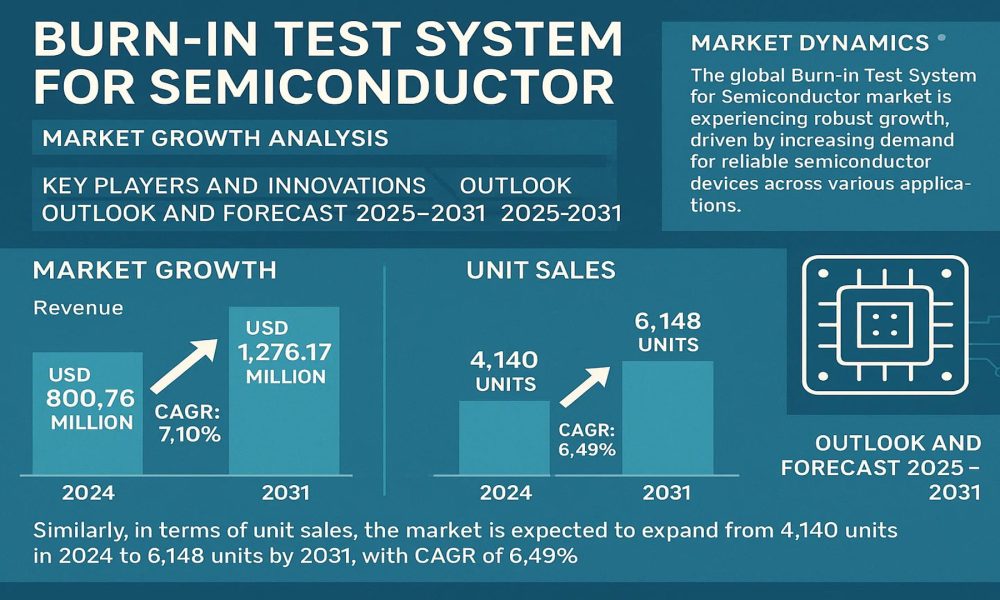
The global Burn-In Test System for Semiconductor market is experiencing robust growth, driven by increasing demand for reliable semiconductor devices across various applications. In terms of revenue, the market is projected to grow from USD 800.76 million in 2024 to USD 1,276.17 million by 2031, representing a CAGR of 7.10% during the forecast period from 2025 to 2031. Similarly, in terms of unit sales, the market is expected to expand from 4,140 units in 2024 to 6,148 units by 2031, with a CAGR of 6.49%.
Download FREE Sample Report:
Burn-In Test System for Semiconductor Market – View in Detailed Research Report
A Burn-In Test System is a specialized device designed to evaluate the reliability and performance of semiconductor components, such as integrated circuits (ICs), power transistors, sensors, and optoelectronic devices. These systems subject the semiconductor devices to extreme environmental conditions, including elevated temperatures and voltages, to accelerate potential failure mechanisms and identify defects. By exposing components to these stress conditions, manufacturers ensure that only reliable devices are shipped to customers, thus minimizing early-life failures in real-world applications.
Market Dynamics
Drivers
- Rising Demand for Reliable Semiconductor Devices: The increasing integration of semiconductors in automotive, medical, and industrial applications necessitates robust testing solutions to ensure reliability and performance.
- Technological Advancements: Innovations in burn-in test systems, such as dynamic testing capabilities and AI-driven diagnostics, are driving market growth.
- Proliferation of IoT and Connected Devices: The growing adoption of IoT devices and smart technologies has heightened the need for reliable semiconductor components, boosting the demand for burn-in testing.
- Expansion of the Electric Vehicle Market: The rising popularity of EVs, which rely heavily on power semiconductors, has created a significant demand for burn-in test systems to ensure component durability under extreme conditions.
Opportunities
- Emerging Markets: Rapid industrialization in emerging economies offers significant growth opportunities for burn-in test system manufacturers.
- Customization of Test Solutions: The demand for tailored burn-in solutions to meet specific application requirements presents a lucrative avenue for market players.
- Supply Chain Disruptions: Ongoing global supply chain challenges, including semiconductor shortages, could hinder market growth.
Regional Analysis
North America
The North American market for Burn-In Test Systems is projected to grow from USD 132.67 million in 2024 to USD 196.45 million by 2031, at a robust CAGR of 10.64%. The region’s growth is driven by significant investments in advanced technologies, particularly in automotive and aerospace sectors.
Europe
Europe is expected to witness moderate growth, with the market size increasing from USD 93.31 million in 2024 to USD 134.40 million by 2031, at a CAGR of 5.44%. The presence of prominent automotive and industrial automation companies supports the demand for reliable semiconductor components and, consequently, burn-in test systems.
Asia-Pacific
The Asia-Pacific region dominates the global market, with revenue expected to grow from USD 558.56 million in 2024 to USD 919.41 million by 2031, at a CAGR of 6.69%. Countries like China, Japan, South Korea, and Taiwan are major contributors, driven by their leadership in semiconductor manufacturing and rising demand for consumer electronics.
Competitor Analysis
The global market is moderately consolidated, with the top five players accounting for approximately 44.39% of total revenue in 2024. Key players include:
- DI Corporation
- Advantest
- Micro Control Company
- STK Technology
- KES Systems
These companies focus on technological innovation, strategic partnerships, and geographic expansion to maintain competitive advantages.
Market Segmentation (by Application)
- Integrated Circuit
- Discrete Device
- Sensor
- Optoelectronic Device
Market Segmentation (by Type)
- Static Testing: Evaluates device performance under fixed conditions.
- Dynamic Testing: Tests devices under variable conditions to simulate real-world applications.
Key Company
- DI Corporation
- Advantest
- Micro Control Company
- STK Technology
- KES Systems
- ESPEC
- Aehr Test Systems
- Zhejiang Hangke Instrument
- STAr Technologies (Innotech)
- Chroma
- Others
Geographic Segmentation
- North America: U.S., Canada
- Asia-Pacific: China, Japan, South Korea, Taiwan, Southeast Asia, India
- Europe: Germany, France, U.K., Italy, Russia
- Latin America, Middle East & Africa: Mexico, Brazil, Israel
What is a Burn-In Test System?
Burn-In Test Systems are specialized equipment designed to accelerate failure mechanisms in semiconductor devices by subjecting them to extreme thermal and electrical stress conditions. These systems help manufacturers identify potential defects that might surface during early product life cycles, ensuring only robust components reach end users. Particularly crucial for mission-critical applications like automotive electronics and aerospace systems, burn-in testing can significantly reduce field failure rates by up to 80% according to industry benchmarks.
Recent Developments in the Burn-In Test System for Semiconductor Market (2024–2025)
- AI-Powered Test Automation – Leading players are integrating AI and machine learning into burn-in systems to optimize failure prediction and reduce test cycle times.
- High-Power & High-Temperature Capabilities – With demand for advanced chips in AI, 5G, and EVs, manufacturers are launching burn-in systems that can withstand higher voltages and extreme thermal conditions.
- Adoption in Automotive Semiconductors – Growing reliance on chips for ADAS, EV power modules, and infotainment has driven increased deployment of burn-in testing to ensure long-term reliability.
- Shift Toward Wafer-Level Burn-In – Several companies are investing in wafer-level burn-in technology to reduce costs and accelerate time-to-market compared to traditional packaged device testing.
- Strategic Partnerships & Acquisitions – Test equipment makers are collaborating with semiconductor foundries to co-develop customized burn-in solutions for high-performance applications.
- Expansion in Asia-Pacific – With rapid semiconductor manufacturing growth in Taiwan, South Korea, and China, burn-in system providers are expanding production and service centers in the region.
- Energy-Efficient Designs – New burn-in systems are being designed with energy-saving features and modular architectures to lower operational costs for semiconductor fabs.
Report Scope & Offerings
This exhaustive 320-page analysis provides:
- 2025-2031 market forecasts with recession impact scenarios
- Competitor benchmarking of 22 global players
- Technology roadmap including AI-driven predictive burn-in
- Supply chain analysis amidst geopolitical shifts
Access Full Report:
Burn-In Test System for Semiconductor Market – Complete Research Package
About Intel Market Research
Intel Market Research delivers actionable insights in technology and infrastructure markets. Our data-driven analysis leverages:
- Real-time infrastructure monitoring
- Techno-economic feasibility studies
Competitive intelligence across 100+ countries
Trusted by Fortune 500 firms, we empower strategic decisions with precision.
International: +1(332) 2424 294 | Asia: +91 9169164321
Website: https://www.intelmarketresearch.com
Follow us on LinkedIn: https://www.linkedin.com/company/intel-market-research




